
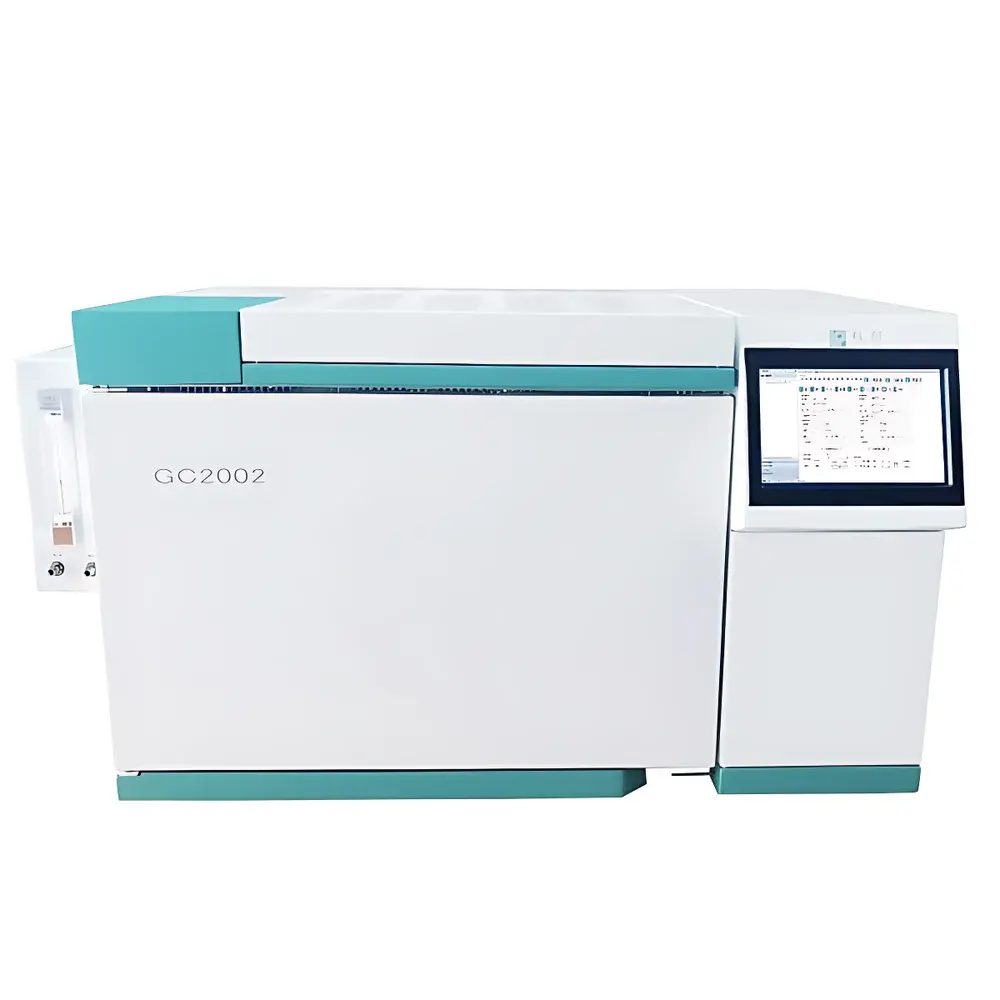
Helium Ionization Gas Chromatograph GC2002N/PDHID for Trace Impurity Analysis in High-Purity and Ultra-High-Purity Nitrogen
| Brand | KeChuang |
|---|---|
| Origin | Shanghai, China |
| Manufacturer Type | Direct Manufacturer |
| Instrument Category | Domestic |
| Model | GC2002N/PDHID |
| Price | USD 35,000 (FOB Shanghai) |
| Instrument Type | Laboratory Gas Chromatograph |
| Application Domain | Dedicated to High-Purity Gas Analysis |
| Oven Temperature Range | 0–400 °C |
| Maximum Ramp Rate | 40 °C/min |
| Maximum Cooling Rate | 60 °C/min (achieves 400 °C → 50 °C in ≤4 min) |
| Carrier Gas Flow Range & Control | 0–500 mL/min |
| Carrier Gas Pressure Range & Control | 0–0.4 MPa |
| Injector Maximum Operating Temperature | 300 °C |
| Injector Pressure Setting Range | 0–0.4 MPa |
| Injector Total Flow Setting Range | 0–500 mL/min |
Overview
The KeChuang GC2002N/PDHID is a helium ionization gas chromatograph engineered specifically for the quantitative determination of trace-level impurities in high-purity (≥99.999%) and ultra-high-purity (≥99.9999%) nitrogen matrices. Unlike conventional thermal conductivity (TCD) or flame ionization (FID) detectors, this system employs a pulsed discharge helium ionization detector (PDHID), which provides sub-part-per-trillion (sub-ppt) detection sensitivity for permanent gases—including H₂, O₂, CH₄, CO, CO₂, and H₂O—without requiring reactive carrier gases or catalytic conversion. The instrument operates on the principle of metastable helium atom-induced ionization in a low-power, non-thermal plasma environment, delivering exceptional selectivity and linear dynamic range (>10⁶) across multi-component analyses. Its optimized oven architecture, precision pressure/flow control, and inert flow path design ensure retention time stability <0.02 min over 24-hour unattended operation—critical for compliance with ISO 8573-5, ASTM D1946, and SEMI F57 standards governing electronic-grade nitrogen certification.
Key Features
- PDHID detector with helium carrier gas: Enables simultaneous detection of H₂, O₂, N₂, CH₄, CO, CO₂, and H₂O at detection limits ranging from 10–50 ppt (v/v), verified per ISO 10156 Annex B protocols.
- Programmable temperature-controlled oven: Supports ramp rates up to 40 °C/min and rapid cooling (60 °C/min), achieving full thermal equilibration from 400 °C to 50 °C in ≤4 minutes—reducing cycle time by >35% versus conventional ovens.
- Dual independent pressure/flow control modules: One for carrier gas (He), one for make-up gas (optional Ar or N₂); each features digital mass flow controllers (MFCs) with ±0.2% full-scale accuracy and real-time feedback regulation.
- High-temperature, inert injector system: Capable of operating up to 300 °C with pressure settings from 0–0.4 MPa; configured for split/splitless injection with deactivated fused-silica liners to prevent adsorption or catalytic decomposition of polar analytes.
- Modular column compartment: Accommodates up to two capillary columns (e.g., Rt-Q-BOND for C₁–C₃ hydrocarbons and molecular sieves for O₂/Ar/N₂ separation) with independent temperature zoning and leak-tight Swagelok® fittings.
- Robust mechanical architecture: All fluidic pathways constructed from electropolished stainless steel or SilcoNert®-treated surfaces; oven chamber insulated with ceramic fiber to minimize thermal gradients and power consumption.
Sample Compatibility & Compliance
The GC2002N/PDHID is validated for direct analysis of compressed nitrogen gas samples from 40 L seamless steel cylinders (e.g., Linde, Air Liquide, Praxair specifications), including liquid-phase vaporized feeds and high-pressure gas streams regulated via stainless-steel pressure-reducing valves. It meets analytical requirements for Grade 5.0–5.7 nitrogen per ISO 8573-1:2010 (Class 1–2 for particles, water, and oil) and supports verification testing under USP for pharmaceutical nitrogen and SEMI F21-0301 for semiconductor process gases. The system’s hardware and firmware architecture support audit-ready data integrity: all method parameters, detector signals, and calibration logs are timestamped, user-identified, and stored with SHA-256 hash verification—enabling alignment with FDA 21 CFR Part 11 and EU Annex 11 expectations when deployed within validated laboratory information management systems (LIMS).
Software & Data Management
KeChuang Chromatography Workstation (KCWS v3.2) provides full instrument control, peak integration, and report generation compliant with GLP/GMP documentation practices. The software implements automatic baseline correction using asymmetric least-squares smoothing, retention time locking (RTL) with internal standard referencing (e.g., argon as surrogate), and multi-point external calibration with quadratic regression weighting. Raw data files (.kcd) are structured in HDF5 format, supporting metadata embedding (sample ID, operator, instrument serial number, environmental conditions). Export options include CSV, PDF (with embedded chromatograms and uncertainty estimates), and XML for LIMS integration. Audit trails record all parameter modifications, reprocessing events, and user logins—with configurable retention policies (default: 18 months).
Applications
- Quality assurance of bulk nitrogen supplied to semiconductor fabs, where O₂ and H₂O must remain below 100 ppt to prevent oxidation during ALD/CVD processes.
- Verification of nitrogen purity in cryogenic air separation units (ASUs), particularly monitoring CO breakthrough during carbon molecular sieve regeneration cycles.
- Validation of nitrogen blanketing gas used in API synthesis reactors, ensuring CH₄ and CO levels do not exceed ICH Q5C thresholds for residual solvent carryover.
- Periodic testing of nitrogen purging lines in pharmaceutical isolators per EU GMP Annex 1, with documented LOD/LOQ validation per ICH Q2(R2).
- Research applications in catalysis studies requiring precise quantification of ppm-level CO and CO₂ in synthetic nitrogen streams prior to hydrogenation reactions.
FAQ
What carrier gas is required for PDHID operation?
Helium (≥99.999% purity) is mandatory. Trace oxygen or moisture in He will quench metastable He* atoms and degrade signal stability.
Can the system analyze moisture (H₂O) without a pre-concentrator or derivatization?
Yes—the PDHID responds directly to H₂O vapor with sub-ppb sensitivity when using a guard column and cold trap configuration optimized for polar compound retention.
Is method transfer supported between different GC2002N/PDHID units?
Yes—retention time locking (RTL) with argon internal standard enables cross-instrument reproducibility within ±0.015 min (RSD <0.3%) across ≥10 instruments calibrated to the same reference standard.
Does the software support 21 CFR Part 11 compliance out-of-the-box?
KCWS v3.2 includes electronic signatures, role-based access control, and immutable audit trails; full Part 11 compliance requires site-specific validation documentation and network infrastructure alignment.
What maintenance intervals are recommended for sustained ppt-level performance?
PDHID electrode cleaning every 200 injections; column bake-out weekly at 280 °C for 2 hours; helium purity verification monthly via dedicated O₂/H₂O analyzer; MFC recalibration every 6 months.




