
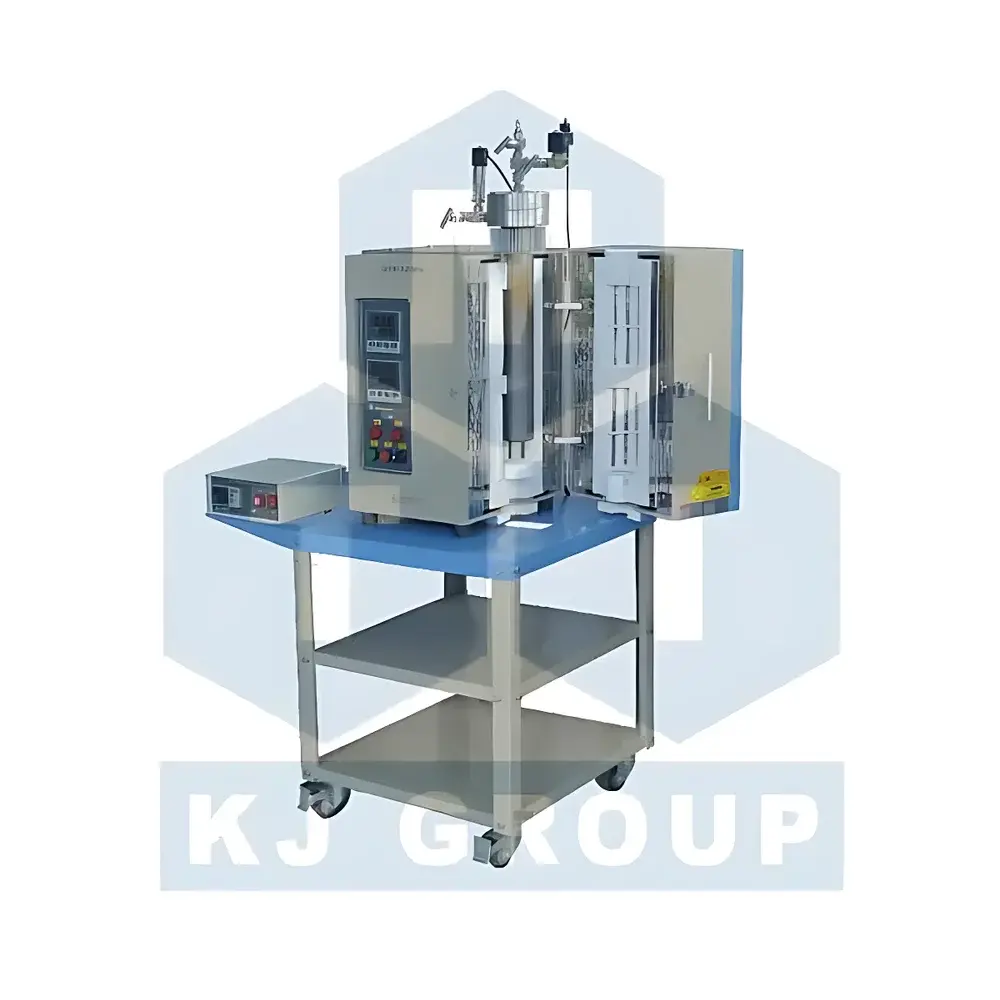
KJG OTF-1200X-II-HPV Dual-Zone Vertical High-Temperature High-Pressure Tube Furnace
| Brand | KJG (Hefei Kejing) |
|---|---|
| Origin | Anhui, China |
| Model | OTF-1200X-II-HPV |
| Furnace Type | Horizontal Tube Furnace (Vertical Orientation) |
| Max Temperature | 1100 °C |
| Temperature Uniformity | ±2 °C over 170 mm isothermal zone |
| Control Accuracy | ±1 °C |
| Heating Rate | ≤10 °C/min (RT–600 °C), ≤5 °C/min (600–1100 °C) |
| Max Pressure Rating | 3 MPa at 1100 °C |
| Pressure Range | 16.5 MPa @ ≤800 °C, 10 MPa @ ≤900 °C, 5 MPa @ ≤1000 °C, 3 MPa @ ≤1100 °C |
| Tube Dimensions | Ø70 mm (OD) × Ø35 mm (ID) × 500 mm (L) |
| Heating Element | Mo-doped Fe-Cr-Al alloy with ZrO₂ coating |
| Thermocouple | Type K (Omega) |
| Power Supply | AC 208–240 V, single-phase |
| Max Power | 2.5 kW |
| Cooling | Air-cooled flange with aluminum heat sink |
| Sealing | Oxygen-free copper gasket |
| Safety Certification | CE compliant |
| Software Option | MTS-03 PC-based control interface (optional) |
Overview
The KJG OTF-1200X-II-HPV is a dual-zone vertical high-temperature high-pressure tube furnace engineered for controlled thermal processing under elevated pressure environments—particularly suited for hydrothermal synthesis, high-pressure oxidation, catalytic reaction studies, and materials densification under inert or reactive atmospheres. Its core architecture integrates two independently controlled heating zones, each equipped with precision PID temperature regulation and calibrated Type K thermocouples, enabling precise axial thermal profiling across the 500 mm-long nickel-based superalloy tube. The furnace operates on the principle of resistive heating via Mo-doped Fe-Cr-Al elements coated with stabilized zirconia—a design that enhances oxidation resistance and extends service life at sustained temperatures up to 1100 °C. Critically, the furnace tube is fabricated from wrought nickel-based high-temperature alloy (e.g., Inconel 600/625 grade equivalent), selected for its exceptional creep resistance, ductility, and long-term structural integrity under combined thermal and mechanical stress. Unlike brittle ceramics or standard stainless steels, this alloy exhibits progressive plastic deformation rather than catastrophic rupture when subjected to overpressure—providing inherent fail-safe behavior essential for laboratory-scale high-pressure experimentation.
Key Features
- Dual independent heating zones (2 × 200 mm) with separate PID controllers and Type K thermocouples for gradient or uniform temperature profiles.
- Nickel-based superalloy tube (Ø35 mm ID × 500 mm L) rated for 3 MPa at 1100 °C; pressure rating degrades predictably with increasing temperature per ISO 15156-3 compliance guidelines.
- Integrated safety-critical pressure management system: digital pressure transducer linked to front-panel display and programmable high-pressure solenoid valve (rated to 15 MPa), automatically venting gas upon exceeding user-defined threshold.
- Air-cooled flange assembly with aluminum finned heat sink prevents thermal degradation of sealing surfaces and extends oxygen-free copper gasket lifetime.
- 30-segment programmable temperature ramp/soak profiles with real-time logging capability via optional MTS-03 software interface.
- CE-certified electrical architecture with reinforced insulation, grounded chassis, and emergency power cutoff—designed for integration into ISO/IEC 17025-accredited laboratories.
Sample Compatibility & Compliance
The OTF-1200X-II-HPV accommodates cylindrical samples up to Ø30 mm in diameter and 400 mm in length, compatible with powder compacts, sintered pellets, fiber arrays, and sealed ampoules. Its pressure-rated design conforms to ASTM E2927-22 (Standard Practice for High-Pressure Reaction Vessels) and aligns with material selection criteria outlined in NACE MR0175/ISO 15156-3 for sour-service alloys. While not a certified ASME BPVC Section VIII Div. 1 vessel, its construction and operational limits are documented for GLP-compliant experimental protocols. Users must install the furnace inside an ANSI Z87.1-rated explosion-resistant containment cabinet during pressurized operation—per KJG’s mandatory safety directive and alignment with OSHA 1910.119 process safety management (PSM) requirements for high-pressure equipment.
Software & Data Management
The optional MTS-03 control software enables full remote supervision via USB or RS485 connection, supporting Windows-based configuration of multi-step temperature-pressure co-ramping sequences. Logged data—including actual vs. setpoint temperature, real-time pressure readings, valve status, and error flags—are timestamped and exportable in CSV format for audit trails. When configured with user authentication and electronic signature modules, the system supports FDA 21 CFR Part 11 compliance for regulated environments requiring electronic records and signatures. All firmware updates and calibration logs are retained locally on the embedded controller with non-volatile memory backup.
Applications
- Hydrothermal crystal growth and nanomaterial synthesis (e.g., metal oxides, MOFs, perovskites).
- High-pressure oxidation kinetics studies for battery cathode precursors and corrosion-resistant coatings.
- Thermochemical treatment of ceramics and composites under controlled pO₂ environments.
- Gas-solid catalytic reaction screening at elevated pressures (e.g., Fischer–Tropsch, ammonia synthesis analogs).
- Creep and stress-relaxation testing of advanced alloys and refractory metals.
- Pre-sintering and binder burnout of additively manufactured components under inert pressurized atmospheres.
FAQ
What is the maximum safe operating pressure at 1000 °C?
The furnace tube is rated for 5 MPa at temperatures ≤1000 °C, as validated by tensile and creep rupture testing per ASTM E139.
Can the electromagnetic pressure relief valve be used above 15 MPa?
No—the solenoid valve has a maximum service pressure of 15 MPa. For experiments exceeding this limit, the valve must be isolated using the integrated needle valve, and manual pressure regulation must be implemented.
Is the furnace suitable for chlorine-containing atmospheres?
Not recommended. Nickel-based alloys exhibit reduced resistance to chloride-induced stress corrosion cracking; use only with dry, purified inert gases (Ar, N₂) or oxidizing gases (O₂, air) within specified temperature–pressure envelopes.
Does the system include validation documentation for IQ/OQ protocols?
Yes—KJG provides factory-assembled FAT reports, thermocouple calibration certificates (NIST-traceable), and pressure sensor calibration data. Custom IQ/OQ support packages are available upon request.
What maintenance intervals are recommended for heating elements and seals?
Heating elements require visual inspection every 200 operational hours; oxygen-free copper gaskets should be replaced after each high-pressure cycle above 5 MPa or after 10 cycles at ≤3 MPa.
Related Products



