
HengaoDe HAD-17889 Portable Infrared Pyrometer for Coke Ovens — 1000–2000 °C, 0.4–1.1 µm Spectral Band, 120:1 Distance-to-Spot Ratio
| Brand | HengaoDe |
|---|---|
| Model | HAD-17889 |
| Origin | Beijing, China |
| Measuring Range | 1000–2000 °C |
| Operating Temperature | 0–70 °C |
| Accuracy | ±1% of full scale |
| Repeatability | ±0.3% |
| Response Time | ≤0.1 s |
| Spectral Band | 0.4–1.1 µm |
| Distance-to-Spot Ratio | 120:1 |
| Measurement Distance | 0.5 m to infinity |
| Emissivity Adjustment | 0.001–1.000 (user-selectable) |
| Data Storage Capacity | 2001 temperature records |
| Output Interface | RS-232C (9600 baud) |
| Power Supply | 2 × AA rechargeable batteries |
| Weight | <0.65 kg |
| Battery Life | >50 hours continuous operation |
Overview
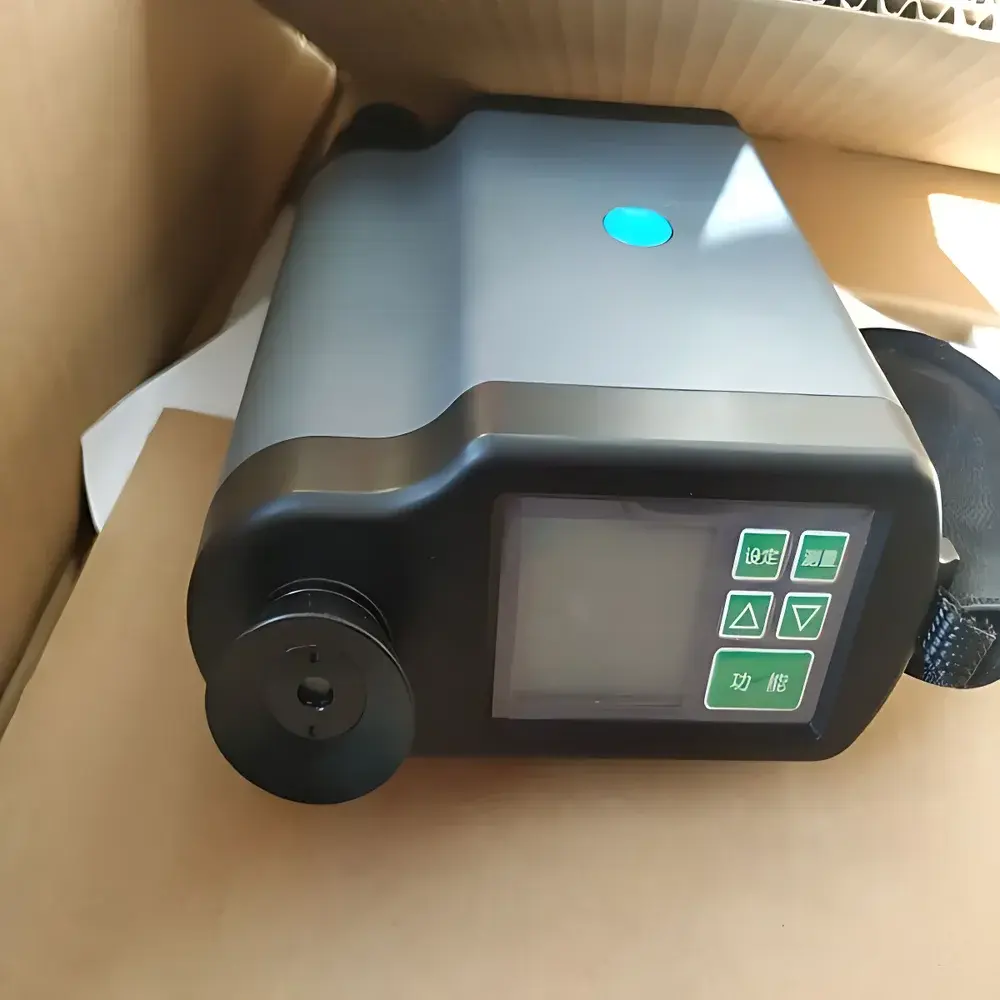
The HengaoDe HAD-17889 Portable Infrared Pyrometer is a precision non-contact temperature measurement instrument engineered for high-temperature industrial environments—particularly coke oven chambers, blast furnace tuyeres, refractory linings, and metallurgical process zones where direct contact sensing is impractical or unsafe. It operates on the principle of narrow-band infrared radiometry in the visible-to-near-infrared spectrum (0.4–1.1 µm), optimized for high-emissivity targets above 1000 °C. This spectral selection minimizes interference from ambient thermal radiation and combustion flame emissions, enabling stable readings even under fluctuating ambient conditions. The instrument integrates an auto-compensated ambient temperature correction circuit that dynamically offsets thermal drift in the analog front-end amplifier—critical for maintaining accuracy across operational temperature ranges from 0 °C to 70 °C. Its optical design employs a fixed-focus lens system with a 120:1 distance-to-spot ratio, permitting reliable spot measurements at standoff distances up to several meters without physical access to the target surface.
Key Features
- High-temperature capability: calibrated range of 1000–2000 °C, suitable for monitoring coke oven crown temperatures, regenerator brick surfaces, and hot metal transfer points.
- Narrow spectral response (0.4–1.1 µm): reduces sensitivity to flame flicker, soot loading, and background radiation—enhancing measurement fidelity in turbulent combustion zones.
- Dual-LCD display: simultaneous readout on both front panel and integrated optical viewfinder, enabling real-time targeting and verification during handheld operation.
- Onboard data logging: stores up to 2001 timestamped temperature records with date/time stamping; data export via RS-232C serial interface for traceability and QA/QC documentation.
- Field-configurable emissivity: adjustable from 0.001 to 1.000 in 0.001 increments—supporting calibration against reference blackbody sources or empirical validation per ASTM E1933 or ISO 18434-1.
- Robust mechanical architecture: lightweight aluminum housing (<0.65 kg), IP54-rated ingress protection, and low-power consumption (<150 mW standby) for extended field deployment.
Sample Compatibility & Compliance
The HAD-17889 is validated for use on oxidized steel surfaces, fired refractory bricks, coke cake faces, and ceramic linings—materials commonly encountered in coking plants and ferrous metallurgy. Its 0.4–1.1 µm band aligns with peak Planckian emission wavelengths for targets above 1000 °C, ensuring optimal signal-to-noise ratio. While not certified to IEC 61508 or SIL standards, the device supports compliance with quality management frameworks including ISO 9001 (calibration traceability), ASTM E1256 (infrared thermometry), and GB/T 26196–2010 (Chinese national standard for industrial pyrometers). Emissivity settings may be documented and audited as part of GLP-compliant measurement procedures.
Software & Data Management
The pyrometer does not require proprietary software for basic operation but supports ASCII-formatted data streaming via RS-232C at 9600 baud. Exported logs include UTC timestamp, measured temperature (°C), emissivity setting, and sequence ID—enabling integration into LIMS or SCADA systems using standard serial communication protocols. Users may perform post-acquisition analysis in Excel, Python (with pySerial), or MATLAB for trend visualization, statistical process control (SPC), or correlation with furnace pressure/airflow data. No FDA 21 CFR Part 11 compliance features are embedded; however, raw data files can be archived with electronic signatures and audit trails within enterprise-grade document management platforms.
Applications
- Real-time monitoring of coke oven chamber wall temperature gradients during pusher operation and soaking cycles.
- Thermal profiling of regenerator checker bricks to detect localized hot spots indicating refractory degradation.
- Verification of heat treatment uniformity in annealing lehrs and ceramic kilns operating above 1200 °C.
- Non-invasive temperature validation during commissioning of new coke battery sections prior to full-load operation.
- Supporting predictive maintenance programs by trending temperature anomalies correlated with flue gas composition or draft imbalances.
FAQ
What is the minimum measurable spot size at 1 meter distance?
At 1 m distance, the 120:1 optics yield a spot diameter of approximately 8.3 mm—suitable for targeting individual brick joints or thermocouple mounting zones.
Can the emissivity be locked to prevent accidental changes during field use?
Yes—emissivity is retained across power cycles and may be set once per application; no password or firmware lock is required, but configuration is preserved in non-volatile memory.
Is the instrument compatible with industrial Ethernet or Modbus RTU networks?
No native Modbus or Ethernet interface is provided; RS-232 output requires external protocol converters for integration into PLC-based control systems.
Does the unit meet explosion-proof certification requirements for Zone 1 coke oven galleries?
It is not ATEX, IECEx, or NEC Class I Div 1 certified; it is intended for use in non-hazardous classified areas only—operators must adhere to local safety regulations regarding electrical equipment in proximity to coke oven gas leaks.
How is calibration traceability maintained?
Factory calibration is performed against NIST-traceable blackbody sources at three points (1200 °C, 1500 °C, 1800 °C); users receive a calibration certificate with uncertainty budget (k=2) and may schedule third-party recalibration per ISO/IEC 17025 accredited laboratories.




