
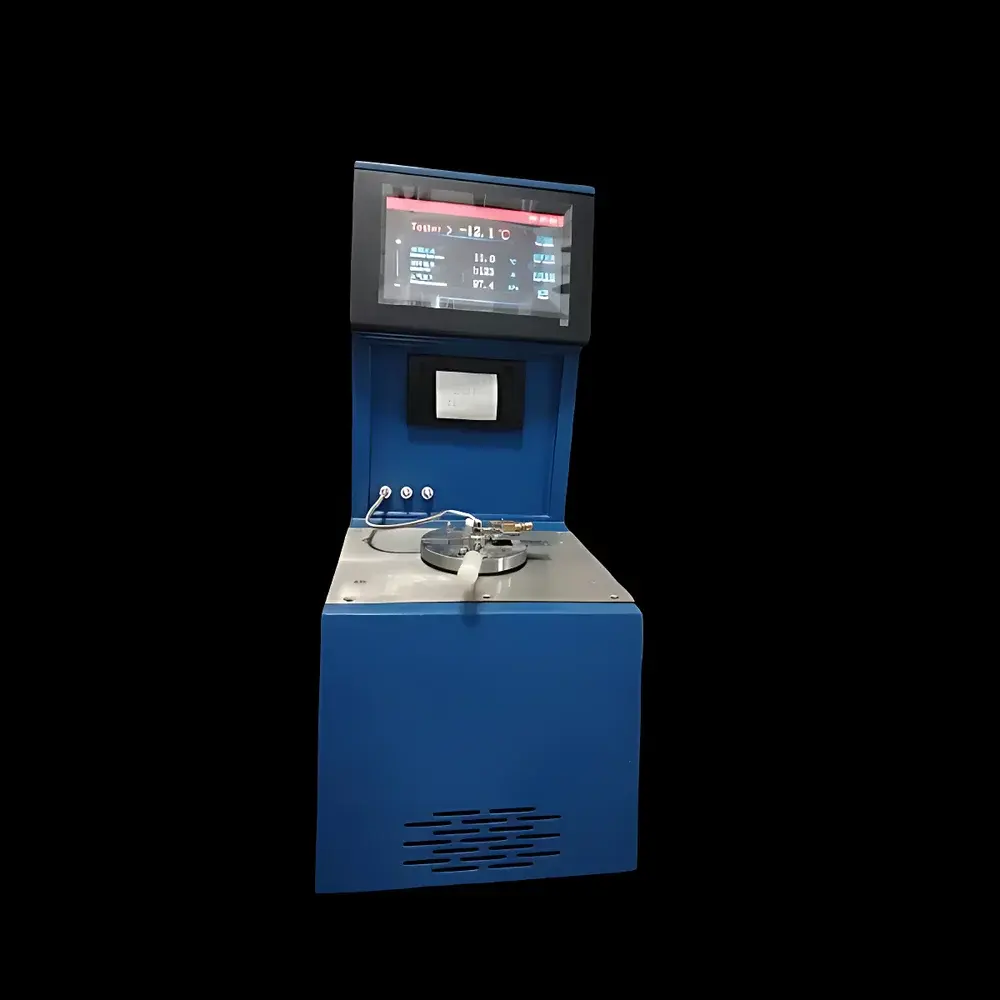
Hengaode HAD-B5208 Intelligent Equilibrium Closed-Cup Flash Point Tester (GB/T 5208-2008, ISO 1523 & ISO 3679 Compliant)
| Brand | Hengaode |
|---|---|
| Origin | Beijing, China |
| Model | HAD-B5208 |
| Flash Point Range | −35 °C to 100 °C |
| Temperature Control Accuracy | ±0.05 °C |
| Sample Volume | 2 mL (liquid) / 4 mL (semi-solid or solid) |
| Ignition Method | Electronic spark igniter |
| Cooling System | Peltier thermoelectric cooling + external chilled water circulation |
| Power Supply | AC 220 V ±10%, 50 Hz |
| Max. Power Consumption | ≤300 W |
| Operating Environment | 5–30 °C, 30–80% RH |
| Dimensions | 370 × 280 × 280 mm (L×W×H) |
| Compliance | GB/T 5208-2008, ISO 1523:2002, ISO 3679:2004 |
Overview
The Hengaode HAD-B5208 Intelligent Equilibrium Closed-Cup Flash Point Tester is a precision laboratory instrument engineered for rapid, reproducible determination of closed-cup flash point in accordance with internationally recognized standards—specifically GB/T 5208-2008, ISO 1523:2002, and ISO 3679:2004. It operates on the equilibrium closed-cup principle, wherein a small sample is heated incrementally inside a sealed test cup until vapor concentration above the liquid surface reaches the lower flammability limit; ignition is then initiated by an electronically controlled spark under standardized atmospheric conditions. This method ensures high repeatability and minimal operator influence, making it suitable for routine quality control and regulatory compliance testing across petroleum refining, coatings, adhesives, solvents, aviation fuels, and industrial chemical manufacturing.
Key Features
- Standards-compliant design per GB/T 5208-2008, enabling rapid flash point measurement at low temperatures (down to −35 °C), critical for volatile solvent formulations and cold-climate fuel specifications.
- Peltier-based thermoelectric cooling system integrated with optional external chilled water circulation delivers precise, responsive temperature control without requiring cryogenic refrigerants or bulky compressors.
- Minimal sample requirement: only 2 mL for liquids or 4 mL for semi-solids/solids—reducing material consumption and waste generation while maintaining analytical integrity.
- Full automation of heating ramp, vapor equilibration, ignition sequence, and result calculation—eliminating manual timing errors and subjective endpoint judgment.
- Intuitive 7-inch capacitive touchscreen interface with embedded firmware (v2007) supports multilingual operation, parameter logging, and real-time status feedback—including thermal profile visualization.
- Modular cup assembly accommodates optional acid- and alkali-resistant test cups (custom-order only), extending instrument usability to aggressive chemical matrices such as chlorinated solvents or organic acid formulations.
Sample Compatibility & Compliance
The HAD-B5208 is validated for use with transparent, opaque, viscous, and heterogeneous liquid samples—including paints, varnishes, resins, hydrocarbon distillates, biofuels, and polymer solutions—within the certified flash point range of −35 °C to 100 °C. Its closed-cup configuration prevents uncontrolled vapor loss and ensures consistent headspace composition during equilibration. Instrument performance meets ASTM D3278 and IEC 60079-10-1 requirements for hazardous area classification support. Data traceability complies with GLP principles: all test parameters (initial temperature, ramp rate, ignition timing, final flash point) are timestamped and stored internally. While not FDA 21 CFR Part 11–certified out-of-the-box, audit-ready data export (CSV/USB) enables integration into validated LIMS environments.
Software & Data Management
The embedded firmware provides local storage for up to 500 test records, each containing date/time stamp, operator ID (manual entry), sample ID, ambient conditions, and full thermal curve metadata. Results are automatically printed via integrated thermal printer (receipt-style output). USB host port supports export of raw datasets for post-acquisition statistical analysis (e.g., RSD, bias assessment per ISO 4259). Firmware v2007 supports user-defined pass/fail thresholds and configurable alarm triggers for out-of-specification results—facilitating QC gatekeeping in production labs. No cloud connectivity or remote access functionality is included; all processing occurs locally to ensure data sovereignty and network security.
Applications
- Petroleum QC labs verifying flash point compliance of gasoline, diesel, jet fuel (Jet A-1), and lubricant base stocks against ASTM D93 or EN ISO 3679.
- Coatings & inks manufacturers validating VOC content and safety handling classifications per GHS and CLP regulations.
- Pharmaceutical excipient suppliers assessing flammability risk of propylene glycol, ethanol, or isopropanol-based formulations.
- Academic research groups studying thermal stability and ignition kinetics of novel bio-solvents or ionic liquids.
- Third-party certification bodies conducting accredited flash point testing for UN transport classification (UN 3334, Class 3 Flammable Liquids).
FAQ
What standards does the HAD-B5208 fully comply with?
It is designed and verified per GB/T 5208-2008 (Chinese national standard), ISO 1523:2002 (petroleum products), and ISO 3679:2004 (solvents and related materials). It is not compliant with ASTM D93 or D56 due to fundamental differences in cup geometry and heating methodology.
Can the instrument measure flash points below 0 °C?
Yes—the certified low-temperature range extends to −35 °C using the Peltier cooling module with external chiller support (recommended coolant temperature ≤10 °C). Calibration verification at sub-zero points requires traceable reference standards (e.g., certified n-pentane or cyclohexane).
Is routine calibration required, and how is it performed?
Daily verification using certified reference materials (CRM) is recommended per ISO/IEC 17025. The instrument includes built-in temperature sensor calibration offset adjustment; full system validation requires external platinum resistance thermometer (PRT) traceable to NIST or equivalent NMIs.
What maintenance is needed for long-term reliability?
Annual inspection of the spark electrode gap (0.5 ±0.1 mm), cleaning of the test cup sealing surface, and verification of Peltier module thermal transfer efficiency. No consumables other than standard flash point test cups (stainless steel, 55 mL capacity) are required.
Does the unit support networked data transfer or LIMS integration?
No native Ethernet or Wi-Fi capability exists. Data export is limited to USB mass-storage mode (CSV format) or direct thermal printout. Custom RS232-to-Ethernet bridge solutions may be implemented externally for enterprise-level integration.





