
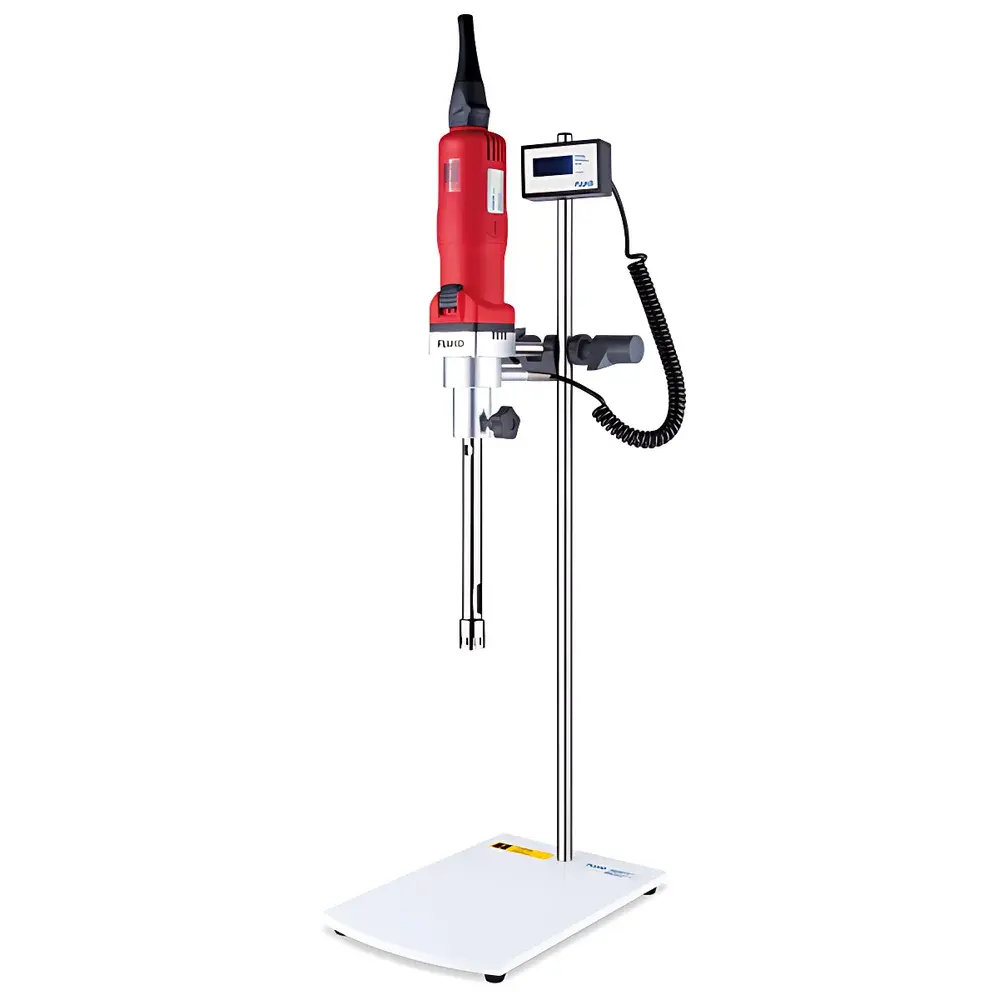
FLUKO FA25D High-Shear Dispersion & Homogenization System
| Brand | FLUKO |
|---|---|
| Origin | Shanghai, China |
| Model | FA25D-001-S |
| Instrument Type | Probe-type rotor-stator homogenizer |
| Dimensions (W×D×H) | 215 × 310 × 730 mm |
| Processing Volume | 0.2–7000 mL |
| Power | 500 W |
| Voltage/Frequency | 220 V, 50 Hz |
| Speed Range (no-load) | 10,000–28,000 rpm |
| Max. Tip Speed | 27 m/s |
| Display | Digital RPM readout |
| Speed Control | Continuously variable |
| Contact Materials | SS316L |
| Shaft Sleeve Material | PTFE |
| Standard Probe | 6G |
| Operating Temperature | 5–40 °C |
| Relative Humidity Limit | ≤80% |
| Duty Cycle | Continuous operation |
| Weight | ~7.1 kg |
Overview
The FLUKO FA25D High-Shear Dispersion & Homogenization System is a precision-engineered laboratory-scale rotor-stator homogenizer designed for reproducible, scalable processing of heterogeneous liquid and semi-liquid systems. It operates on the principle of high-velocity fluid shear generated between a rapidly rotating probe (rotor) and a fixed concentric stator—creating intense hydrodynamic cavitation, turbulent flow, and controlled mechanical disruption. This architecture enables efficient particle size reduction, droplet breakup, cell lysis, and molecular-level dispersion across diverse formulations including emulsions, suspensions, nano-dispersions, polymer blends, and biological lysates. Engineered for benchtop flexibility and long-term operational stability, the FA25D serves as a critical unit operation in formulation development, QC/QA testing, and preclinical process optimization where batch-to-batch consistency and scalability to pilot-scale rotor-stator systems are essential.
Key Features
- High-performance 500 W brushless motor delivering stable torque across the full speed range (10,000–28,000 rpm), with digital RPM feedback ensuring precise rotational control.
- Modular probe system compatible with six standardized rotor-stator geometries (6G, 8G, 10G, 18F, 25F), each optimized for specific volume ranges (0.2–7000 mL) and rheological profiles—from low-viscosity aqueous solutions to shear-thinning or moderately viscous media up to 8,000 cP.
- SS316L wetted components ensure corrosion resistance and compliance with general pharmaceutical and food-grade material contact requirements; PTFE shaft sleeves provide chemical inertness and low-friction thermal management.
- Compact footprint (215 × 310 × 730 mm) and integrated support stand with universal clamp accommodate standard labware (e.g., beakers, conical flasks, jacketed vessels) without external fixtures.
- Continuous-duty thermal design supports extended operation under load, minimizing thermal drift and maintaining consistent shear energy input during multi-minute processing cycles.
- Ergonomic housing with non-slip base and intuitive front-panel controls facilitate single-hand operation and reduce operator fatigue during repetitive sample preparation tasks.
Sample Compatibility & Compliance
The FA25D accommodates a broad spectrum of sample types: oil-in-water and water-in-oil emulsions, pigment dispersions, nanoparticle suspensions, protein aggregates, bacterial and mammalian cell lysates, tissue homogenates, and high-solid-content pastes. Its rotor-stator geometry generates localized shear rates exceeding 10⁵ s⁻¹—sufficient to overcome interfacial tension and aggregate cohesion in most colloidal and biological systems. While not certified to ISO 13485 or FDA 21 CFR Part 11 out-of-the-box, the system’s construction, traceable component materials (SS316L, PTFE), and repeatable mechanical output support GLP-compliant documentation when paired with validated SOPs and external audit trails. It meets general electrical safety standards applicable to Class I laboratory equipment per IEC 61010-1.
Software & Data Management
The FA25D operates as a standalone analog-controlled instrument with real-time digital RPM display—intentionally omitting embedded firmware or proprietary software to maximize reliability, minimize validation burden, and ensure compatibility with existing lab informatics infrastructure. All operational parameters (speed setpoint, duration, probe type, vessel geometry, sample mass/volume) are recorded manually or via LIMS-integrated electronic notebooks. For regulated environments requiring electronic records, users may integrate external data loggers or time-stamped video capture synchronized with manual entries. The absence of network connectivity or internal storage aligns with cybersecurity best practices for instruments deployed in secure research or GMP-adjacent laboratories.
Applications
- Preparation of stable submicron emulsions for topical drug delivery and cosmetic formulations.
- Rapid dispersion of carbon nanotubes, graphene oxide, or metal oxide nanoparticles into polymeric matrices.
- Homogenization of liver, muscle, or plant tissues for metabolite extraction and proteomic analysis.
- Deagglomeration of ceramic or pharmaceutical powders in solvent-based slurries prior to spray drying or lyophilization.
- Scale-down modeling of industrial inline homogenizers for process transfer and DOE-based parameter mapping.
- Viscosity-dependent optimization of mixing energy input in non-Newtonian polymer solutions and hydrogels.
FAQ
What is the maximum viscosity the FA25D can process?
The system is rated for continuous operation with media up to 8,000 cP at lower speeds (≤12,000 rpm); higher viscosities require reduced speed or shorter duty cycles to prevent motor overload.
Is the 6G probe suitable for DNA shearing applications?
No—the 6G probe is optimized for micro-volume dispersion (0.2–10 mL) but lacks the fine-tolerance geometry required for controlled chromatin fragmentation; dedicated sonication or enzymatic methods are recommended for nucleic acid shearing.
Can the FA25D be used under inert atmosphere or vacuum?
Yes—when mounted in a glovebox or sealed reactor vessel with appropriate feedthroughs, provided the ambient temperature remains within 5–40 °C and condensation is prevented on electrical components.
Does FLUKO provide IQ/OQ documentation for this model?
Factory-issued calibration certificates and mechanical verification reports are available upon request; full qualification packages must be developed by the end user per internal validation protocols.
How does probe selection affect shear rate distribution?
Smaller-diameter probes (e.g., 6G, 8G) generate higher localized shear rates at equivalent RPM due to increased tip velocity and narrower rotor-stator gap, making them ideal for low-volume, high-intensity applications.



