
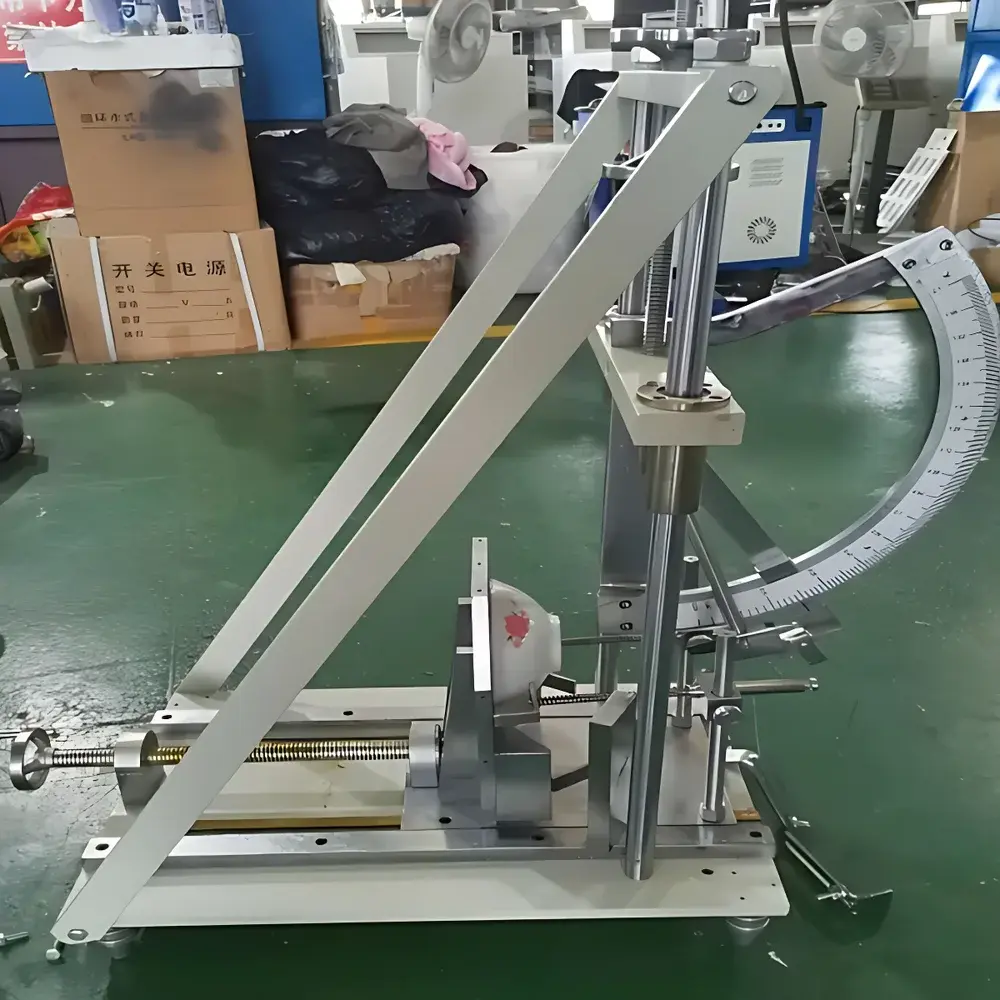
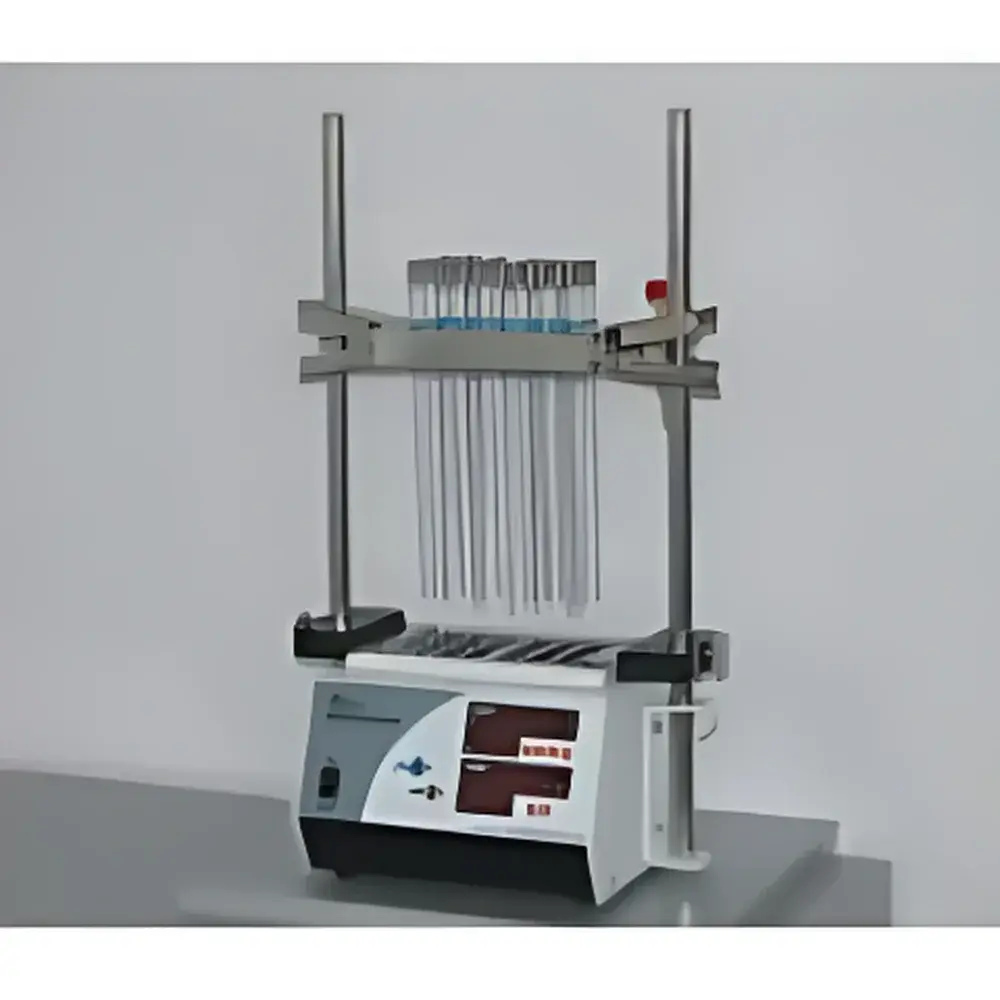
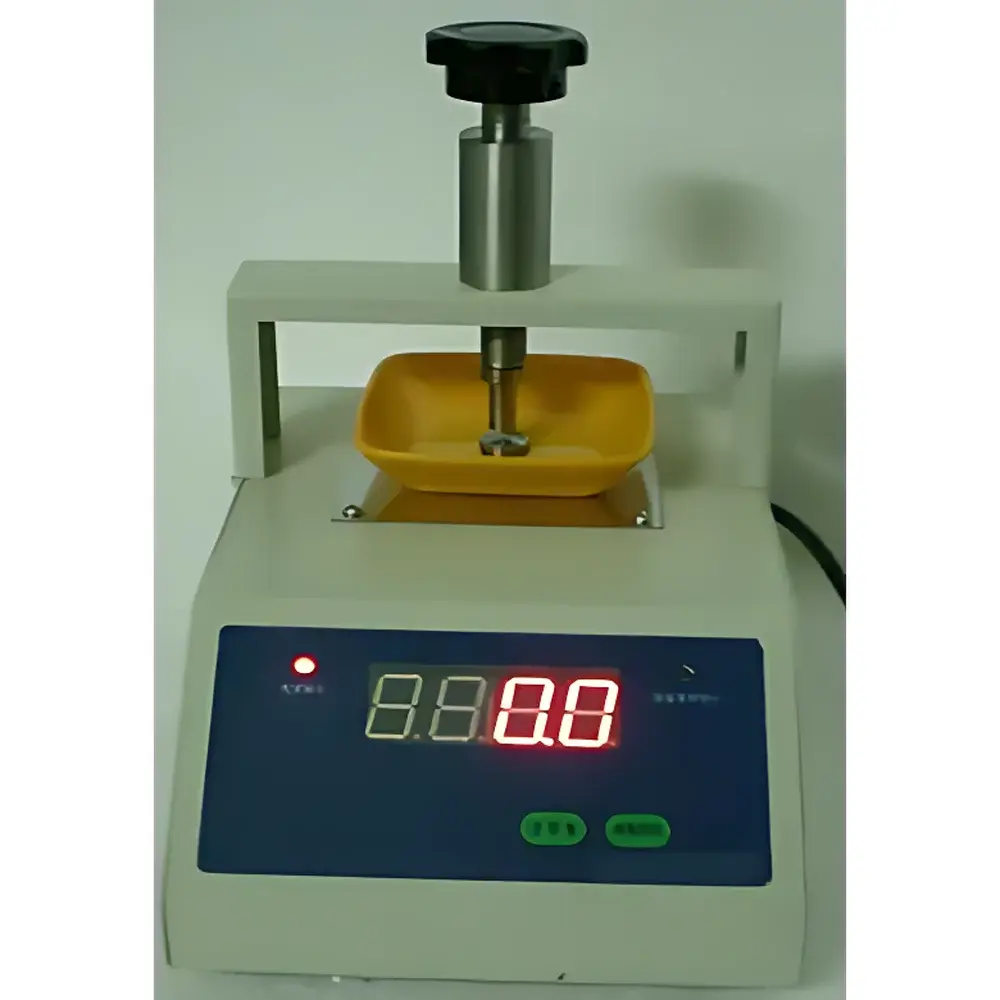
HengaoDe H08003 T4742 Ceramic Impact Resistance Tester for Domestic Tableware per QB/T 1993–2012
| Brand | HengaoDe |
|---|---|
| Origin | Beijing, China |
| Manufacturer Type | Authorized Distributor |
| Country of Origin | China |
| Model | H08003 |
| Impact Energy | 2.1 J |
| Scale Division | 0.02 J |
| Pendulum Lifting Angle | 120° |
| Distance from Pendulum Axis to Impact Point | 300 mm |
| Vertical Travel of Test Table | 120 mm |
| Longitudinal Travel of Test Table | 210 mm |
| Max Sample Dimensions | Ø ≤ 300 mm × H ≤ 300 mm |
| Net Weight | 100 kg |
| Overall Dimensions | 890 × 370 × 925 mm |
Overview
The HengaoDe H08003 T4742 Ceramic Impact Resistance Tester is a precision mechanical pendulum impact system engineered for quantitative assessment of fracture initiation and catastrophic failure energy in domestic ceramic tableware—specifically flatware (plates, saucers) and hollowware (bowls, cups). It operates on the principle of controlled gravitational pendulum impact, where a calibrated hammer delivers a single, reproducible kinetic impulse to standardized test locations: the geometric center of flat specimens and the rim or base edge of concave forms. The instrument directly measures two critical mechanical thresholds defined in QB/T 1993–2012 and GB/T 4742: (1) the minimum impact energy required to initiate a surface crack (crack onset energy), and (2) the total cumulative energy required to induce complete structural disintegration (fracture energy). This dual-parameter output enables rigorous classification of ceramic impact toughness, supporting quality gate decisions in production and compliance verification against national standards for consumer safety and durability.
Key Features
- Fixed-energy pendulum mechanism with nominal impact energy of 2.1 J and high-resolution analog scale (0.02 J division) for traceable manual readout
- Adjustable test table with independent vertical (120 mm) and longitudinal (210 mm) positioning for precise alignment of impact point relative to specimen geometry
- Robust cast-iron frame and hardened steel impact anvil ensuring long-term dimensional stability and minimal energy loss during strike
- Compliant with mechanical design requirements of QB/T 1993–2012 Annex A, including specified pendulum arm length (300 mm), lifting angle (120°), and impact velocity profile
- Universal sample accommodation for plates, bowls, and cups up to Ø300 mm × H300 mm without fixture modification
- No electrical power requirement—fully mechanical operation enhances reliability in factory-floor environments and eliminates calibration drift associated with electronic sensors
Sample Compatibility & Compliance
The tester accepts both glazed and unglazed ceramic specimens, accommodating variations in surface finish and thermal history without recalibration. Specimen preparation follows QB/T 1993–2012 Section 5: samples must be free of visible flaws, dried to constant mass at 105°C ± 2°C, and conditioned at 23°C ± 2°C and 50% ± 5% RH for ≥24 h prior to testing. The instrument satisfies metrological traceability requirements for Class II mechanical impact testers under ISO/IEC 17025–2017 when used with certified reference masses and angular encoders. While not inherently GLP-compliant due to analog readout, it supports audit-ready documentation when paired with standardized test logs and operator sign-off sheets aligned with internal quality management systems (e.g., ISO 9001:2015). It is routinely deployed in third-party certification labs accredited to CNAS (China National Accreditation Service) for QB/T 1993 conformance testing.
Software & Data Management
The H08003 is a stand-alone mechanical instrument with no embedded firmware or digital interface. Data acquisition relies on operator-recorded analog scale readings, which are manually entered into laboratory information management systems (LIMS) or Excel-based QA databases. For laboratories requiring digital traceability, optional external USB digital calipers (e.g., Mitutoyo CD-6”CHX) can be mounted adjacent to the scale for real-time image capture and OCR-assisted transcription. All recorded values must include operator ID, date/time stamp, specimen ID, test location (center/rim), and environmental conditions—practices consistent with FDA 21 CFR Part 11 principles for handwritten records in regulated environments. Calibration certificates for the pendulum mass and angular encoder (if retrofitted) are maintained per ISO/IEC 17025 calibration intervals (typically annually).
Applications
- Final quality control of porcelain, stoneware, and earthenware tableware prior to packaging and distribution
- Raw material evaluation: comparative impact resistance screening of clay-body formulations and glaze compositions
- R&D validation of new firing schedules—quantifying trade-offs between vitrification temperature and mechanical resilience
- Supplier qualification audits for ceramic component manufacturers supplying OEM kitchenware brands
- Failure analysis investigations following field reports of chipping or shattering under normal use conditions
- Academic research on brittle fracture mechanics in polycrystalline silicates and microstructural toughening mechanisms
FAQ
Does this instrument comply with international standards such as ISO 10545-11 or ASTM C1161?
No. The H08003 is designed exclusively to meet Chinese national standards QB/T 1993–2012 and GB/T 4742. ISO 10545-11 specifies a different impact geometry (drop-weight method), while ASTM C1161 addresses flexural strength—not impact resistance—of advanced ceramics.
Can the impact energy be adjusted beyond 2.1 J?
No. The pendulum mass and drop height are fixed per QB/T 1993–2012 requirements. Altering either parameter invalidates compliance with the standard.
Is calibration certification included with shipment?
Yes. Each unit ships with a factory calibration report verifying pendulum mass, arm length, and scale linearity against NIM (National Institute of Metrology, China) traceable references.
What maintenance is required?
Monthly visual inspection of pendulum bearing play, lubrication of pivot points with light machine oil (ISO VG 10), and verification of scale zero position using the built-in stop pin. Annual verification by an accredited metrology lab is recommended.
Are replacement pendulum hammers available?
Yes. Certified replacement hammers (part #H08003-HAMMER-2.1J) are supplied with individual calibration certificates and are serialized to match the original instrument’s calibration record.





