
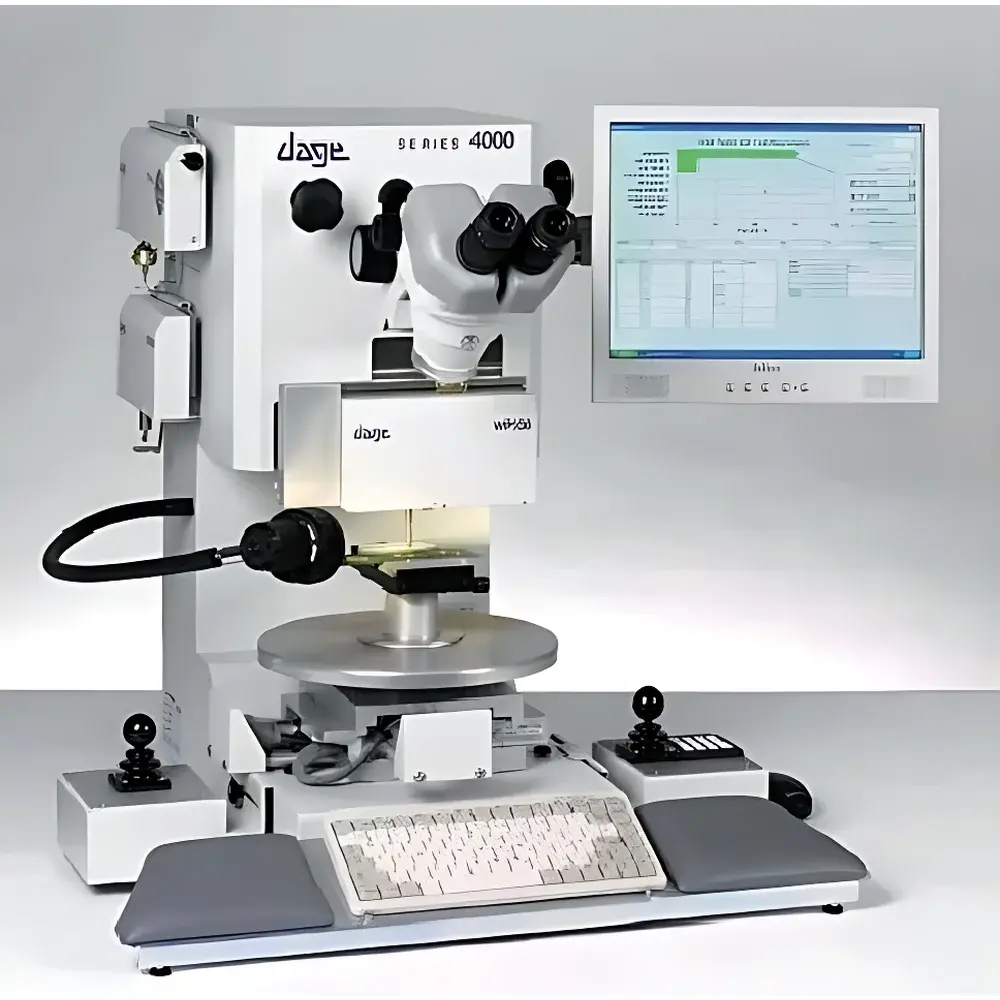
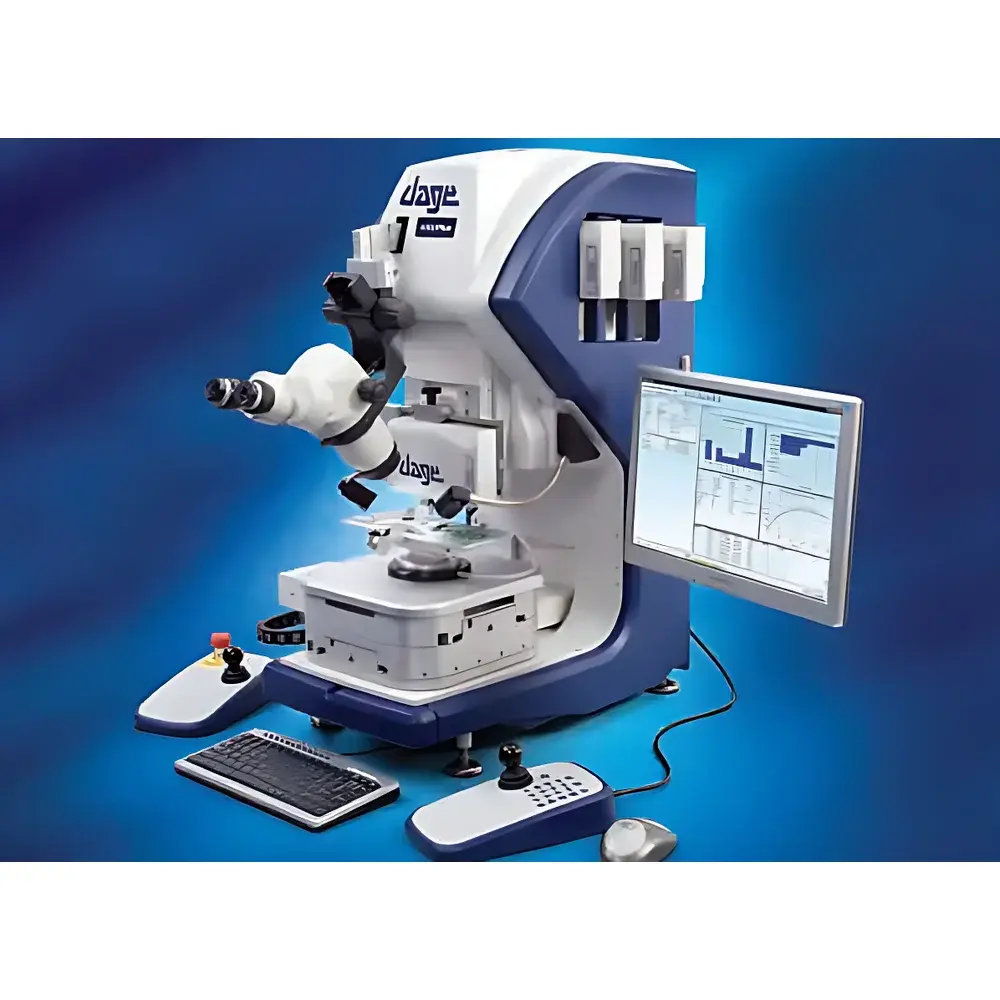
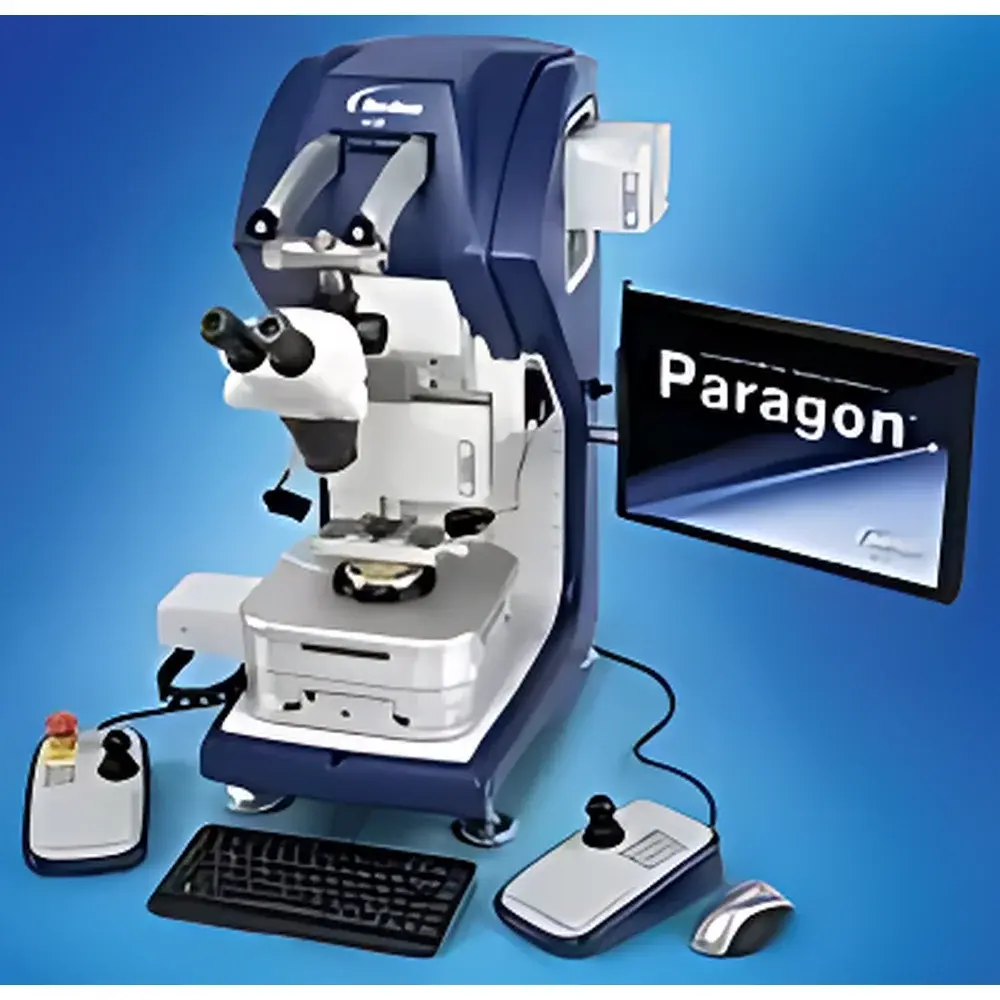
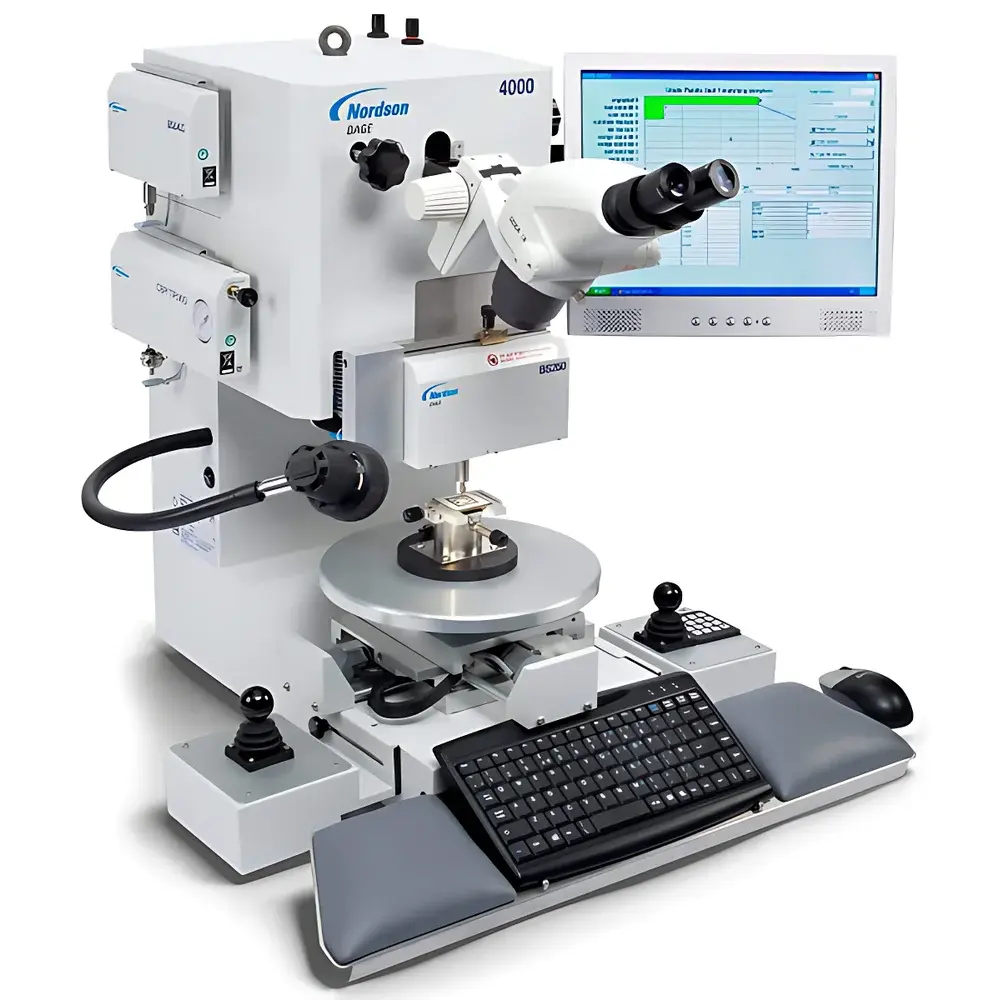
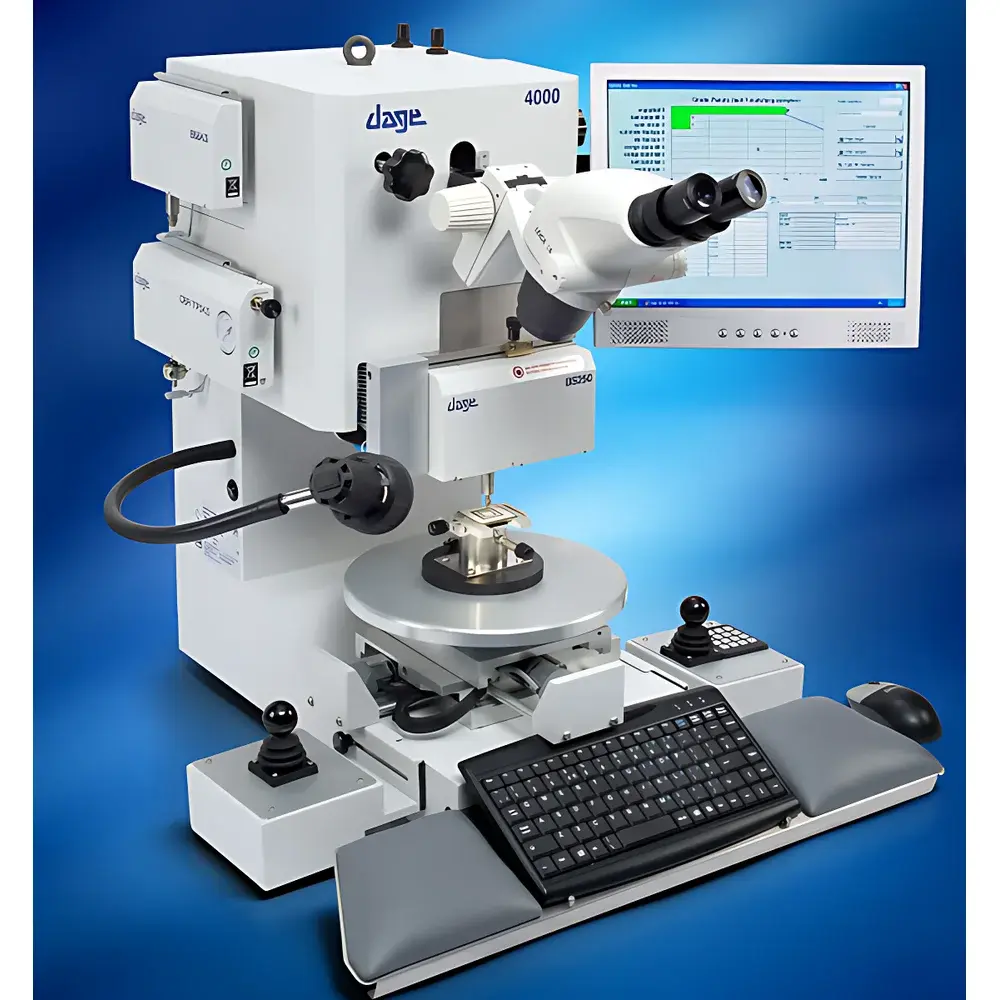
Nordson DAGE 4000 Bond Strength Tester
| Brand | Nordson DAGE |
|---|---|
| Origin | United Kingdom |
| Model | DAGE 4000 |
| Maximum Test Load | 500 kgf |
| Test Axes | Motorized X- and Z-axis with synchronized motion control |
| Software | DAGE MultiTest™ v6.x with statistical analysis, fracture mode classification, QC reporting, and audit trail (21 CFR Part 11 compliant) |
| Compliance | ASTM F459, MIL-STD-883 Method 2011, JEDEC JESD22-B116, IPC-9701, ISO/IEC 17025 accredited operation support |
| Test Modalities | Wire pull, ball shear, stud pull, tweezer pull, cold bump pull, lift-off, chip push, solder joint shear, lead fatigue, non-destructive bond integrity verification |
| Sample Stage | Precision XYZ motorized stage with programmable approach profiles and real-time force-displacement feedback |
Overview
The Nordson DAGE 4000 is a high-precision, modular bond strength testing system engineered for quantitative mechanical evaluation of microelectronic interconnects and packaging structures. Operating on the principle of controlled force application with real-time load-cell feedback and sub-micron positional resolution, it delivers traceable, repeatable measurements across a wide spectrum of bonding interfaces—including wire bonds (Au/Al), solder bumps (SnPb, SAC), die attach adhesives, flip-chip underfills, and SMT solder joints. Designed specifically for semiconductor packaging validation, PCBA reliability qualification, and failure analysis laboratories, the DAGE 4000 meets the stringent metrological requirements of industrial R&D, production QA/QC, and third-party accreditation bodies. Its architecture supports both destructive and non-destructive test protocols, enabling correlation between mechanical integrity and functional performance in devices ranging from consumer ICs to automotive-grade AEC-Q200 components and aerospace-grade hermetic assemblies.
Key Features
- 500 kgf maximum load capacity with dual-range high-resolution load cells (±0.05% FS accuracy) for seamless transition between fine-pitch microbond testing and high-force package-level shear/push evaluation.
- Independent, software-synchronized X- and Z-axis motorization ensures constant pull angle during wire pull tests—critical for eliminating angular error in ISO/IEC 17025-compliant reporting.
- Modular tooling interface accommodates interchangeable test heads: ball shear chucks (10–500 µm), wire pull hooks (12–500 µm), tweezers (20–1000 µm), and custom fixtures for cold bump pull or lift-off configurations.
- DAGE MultiTest™ v6.x software provides automated test sequencing, real-time force-displacement curve acquisition, fracture mode classification (ductile/brittle/mixed), statistical process control (SPC) charts, and GLP/GMP-compliant electronic signatures and audit trails per FDA 21 CFR Part 11.
- Programmable approach profiles include ramped velocity control, dwell time at pre-load, and dynamic load-rate adjustment—enabling compliance with JEDEC JESD22-B116 (ball shear) and MIL-STD-883 Method 2011 (wire bond pull).
- Integrated environmental monitoring (optional) supports temperature-controlled testing from −40°C to +150°C, facilitating thermal-mechanical reliability assessment per IPC-9701 standards.
Sample Compatibility & Compliance
The DAGE 4000 accommodates substrates up to 300 × 300 mm and wafer formats up to 8-inch diameter, supporting bare die, packaged ICs (QFN, BGA, WLCSP), LED modules, optoelectronic transceivers, and hybrid RF assemblies. Its test methodologies align with globally recognized standards including ASTM F459 (wire bond pull strength), IPC-9701 (solder joint shear strength), JEDEC JESD22-B116 (ball shear), and MIL-STD-883 Method 2011 (bond strength qualification). When operated within an ISO/IEC 17025-accredited laboratory environment, the system supports full traceability to NIST-traceable force calibration standards and documented uncertainty budgets per GUM (Guide to the Expression of Uncertainty in Measurement).
Software & Data Management
DAGE MultiTest™ v6.x serves as the central analytical engine, offering fully configurable test templates, batch-mode execution, and hierarchical data export (CSV, XML, PDF). Built-in statistical tools compute Cp/Cpk, Weibull distribution fitting, and outlier detection using Grubbs’ test. All raw data—including time-stamped force-displacement curves, video capture synchronization (via optional camera module), and operator metadata—are stored in an encrypted local database with role-based access control. Audit logs record every parameter change, user login/logout, and report generation event—ensuring full compliance with FDA 21 CFR Part 11 requirements for electronic records and signatures in regulated environments.
Applications
- Semiconductor manufacturing: Qualification of Au/Al wire bonds in power discretes, memory stacks, and RF front-end modules.
- LED and optoelectronics: Shear strength validation of phosphor-coated die attach in high-brightness LED packages subject to thermal cycling.
- Automotive electronics: Mechanical verification of solder joints in ADAS radar modules per AEC-Q200 stress test schedules.
- Failure analysis labs: Correlation of bond strength degradation with SEM/EDS cross-section analysis following HAST or TCT exposure.
- Academic research: Quantitative study of intermetallic growth kinetics at Cu/Sn interfaces under isothermal aging conditions.
- Contract manufacturing: First-article inspection and periodic lot sampling for IPC-A-610 Class 3 assemblies.
FAQ
What standards does the DAGE 4000 support for wire bond pull testing?
ASTM F459, MIL-STD-883 Method 2011, and JEDEC JESD22-B116 define the procedural framework; the system’s synchronized X-Z motion and calibrated load cell ensure adherence to angular and force tolerance requirements.
Can the DAGE 4000 perform non-destructive bond integrity screening?
Yes—through programmable low-force “lift-off” and “tweezer pull” protocols with real-time displacement thresholding, enabling pass/fail verification without interfacial rupture.
Is multi-user access and electronic signature capability available?
Yes—MultiTest™ v6.x includes configurable user roles, biometric or token-based authentication, and 21 CFR Part 11-compliant electronic signatures with tamper-evident audit logs.
How is calibration traceability maintained?
Load cells are calibrated annually against NIST-traceable deadweight standards; certificate of calibration includes measurement uncertainty, environmental conditions, and technician accreditation details.
Does the system support integration with LIMS or MES platforms?
Yes—via OPC UA and RESTful API interfaces, enabling bidirectional data exchange with LabVantage, Thermo Fisher SampleManager, and Siemens Opcenter Execution.



