HengaoDe HAD-SD8 Smart Online Water Colorimeter Based on Spectrophotometric Absorption Method
| Brand | HengaoDe |
|---|---|
| Origin | Beijing, China |
| Manufacturer Type | Authorized Distributor |
| Country of Origin | China |
| Model | HAD-SD8 |
| Price | USD 135 (FOB) |
| Measurement Principle | Spectrophotometric Absorption |
| Range | 0–500 PCU |
| Resolution | 0.01 PCU |
| Temperature Range | 0.0–65.0 °C |
| Sensitivity | >0.02 m/s |
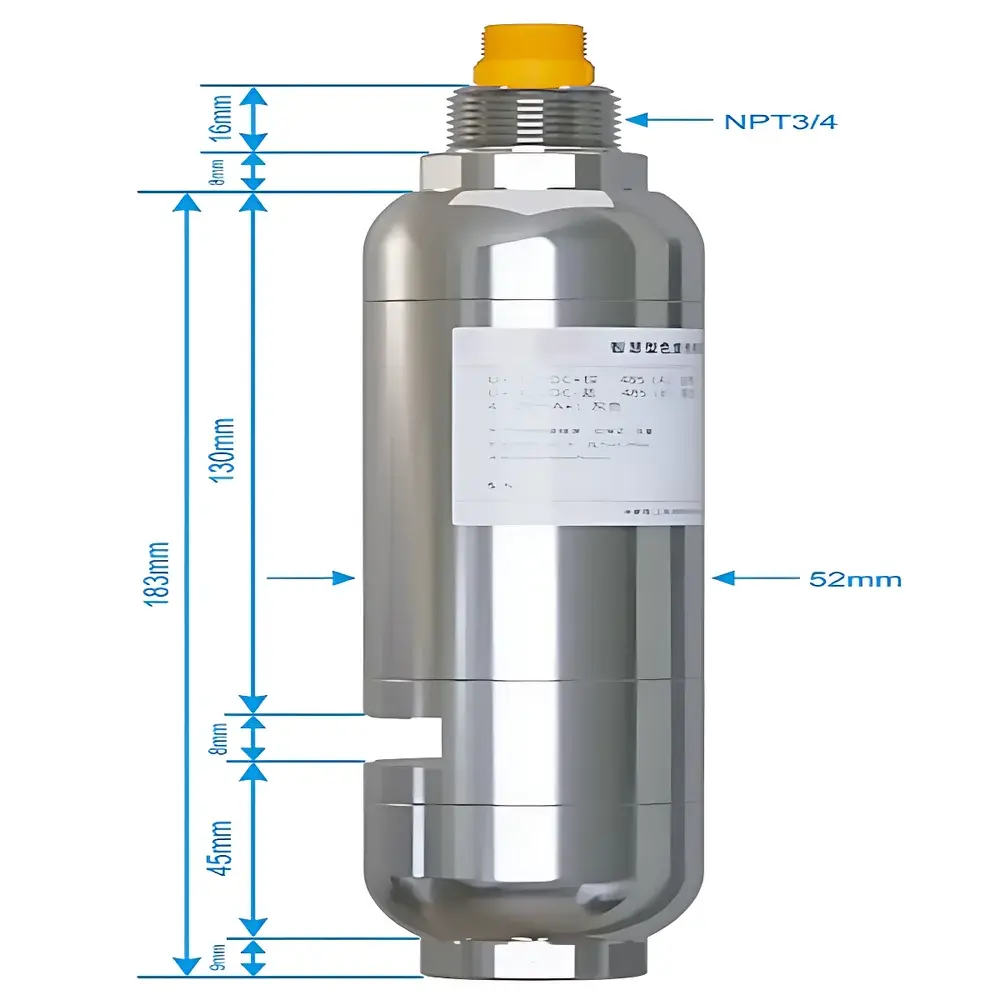
| Housing Material | Stainless Steel (316L) |
| Thread Connection | NPT 3/4" |
| Signal Cable Length | 5 m (customizable) |
| Accuracy | ±5.0% FS or ±10 PCU (whichever is greater) |
| Calibration | Zero-point and span calibration |
| Protection Rating | IP68 |
| Pressure Rating | 0–3 bar |
| Output Interface | RS485 (MODBUS-RTU protocol) |
Overview
The HengaoDe HAD-SD8 Smart Online Water Colorimeter is an industrial-grade, in-line color measurement sensor engineered for continuous, real-time monitoring of water color in accordance with the platinum-cobalt (PCU) scale. It operates on the principle of spectrophotometric absorption—measuring the attenuation of specific visible-wavelength light (typically 430 nm or 525 nm, depending on configuration) as it passes through a water sample. This optical method delivers high reproducibility and long-term stability without consumables or reagents, making it suitable for unattended operation in harsh environmental conditions. Designed for permanent installation in pressurized pipelines or open-channel flow cells, the HAD-SD8 provides traceable, metrologically sound color data essential for regulatory compliance, process optimization, and early warning of contamination events.
Key Features
- True in-situ measurement with stainless steel (316L) wetted parts and IP68-rated housing for submersible or pipe-mounted deployment
- High-resolution detection (0.01 PCU) across a broad dynamic range (0–500 PCU), supporting both low-color drinking water and highly colored industrial effluents
- Integrated temperature sensor (0.0–65.0 °C) with automatic thermal compensation to minimize drift due to ambient or process temperature fluctuations
- Robust mechanical design featuring NPT 3/4″ threaded connection and pressure tolerance up to 3 bar—compatible with standard municipal and industrial piping systems
- RS485 digital output compliant with MODBUS-RTU protocol, enabling seamless integration into SCADA, DCS, or PLC-based monitoring infrastructures
- Zero- and span-calibration capability using certified PCU standards; no optical alignment or internal lamp replacement required during service life
- Low-power consumption and EMI-hardened electronics optimized for 24/7 operation in electrically noisy plant environments
Sample Compatibility & Compliance
The HAD-SD8 is validated for use with potable water, surface water, wastewater, cooling tower makeup, and process streams in pharmaceutical, food & beverage, and chemical manufacturing. Its optical path geometry and spectral response conform to ASTM D1209 (Standard Test Method for Color of Clear Liquids) and ISO 7887:2011 (Water quality — Determination of colour). While not certified to USP or EPA Method 180.1, its PCU output is directly translatable for reporting under regulatory frameworks requiring standardized color units. The sensor meets CE marking requirements for electromagnetic compatibility (EN 61326-1) and environmental protection (RoHS Directive 2011/65/EU). Its stainless steel construction complies with FDA 21 CFR Part 177 for indirect food contact where applicable.
Software & Data Management
The HAD-SD8 communicates via ASCII-based MODBUS-RTU over RS485, supporting standard register mapping for color value (holding register 40001), temperature (40002), status flags (40003), and calibration timestamps (40004–40005). When integrated with HengaoDe’s optional Edge Gateway Module (sold separately), raw data can be time-stamped, buffered during network outages, and transmitted via MQTT or OPC UA to cloud platforms such as Azure IoT Hub or AWS IoT Core. Audit trails—including calibration logs, firmware version history, and sensor health diagnostics—are retained locally for GLP/GMP-aligned validation protocols. No proprietary software is required for basic operation; standard MODBUS master tools (e.g., ModScan, QModMaster) suffice for commissioning and troubleshooting.
Applications
- Municipal water treatment: Real-time color monitoring at intake, filtration effluent, and distribution points to verify coagulation efficiency and detect algal bloom ingress
- Pharmaceutical water systems: Continuous verification of purified water (PW) and water for injection (WFI) color compliance per USP
- Food & beverage production: In-line control of rinse water clarity, syrup dilution consistency, and CIP return stream cleanliness
- Industrial wastewater discharge: Automated reporting of effluent color against permit limits (e.g., NPDES) with timestamped MODBUS records for regulatory submission
- Aquaculture and reservoir management: Early detection of organic loading shifts or sediment resuspension events via trending PCU deviations
FAQ
Is the HAD-SD8 suitable for turbid or suspended-solid-laden samples?
Yes—its dual-beam optical architecture compensates for moderate scattering effects. However, for samples exceeding 10 NTU, inline filtration (e.g., 50 µm mesh) upstream of the sensor is recommended to prevent fouling and maintain accuracy.
Can the sensor be calibrated without removing it from the pipeline?
Yes—zero calibration is performed dry (with clean air/water flush), and span calibration uses a traceable PCU standard solution introduced via a dedicated sampling port or bypass loop.
What maintenance intervals are recommended for long-term reliability?
Visual inspection every 3 months; quartz window cleaning with isopropyl alcohol if fouling is observed; full verification against reference standards annually or after any physical impact or thermal shock.
Does the device support hazardous area classification?
No—the HAD-SD8 is rated for Class I, Division 2 (non-incendive) environments only. For Zone 1/2 applications, an intrinsically safe barrier must be installed between the sensor and control system.
How is temperature compensation implemented?
A built-in Pt100 RTD measures fluid temperature adjacent to the optical path; compensation coefficients are applied per NIST-traceable polynomial equations embedded in firmware.