
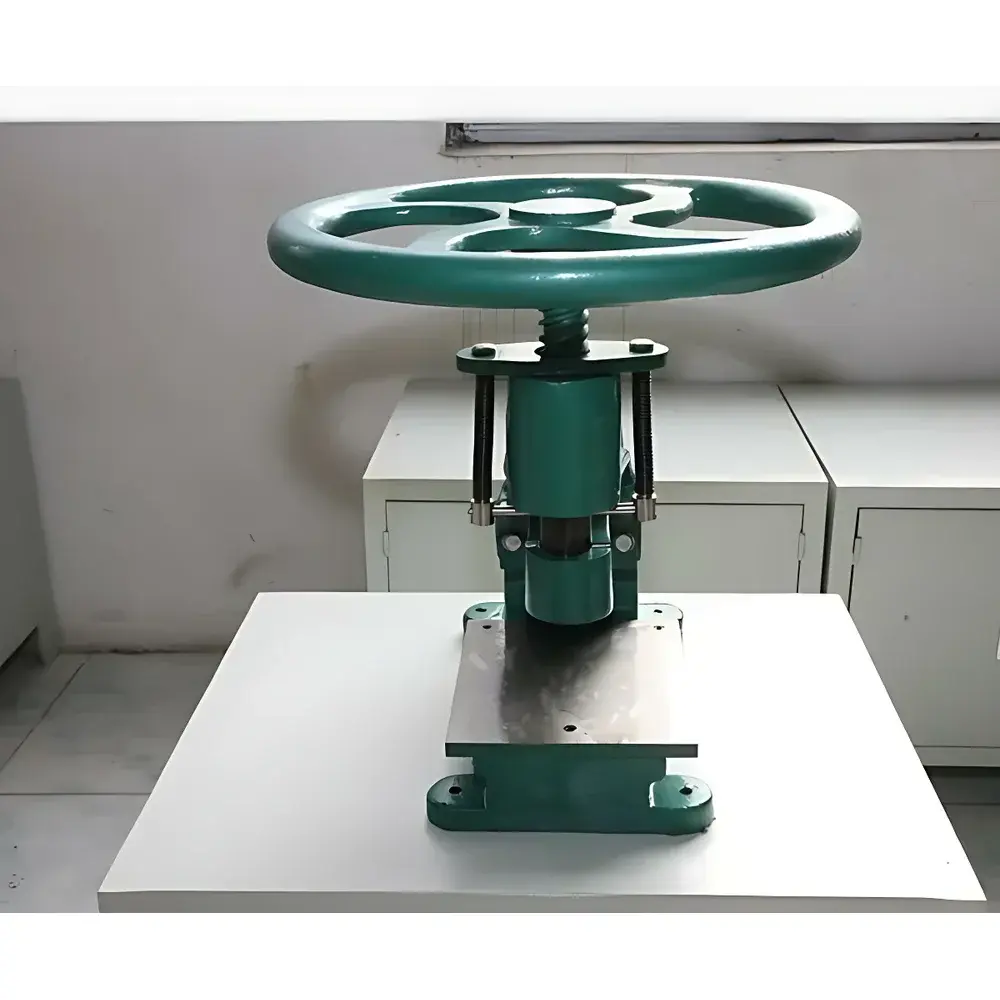
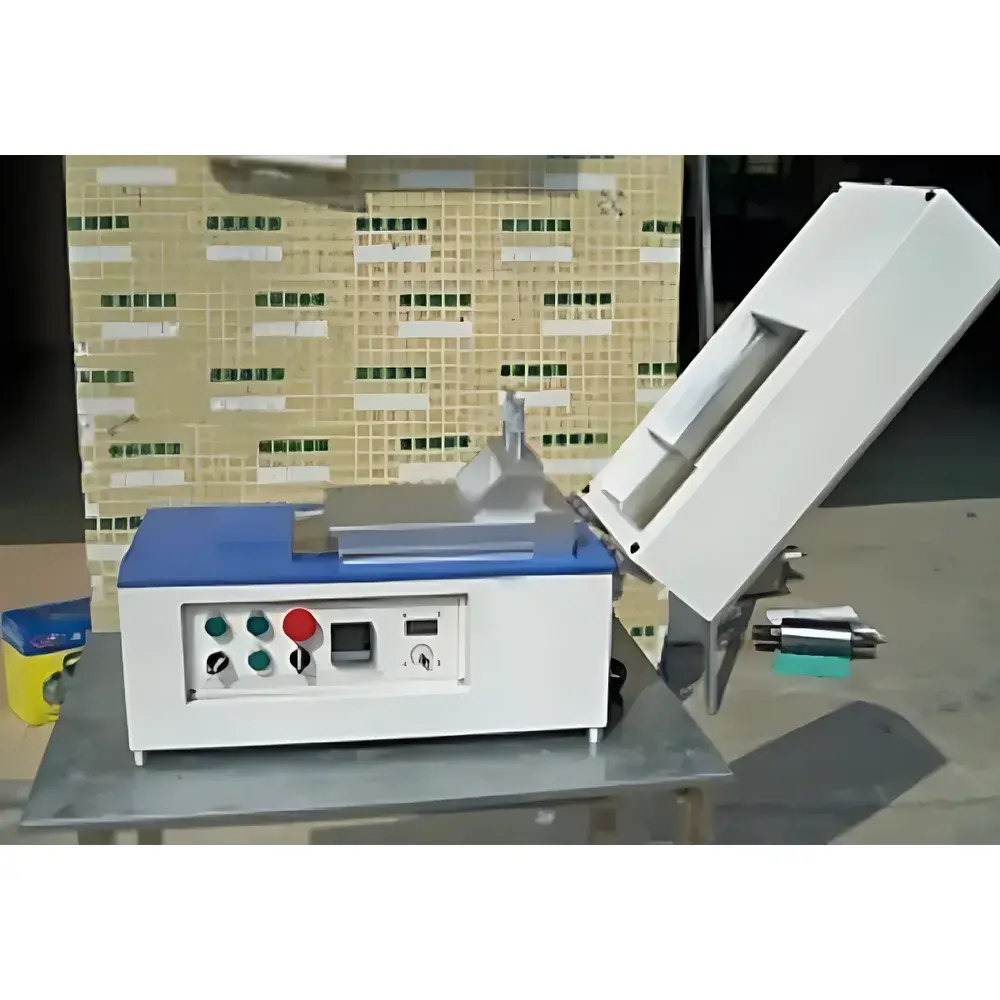
Hengaode HAD-Y1025 Manual Rubber Specimen Punching Machine
| Brand | Hengaode |
|---|---|
| Origin | Beijing, China |
| Manufacturer Type | Authorized Distributor |
| Country of Origin | China |
| Model | HAD-Y1025 |
| Punching Stroke | 25 mm |
| Worktable Dimensions | 175 × 140 mm |
| Overall Dimensions | 320 × 450 × 515 mm |
| Weight | 80 kg |
| Application | Standard rubber test specimen preparation per ASTM D3182, ISO 37, and GB/T 528 |
Overview
The Hengaode HAD-Y1025 Manual Rubber Specimen Punching Machine is a precision-engineered mechanical device designed for the reproducible preparation of standardized test specimens from vulcanized rubber and elastomeric compounds. It operates on a simple yet robust manual lever-actuated principle, applying controlled compressive force through a vertically guided punch to cut specimens under consistent stroke displacement (25 mm). This ensures dimensional repeatability critical for tensile, tear, and hardness testing in compliance with international standards including ASTM D3182 (Standard Practice for Rubber—Materials—Sampling), ISO 37 (Rubber—Determination of Tensile Strength and Elongation at Break), and Chinese national standard GB/T 528. The machine does not require electrical power or pneumatic supply, making it suitable for clean laboratory environments, QC labs, and production floor use where operational simplicity and mechanical reliability are prioritized.
Key Features
- Manually operated lever mechanism with positive mechanical feedback—no hydraulic or electronic components to calibrate or maintain.
- Fixed 25 mm punching stroke ensures consistent penetration depth across repeated cycles, minimizing variability in specimen thickness and edge integrity.
- Sturdy cast-iron base and reinforced steel frame provide high rigidity and vibration damping during operation.
- Adjustable upper plate accommodates interchangeable die sets (e.g., dumbbell No. 1 per ISO 37, ring dies per ASTM D1415) without tooling changes.
- 175 × 140 mm worktable offers ample support area for sheet stock up to 6 mm thick; compatible with cured rubber sheets, thermoplastic elastomers, and polyurethane foams.
- Integrated safety stop limits downward travel beyond nominal stroke—prevents over-compression and die damage.
Sample Compatibility & Compliance
The HAD-Y1025 is validated for use with vulcanized natural rubber (NR), styrene-butadiene rubber (SBR), nitrile rubber (NBR), ethylene propylene diene monomer (EPDM), and silicone elastomers. It supports specimen geometries defined in ASTM D412 (tensile), ASTM D624 (tear), and ISO 2285 (compression set). All mechanical dimensions and force transmission pathways comply with ISO/IEC 17025 requirements for equipment used in accredited testing laboratories. The unit meets CE machinery directive essential health and safety requirements (2006/42/EC) when used with certified dies and within specified material thickness limits. No hazardous substances are employed in construction; all structural components conform to RoHS Directive 2011/65/EU.
Software & Data Management
This is a purely mechanical instrument with no embedded electronics, firmware, or data logging capability. As such, it requires no software installation, calibration certificates with digital signatures, or audit trail functionality. Its operation is fully traceable via physical logbook entries referencing specimen batch ID, die type, operator name, date/time, and material lot number—fully compatible with GLP and GMP documentation workflows. For laboratories implementing LIMS integration, specimen preparation events may be manually entered or linked via barcode-scanned work orders. No cybersecurity or FDA 21 CFR Part 11 compliance considerations apply due to absence of electronic record generation.
Applications
The HAD-Y1025 serves as a foundational sample preparation tool in rubber compound development, quality control, and regulatory submission testing. Typical use cases include: preparing ASTM D412 Type C dumbbell specimens for tensile property validation prior to extrusion line qualification; cutting ISO 37 Type 2 specimens for elongation-at-break verification in tire tread compound release; generating GB/T 528 ring specimens for hardness correlation studies; and producing uniform discs for Shore A durometer calibration checks. It is routinely deployed in R&D labs at tier-1 automotive suppliers, rubber goods manufacturers, and third-party testing facilities accredited to ISO/IEC 17025. Its mechanical simplicity ensures uninterrupted operation during extended shift schedules and eliminates downtime associated with sensor drift or firmware updates.
FAQ
Is the HAD-Y1025 compatible with non-rubber materials such as silicone gels or thermoplastic elastomers?
Yes—provided the material exhibits sufficient green strength and modulus to resist deformation during punch engagement, and thickness remains within 0.5–6 mm range. Validation per ASTM D3182 Annex A is recommended for novel substrates.
Does the machine require periodic recalibration?
No—mechanical stroke is fixed by hardened steel limit stops; verification consists of annual visual inspection of die sharpness and frame alignment per manufacturer’s maintenance checklist.
Can custom die profiles be fabricated for proprietary specimen geometries?
Yes—Hengaode provides OEM die design services based on customer-provided CAD drawings; lead time is typically 4–6 weeks.
What is the maximum recommended sheet thickness for reliable cutting?
6 mm for Shore A 40–90 compounds; for softer materials (<Shore A 30), reduce to ≤3 mm to prevent lateral extrusion and incomplete shearing.
Is operator training required prior to use?
A 15-minute orientation covering lever ergonomics, die mounting sequence, and safety interlock function is sufficient; no certification is mandated under ISO 13857.




