
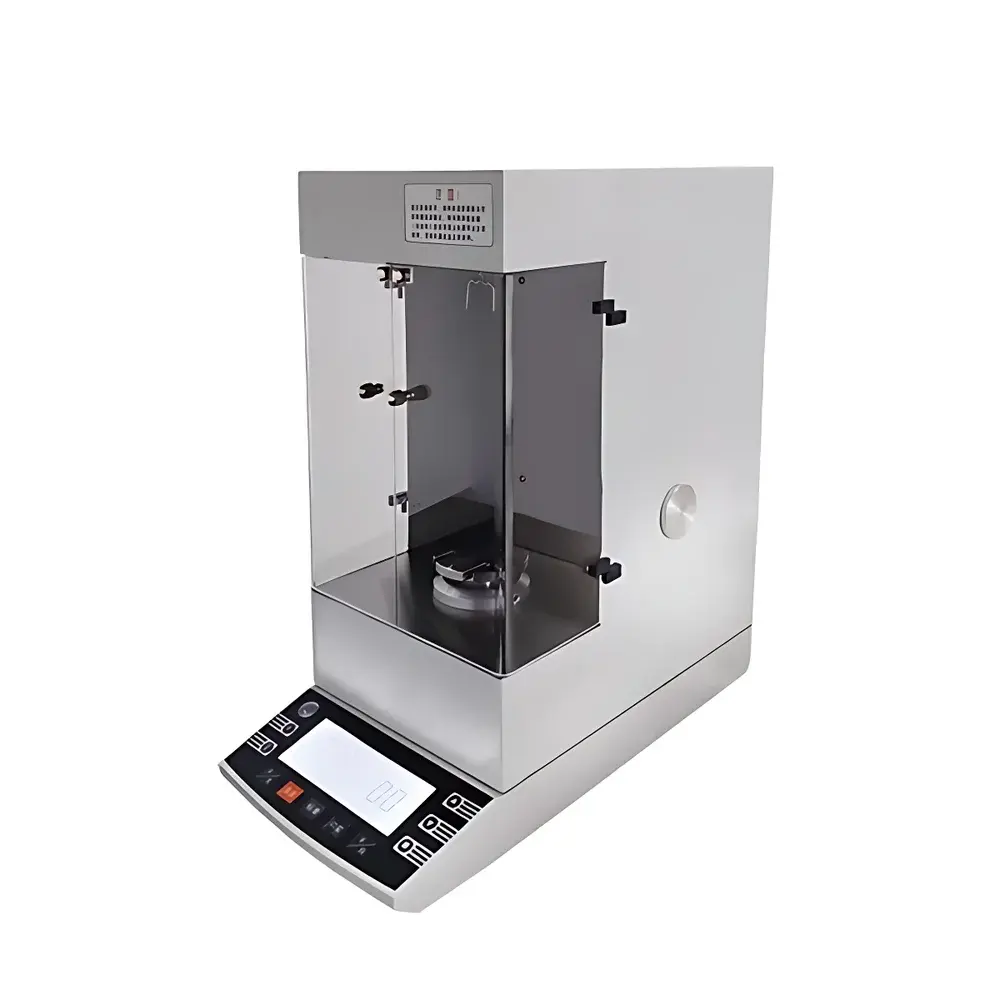
Hengping BZY-2N Automatic Surface and Interfacial Tensiometer
| Brand | Hengping |
|---|---|
| Origin | Shanghai, China |
| Model | BZY-2N |
| Measurement Range | 0–200 mN/m |
| Resolution | 0.01 mN/m |
| Accuracy | ±0.02 mN/m |
| Temperature Display Range | 0–100 °C |
| Measurement Method | Du Noüy Ring Method & Wilhelmy Plate Method |
Overview
The Hengping BZY-2N Automatic Surface and Interfacial Tensiometer is a precision laboratory instrument engineered for the quantitative determination of surface tension (liquid–air) and interfacial tension (liquid–liquid) using established physical measurement principles. It operates on the Wilhelmy plate and Du Noüy ring methods—both standardized techniques grounded in force-balance analysis of capillary rise and detachment forces. The system employs a closed-loop electromagnetic force transducer with microprocessor-based real-time control, enabling fully automated acquisition of equilibrium tension values without manual intervention. Designed for high reproducibility and long-term stability, the BZY-2N delivers traceable, linear measurements compliant with internationally recognized test protocols including ASTM D971, ISO 6295, ISO 1409, GB/T 6541, and GB/T 22237. Its architecture supports both routine QC workflows and advanced research applications requiring time-resolved interfacial kinetics—particularly relevant for surfactant adsorption studies, emulsion stability assessment, and formulation development across regulated industries.
Key Features
- Fully automated measurement cycle: motorized sample stage with programmable vertical travel ensures consistent immersion depth and withdrawal speed for both plate and ring geometries
- Dual-method capability: interchangeable platinum plate and platinum ring sensors—each calibrated per ISO 1409 specifications; plate method enables dynamic surface tension profiling for high-viscosity or slow-adsorbing systems
- High-fidelity force sensing: electromagnetic balance with 0.01 mN/m resolution and ±0.02 mN/m accuracy over full 0–200 mN/m range
- Integrated temperature monitoring: built-in PT100 sensor (BZY-1/23 option) provides real-time liquid temperature readout with 0.1 °C resolution (0–99 °C), supporting thermodynamic consistency in interfacial data reporting
- Zero and calibration functions: one-button tare (adjustable zero point within 0–400 mN range) and hardware-assisted calibration using supplied certified weights
- Standalone operation: embedded controller eliminates dependency on external PCs; optional USB interface enables data export and synchronized curve visualization via included software
Sample Compatibility & Compliance
The BZY-2N accommodates a broad spectrum of liquid systems—including aqueous surfactant solutions, hydrocarbon–water interfaces, polymer melts, pharmaceutical emulsions, and high-viscosity coatings—without modification to core hardware. Its platinum components meet ISO 1409 requirements for material purity and dimensional tolerances (e.g., Pt wire diameter ±0.005 mm, ring circumference 60 mm). When paired with optional thermostatic accessories—such as the BZY-1/22 low/high-temperature bath (–5 to 110 °C) or BZY-1/21 standard bath (0–60 °C)—the system achieves thermal control suitable for ASTM D1331-compliant interfacial tension testing. All measurement outputs are traceable to SI units and align with GLP documentation practices, including timestamped raw force vs. time datasets, operator ID logging, and audit-ready calibration records.
Software & Data Management
The included real-time curve acquisition software provides synchronized plotting of force versus time during immersion and withdrawal cycles. Users can define custom evaluation windows for equilibrium tension extraction, apply polynomial baseline correction, and export CSV-formatted datasets for statistical analysis in third-party tools (e.g., MATLAB, JMP, or Python pandas). While the instrument operates autonomously, the software supports FDA 21 CFR Part 11–compliant configurations when deployed in regulated environments: electronic signatures, role-based access control, and immutable audit trails for method parameters, calibration events, and result modifications are achievable via optional firmware upgrade and networked deployment.
Applications
- Petroleum refining: oil–water interfacial tension monitoring for demulsifier screening and transformer oil aging assessment per IEC 62961
- Pharmaceutical formulation: CMC determination of nonionic surfactants, wetting efficiency evaluation of drug nanosuspensions, and stability prediction of parenteral emulsions
- Coatings & inks: quantification of substrate wettability, pigment dispersion stability, and rheo-interfacial coupling in acrylic and epoxy resins
- Agrochemical R&D: adjuvant performance mapping via dynamic surface tension decay analysis under controlled humidity and temperature
- Food science: interfacial behavior of plant-based proteins at oil–water interfaces, foam stability modeling in dairy alternatives
- Electroplating process control: bath surfactant concentration optimization to suppress pitting and dendrite formation on cathodic substrates
- Academic research: Langmuir isotherm derivation, Gibbs adsorption equation validation, and interfacial rheology correlation studies
FAQ
What measurement standards does the BZY-2N comply with?
It conforms to GB/T 6541-1986 (ring method), GB/T 22237-2008 (plate method), ISO 1409:1995, ASTM D971, and ISO 6295 for surface and interfacial tension determination.
Can the instrument measure interfacial tension between two immiscible liquids?
Yes—the BZY-2N is specifically designed for liquid–liquid interfacial tension measurements, including oil–water, polymer–solvent, and molten salt–metal systems.
Is temperature control mandatory for accurate results?
While ambient-temperature measurements are valid, interfacial tension exhibits strong temperature dependence; use of the optional PT100 probe and thermostatic bath is recommended for comparative or thermodynamic studies.
How is calibration performed?
Calibration uses a certified stainless-steel weight traceable to national metrology institutes; the system supports multi-point verification across its operational range.
Does the device support dynamic surface tension measurement?
Yes—when configured with the Wilhelmy plate method, it captures time-dependent surface tension profiles essential for evaluating surfactant diffusion and adsorption kinetics.



