
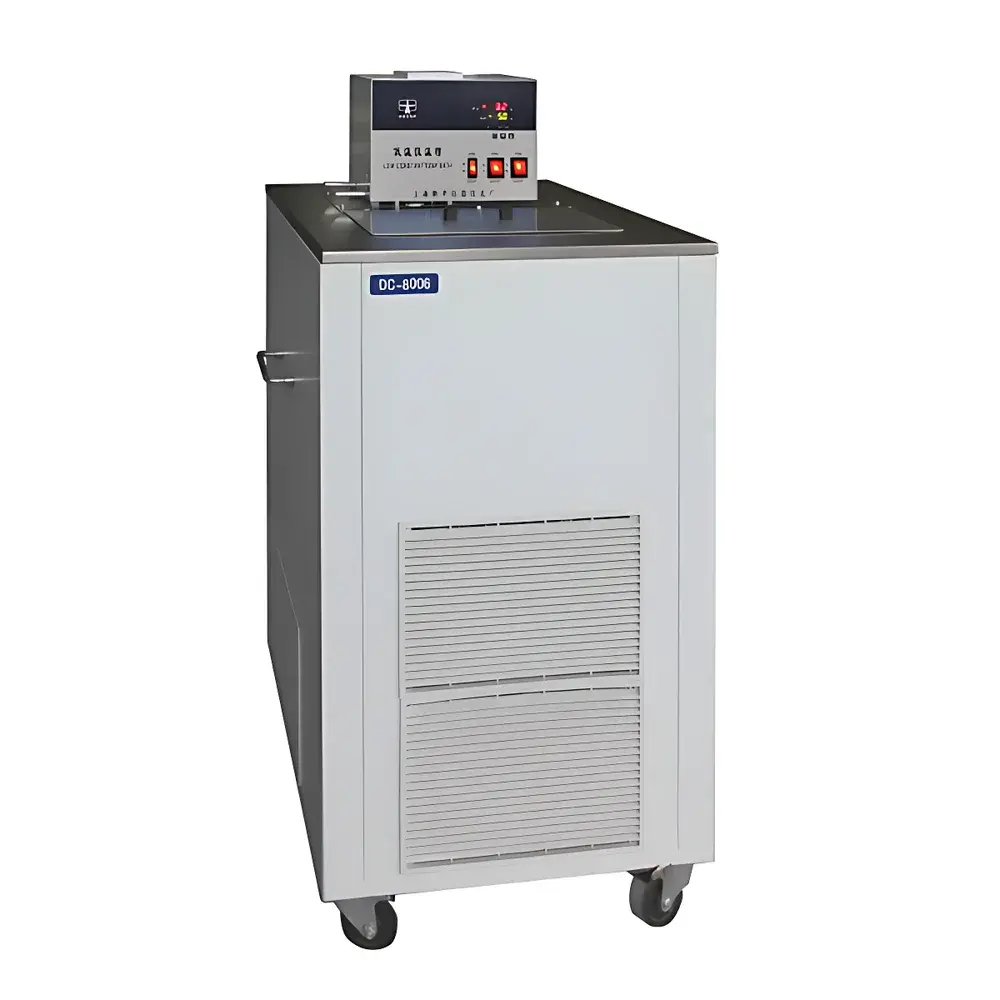
Hengping DC-6515 Benchtop Cryogenic Circulating Bath with Dual Internal/External Temperature Control
| Brand | Hengping |
|---|---|
| Origin | Shanghai, China |
| Model | DC-6515 |
| Capacity | 15 L |
| Temperature Range | −65 °C to +100 °C |
| Temperature Stability | ±0.05 °C (at 25 °C, water or ethanol) |
| Display Resolution | 0.1 °C |
| Circulation Flow Rate | 10 L/min (internal & external) |
| Refrigeration System | Dual-stage compressor |
| Control Method | Microprocessor-based PID with auto-tuning |
| Sensor | Pt100 platinum resistance thermometer |
| Power Supply | 220 VAC ±10%, 50 Hz |
| Dimensions (W×D×H) | 375 × 455 × 740 mm |
| Construction | 304 stainless steel tank and top plate |
| Safety Features | Over-temperature, low-level, dry-run, over-current, and compressor thermal protection |
| Certifications | CE-compliant design, GLP-ready architecture |
Overview
The Hengping DC-6515 is a precision-engineered benchtop cryogenic circulating bath designed for laboratories requiring stable, programmable temperature control across an extended range of −65 °C to +100 °C. It operates on the principle of forced liquid circulation via a dual-stage vapor-compression refrigeration system—optimized for rapid cooldown, minimal thermal overshoot, and high reproducibility in both internal bath and externally coupled applications. Unlike single-stage chillers, the DC-6515 employs a cascade refrigeration architecture to achieve sub-40 °C operation without chlorofluorocarbon (CFC)-based coolants, ensuring environmental compliance and long-term system reliability. Its microprocessor-controlled PID algorithm supports auto-tuning for dynamic load compensation, making it suitable for integration with calorimeters, spectrometers, reaction vessels, and other temperature-sensitive instrumentation where thermal inertia and field uniformity are critical performance parameters.
Key Features
- Dual-mode temperature control: Supports both internal bath immersion and external closed-loop circulation (via rear-mounted PT100 sensor port), enabling precise secondary temperature field establishment for reactors, condensers, or analytical accessories.
- High-stability thermal management: ±0.05 °C temperature fluctuation at 25 °C (measured in water or ethanol), achieved through insulated polyurethane foam housing, low-heat-generation centrifugal circulation pump, and real-time Pt100 feedback loop.
- Robust mechanical construction: 304 stainless steel inner tank and work surface; electrostatically coated steel outer casing with R-corner safety geometry; foldable side handles and optional locking casters for ergonomic handling.
- Comprehensive safety architecture: Includes independent over-temperature cutoff, low-bath-level detection, dry-run prevention for heater elements, dual-stage compressor thermal overload protection, and open-sensor diagnostics.
- Maintenance-friendly design: Removable front grille for direct access to condenser coils; modular pump assembly; corrosion-resistant fluid pathways compatible with aqueous, ethylene glycol, and ethanol-based heat transfer media.
Sample Compatibility & Compliance
The DC-6515 accommodates a broad spectrum of laboratory workflows requiring thermal conditioning of samples, instruments, or process fluids. Its 15 L working volume and 215 × 175 × 200 mm opening allow immersion of standard flasks, cuvettes, viscometer spindles, and small-scale bioreactors. The unit is compatible with ASTM E2877 (Standard Practice for Calibration of Temperature-Controlled Baths), ISO/IEC 17025 calibration traceability frameworks, and supports Good Laboratory Practice (GLP) documentation requirements when paired with optional RS485/Modbus RTU interface. All electrical components meet IEC 61010-1 safety standards for laboratory equipment. No CFC or HCFC refrigerants are used; the system complies with EU F-Gas Regulation (EU) No 517/2014 and RoHS directives.
Software & Data Management
While the DC-6515 operates as a standalone instrument with intuitive front-panel controls, its digital infrastructure enables seamless integration into automated lab environments. Optional RS232 or RS485 communication modules support Modbus RTU protocol for bidirectional data exchange with SCADA systems, LIMS, or custom Python/Matlab control scripts. Users may configure up to 30 programmable temperature ramps and holds—ideal for accelerated aging studies, thermal cycling validation, or reaction kinetics profiling. Audit-trail functionality (when connected to compliant host software) satisfies FDA 21 CFR Part 11 requirements for electronic records and signatures in regulated QC/QA settings. Real-time external temperature monitoring is enabled via optional extended-length PT100 probe, allowing closed-loop regulation of jacketed reactors or flow cells without auxiliary controllers.
Applications
The DC-6515 serves as a primary thermal source across physical chemistry, materials science, pharmaceutical development, and biomedical engineering. It provides stable thermal conditioning for rotating evaporators, rheometers, UV-Vis spectrophotometers, CCD detectors, and NMR preamplifiers. In synthesis labs, it maintains precise jacket temperatures for Grignard reactions, hydrogenations, and low-temperature lithiations. In quality control, it supports viscosity measurements per ASTM D445, refractive index determinations (ASTM D1218), and dissolution testing (USP ). Its −65 °C capability enables cryo-SEM sample preparation, superconducting device characterization, and cold-trap operation in vacuum systems. For industrial R&D, it functions as a temperature source for fatigue testers, thin-film deposition chambers, and plasma etch tools requiring thermal stabilization below −40 °C.
FAQ
What heat transfer fluids are compatible with the DC-6515 at −65 °C?
Ethanol, methanol, or specialized low-temperature silicone oils (e.g., DC-200 series) are recommended. Pure water must not be used below 0 °C.
Can the DC-6515 maintain temperature stability during external circulation with a 5-meter hose length?
Yes—provided insulation is applied to the external loop and flow resistance remains within the 10 L/min pump capacity; pressure drop should be verified prior to deployment.
Is the internal temperature sensor (Pt100) calibrated traceable to NIST standards?
Factory calibration is performed using NIST-traceable reference thermometers; full calibration certificates (ISO/IEC 17025 accredited) are available upon request.
Does the unit support continuous unattended operation for 72+ hours?
Yes—the system includes redundant thermal protection, power-failure memory retention, and self-diagnostic routines validated for extended runtime under GLP-compliant conditions.
How often should the condenser coil be cleaned, and what is the recommended method?
Every 3–6 months in standard lab environments; use compressed air or soft brush through the removable front grille—avoid solvents or abrasive tools.



