
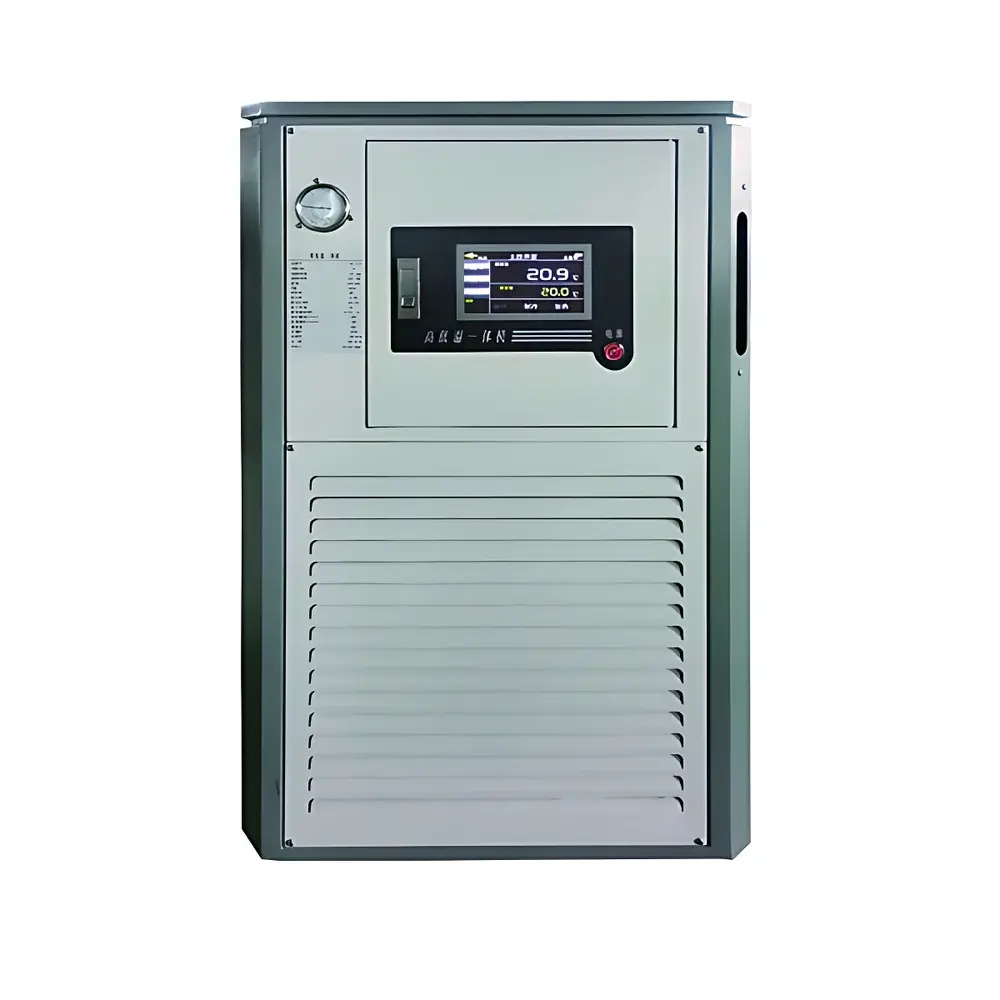
Hengping GDX-Series High-Low Temperature Circulating Bath
| Brand | Hengping |
|---|---|
| Origin | Shanghai, China |
| Model | GDX-Series |
| Instrument Type | Constant-Temperature Circulating Bath |
| Circulation Mode | Internal & External Closed-Loop |
| Temperature Control | Dual-mode (Heating & Refrigeration) |
| Bath Volume | 50 L |
| Temperature Range | -30 °C to +200 °C |
| Temperature Stability | Achieved via Sealed Circulation System |
| Display Resolution | 0.1 °C |
| Cooling Capacity | 900–10,500 W (model-dependent) |
| Heating Power | 6 kW |
| Pump Head | 35 m |
| Flow Rate | 12 L/min |
| Control Interface | Microprocessor-Based LCD Display |
| Safety Protections | Delayed Start, Leakage Detection, Overcurrent & Overtemperature Protection |
| Refrigeration Unit | OEM Industrial Compressor |
| Circulation Pump | Hermetically Sealed Magnetic Drive Pump |
| Total Power Consumption | 10 kW |
| Supply Voltage | 380 V AC, 50 Hz |
| Net Weight | 170 kg |
Overview
The Hengping GDX-Series High-Low Temperature Circulating Bath is an engineered thermal management system designed for precise, stable, and repeatable temperature control across a broad operational range—from cryogenic cooling at -30 °C to high-temperature operation up to +200 °C. Unlike open-bath or single-function units, the GDX-Series employs a fully sealed, closed-loop liquid circulation architecture. This design eliminates ambient contamination: no moisture absorption during low-temperature operation, and no volatile oil mist generation at elevated temperatures. The system integrates a thermally isolated expansion tank—mechanically connected but thermally decoupled—which maintains its internal medium below 60 °C regardless of process temperature extremes. This architecture ensures long-term fluid integrity, minimizes oxidation of heat transfer media (e.g., silicone oil or specialized synthetic fluids), and supports extended service intervals. Its primary engineering purpose is to serve as a reliable external thermal source/sink for jacketed laboratory equipment—including double-layer glass reactors, stainless-steel jacketed vessels, calorimeters, and material testing fixtures—where bidirectional thermal control and high thermal inertia stability are critical.
Key Features
- Fully sealed closed-loop circulation system with thermally isolated expansion reservoir
- Wide operating temperature span: -30 °C to +200 °C, enabling both cryogenic and high-temperature applications in a single platform
- High-capacity dual-mode thermal regulation: integrated industrial-grade compressor for refrigeration and 6 kW resistive heating element for rapid ramp-up
- Hermetically sealed magnetic-drive circulation pump (no shaft seals, zero leakage risk), rated for continuous duty at 12 L/min flow and 35 m head
- Microprocessor-based PID temperature controller with 0.1 °C display resolution and programmable ramp/soak profiles
- Comprehensive safety suite: overtemperature cutoff, ground-fault leakage detection, overcurrent protection, compressor delay logic, and thermal fuse redundancy
- Robust mechanical construction: stainless-steel fluid pathways, reinforced insulation, and 380 V three-phase power interface for stable industrial-grade operation
Sample Compatibility & Compliance
The GDX-Series is compatible with a wide range of externally jacketed laboratory apparatus, including but not limited to: glass-jacketed reaction vessels (1–100 L capacity), stainless-steel bioreactors with thermal jackets, rheological test cells requiring controlled boundary conditions, and materials characterization stages (e.g., DSC sample holders, tensile testing environmental chambers). Fluid compatibility depends on user-selected heat transfer medium—commonly silicone oil (for >100 °C), polyalkylene glycol (for -20 °C to 150 °C), or low-viscosity synthetic esters (for full -30 °C to 200 °C coverage). While the unit itself is not certified to ISO/IEC 17025 or ASTM E2877, its design principles align with GLP-compliant thermal control requirements when integrated into validated workflows. Temperature stability data (±0.2 °C typical under steady-state load) supports method validation per USP and ISO 17025 clause 5.4.2 for equipment used in regulated testing environments.
Software & Data Management
The GDX-Series operates via an embedded microcontroller with local LCD interface; no proprietary PC software is bundled. However, analog (0–10 V or 4–20 mA) and digital (RS485 Modbus RTU) output interfaces are provided for integration into centralized lab automation systems (e.g., LabVIEW, DeltaV, or custom SCADA). All critical operational parameters—including setpoint, actual bath temperature, pump status, compressor cycling, and fault logs—are timestamped and accessible via serial query. Audit-trail capability requires external logging; when connected to a 21 CFR Part 11-compliant data acquisition system, the unit supports electronic record retention, user access control, and change history tracking for GxP-aligned processes.
Applications
- Temperature-controlled synthesis in jacketed glass reactors under inert atmosphere
- Calibration of temperature-sensitive sensors (RTDs, thermocouples, IR cameras) across extended ranges
- Thermal cycling tests for polymer composites, adhesives, and battery electrolytes
- Stabilization of optical benches, interferometers, or laser diode mounts requiring sub-degree thermal drift control
- Pre-conditioning of samples prior to mechanical testing (tensile, impact, creep) per ASTM D638 or ISO 527
- Support of accelerated stability studies (ICH Q1A) for pharmaceutical formulations in jacketed stability chambers
FAQ
What heat transfer fluids are recommended for the full -30 °C to +200 °C range?
Synthetic polyol ester-based fluids (e.g., Mobiltherm 600 series or similar HTFs qualified per ASTM D6722) are recommended. Silicone oils may be used above 100 °C but exhibit excessive viscosity below -10 °C.
Can the GDX-Series supply external cooling to multiple devices simultaneously?
Yes—via external manifold configuration—but total flow demand must remain within 12 L/min and pressure drop across all branches must not exceed 35 m head. A flow-balancing valve kit is advised for multi-port setups.
Is the unit suitable for use in fume hoods or Class I biological safety cabinets?
No—the 380 V power requirement, compressor heat rejection, and lack of explosion-proof rating preclude installation in confined or hazardous ventilation environments.
Does the system support remote start/stop and setpoint adjustment via Ethernet or Wi-Fi?
Not natively. RS485 Modbus RTU is standard; Ethernet gateway integration requires third-party protocol converters compliant with Modbus TCP.
What maintenance intervals are recommended for compressor and pump subsystems?
Compressor oil and filter replacement every 3,000 operating hours; magnetic drive pump inspection annually or after 500 cycles below -20 °C.



