
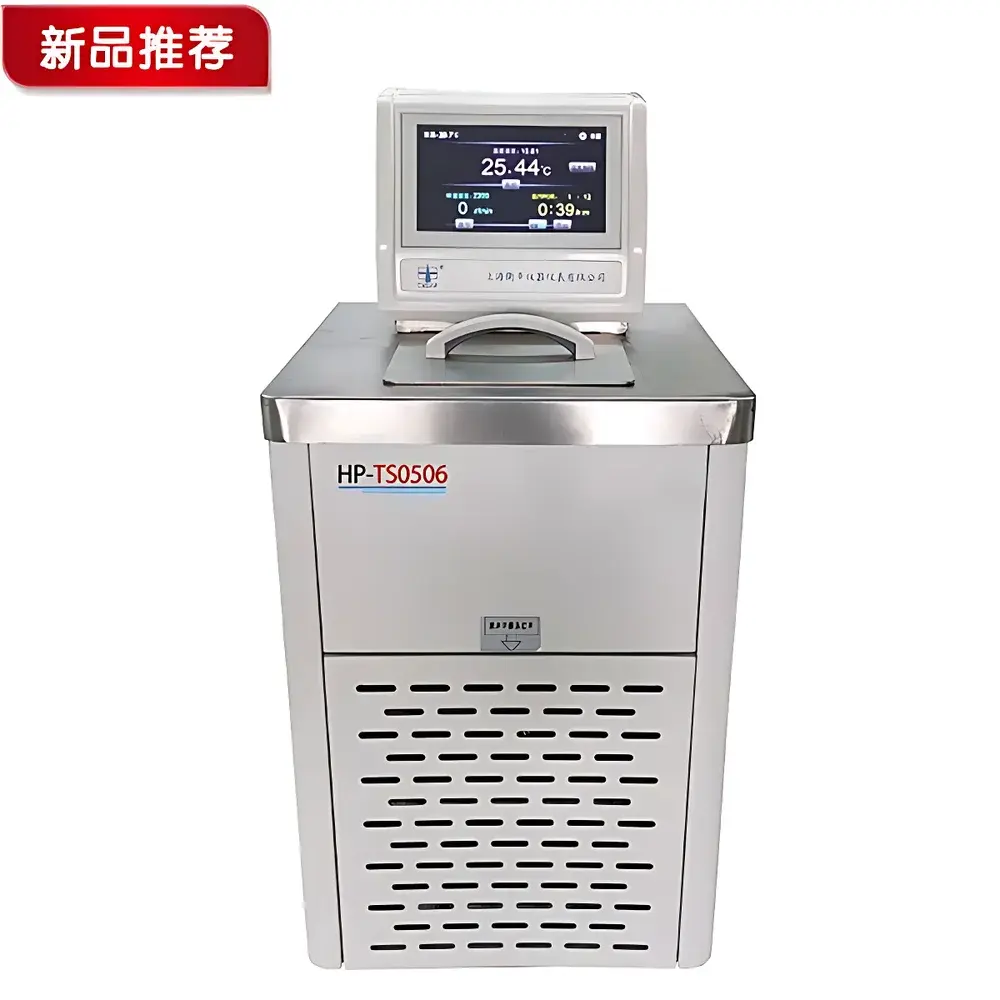
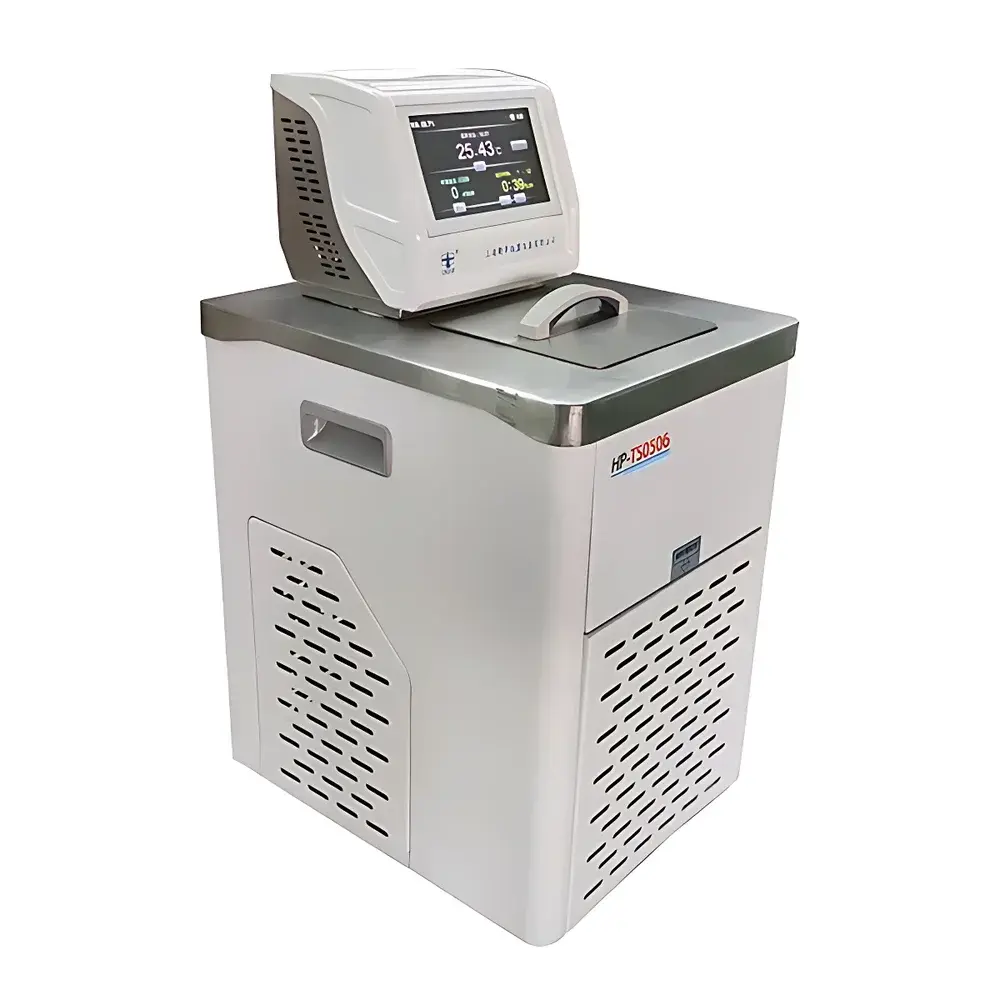
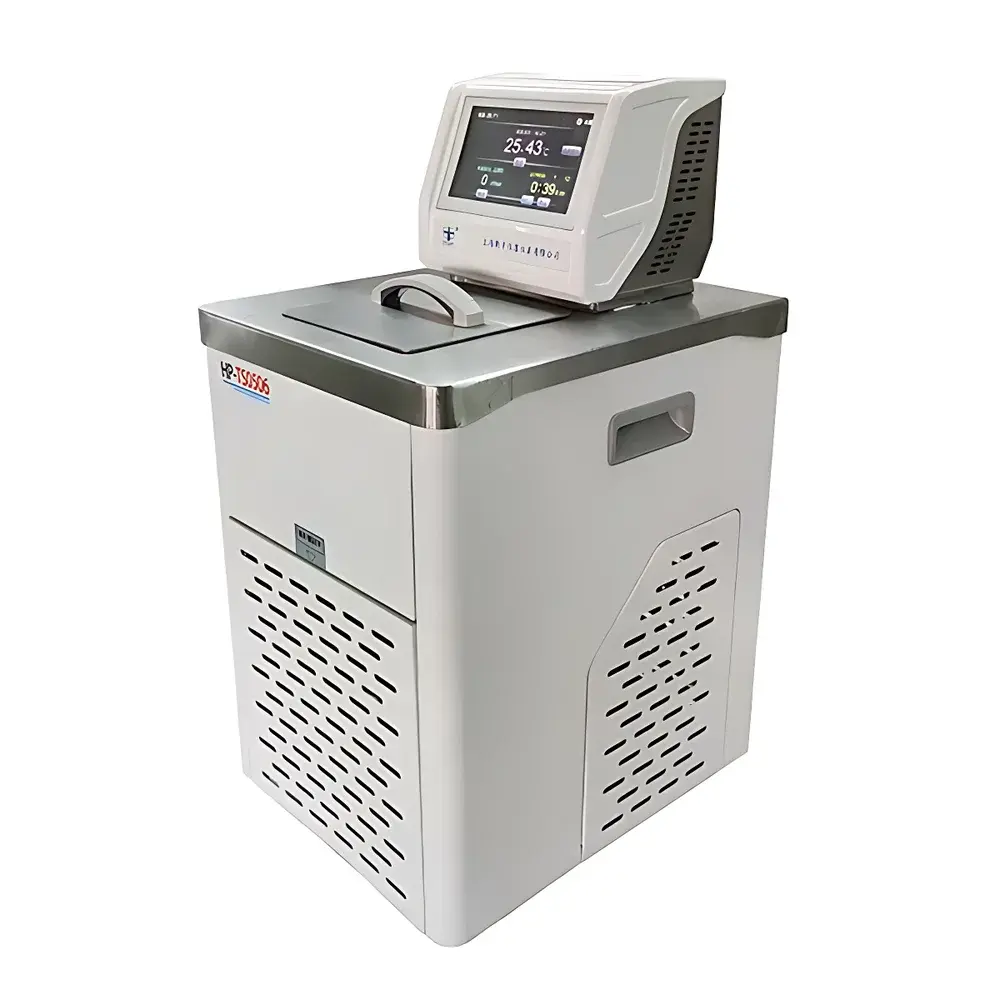
Hengping HP-TS0506 Vertical Cryogenic Circulating Thermostat
| Brand | Hengping |
|---|---|
| Origin | Shanghai, China |
| Model | HP-TS0506 |
| Instrument Type | Vertical |
| Temperature Stability | ±0.02 °C (at 25 °C, water or ethanol bath) |
| Bath Opening | 150 × 150 mm |
| Heating Power | 1.2 kW |
| Circulation Flow Rate | 10 L/min |
| Internal Dimensions (L×W×H) | 150 × 150 × 150 mm |
| External Dimensions (W×D×H) | 340 × 340 × 670 mm |
| Weight | Approx. 42 kg |
| Temperature Range | −5 °C to +100 °C |
| Display Resolution | 0.01 °C |
| Sensor | Pt100 Platinum Resistance Thermometer |
| Control Algorithm | Self-tuning PID |
| Cooling Method | Hermetic Compressor (Single-stage) |
| Circulation Mode | Internal & External Dual-loop |
| Compatible Media | Deionized water, ethanol, glycol-water mixtures, or low-temperature cryogenic fluids |
| Power Supply | 220 VAC ±10%, 50 Hz |
Overview
The Hengping HP-TS0506 Vertical Cryogenic Circulating Thermostat is a precision temperature control system engineered for laboratory environments requiring stable, uniform, and programmable thermal conditions across a wide operational range (−5 °C to +100 °C). It operates on the principle of active refrigeration combined with resistive heating and high-fidelity feedback control, utilizing a hermetically sealed compressor for efficient cooling and a 1.2 kW heating element for rapid thermal response. Temperature sensing is performed via a calibrated Pt100 platinum resistance thermometer—traceable to national standards—with 0.01 °C display resolution and real-time digital readout of both setpoint and actual bath temperature. The unit features dual-loop circulation (internal mixing and external recirculation), enabling precise thermal equilibration within the bath chamber and reliable temperature transfer to external apparatus such as spectrophotometer cells, reaction jackets, or material testing fixtures. Its stainless-steel 304 construction—including inner tank, top plate, and impeller—ensures chemical resistance, long-term dimensional stability, and compliance with GLP-aligned lab hygiene requirements.
Key Features
- Self-tuning PID temperature control algorithm ensures minimal overshoot and rapid convergence to target setpoints, with stability maintained at ±0.02 °C at 25 °C using water or ethanol as medium
- 7-inch capacitive touch LCD interface with intuitive menu navigation, dual-window digital display (setpoint and measured temperature), and real-time trend logging capability
- Dual-mode circulation pump (10 L/min flow rate) supports both internal homogenization and external temperature field extension via flexible tubing connections
- Integrated safety systems include low-level fluid detection, open-sensor alarm, over-temperature cutoff, and automatic compressor restart delay (≥15 min) to prevent mechanical stress
- Foldable side handles and compact vertical footprint (340 × 340 × 670 mm) facilitate safe relocation and space-efficient benchtop integration
- Full 304 stainless-steel wetted components ensure compatibility with aqueous, alcoholic, and mildly corrosive thermal media—validated per ASTM E2877-22 guidelines for liquid bath stability verification
Sample Compatibility & Compliance
The HP-TS0506 accommodates standard laboratory sample formats including immersion probes, cuvettes (up to 150 mm height), jacketed reactors, and sensor calibration fixtures. Its 6-liter working volume and 150 × 150 mm bath opening support multi-point sensor placement and modular accessory integration. The thermostat complies with IEC 61010-1:2010 for electrical safety in laboratory equipment and meets electromagnetic compatibility (EMC) requirements per EN 61326-1:2013. While not certified for ISO/IEC 17025 accreditation out-of-the-box, its documented temperature uniformity profile (±0.05 °C across bath volume, per internal validation protocol) supports traceable calibration workflows when used with NIST-traceable reference thermometers. For regulated environments, audit trails can be generated manually via screen capture or exported via optional RS232/USB interface (firmware v2.3+).
Software & Data Management
The embedded microcontroller supports time-stamped temperature logging at user-selectable intervals (1–60 s), storing up to 10,000 data points internally. Export is facilitated via USB flash drive (FAT32 formatted) in CSV format for post-processing in MATLAB, Python (NumPy/Pandas), or Excel. No proprietary software installation is required. For integration into automated test sequences, Modbus RTU protocol is available via optional RS485 expansion module (sold separately), enabling synchronization with PLC-controlled environmental chambers or LIMS platforms. All firmware updates are delivered as signed binary files with SHA-256 checksums to ensure integrity—consistent with FDA 21 CFR Part 11 principles for electronic records where local SOPs mandate version-controlled instrument software.
Applications
This thermostat serves as a primary temperature source in analytical, quality control, and research settings. Typical use cases include: viscosity calibration of rotational rheometers using standardized oil baths; thermal conditioning of optical components prior to interferometric measurement; stabilization of HPLC column ovens and detector cells; pre-conditioning of polymer samples for DSC or TMA analysis; enzymatic activity assays requiring strict thermal control; and accelerated aging studies of pharmaceutical formulations under controlled humidity-temperature profiles (when paired with environmental enclosures). Its −5 °C lower limit enables low-temperature kinetic studies without dry ice dependency, while its 100 °C upper bound supports solvent reflux simulations and thermal degradation screening.
FAQ
What thermal media are recommended for operation below 0 °C?
Ethanol (≥99.5% purity) or certified low-viscosity cryogenic heat transfer fluids are recommended. Avoid methanol due to volatility and toxicity concerns; never use tap water below 5 °C.
Is external circulation compatible with pressurized systems?
Yes—the pump delivers up to 0.2 bar static head; however, closed-loop external circuits must incorporate pressure relief and thermal expansion compensation per ASME B31.9 guidelines.
How often should maintenance be performed?
Compressor condenser coils require dust removal every 3 months in standard lab environments; annual inspection of refrigerant charge and Pt100 calibration is advised for GMP-critical applications.
Can the unit maintain stability during power fluctuations?
It incorporates line voltage regulation (220 VAC ±10%) and brownout recovery; sustained deviations beyond this range may trigger protective shutdown.
Does it support remote monitoring via Ethernet or Wi-Fi?
No native Ethernet/Wi-Fi interface is included; however, third-party IoT gateways with Modbus TCP bridging can be deployed using the RS485 option module.



