
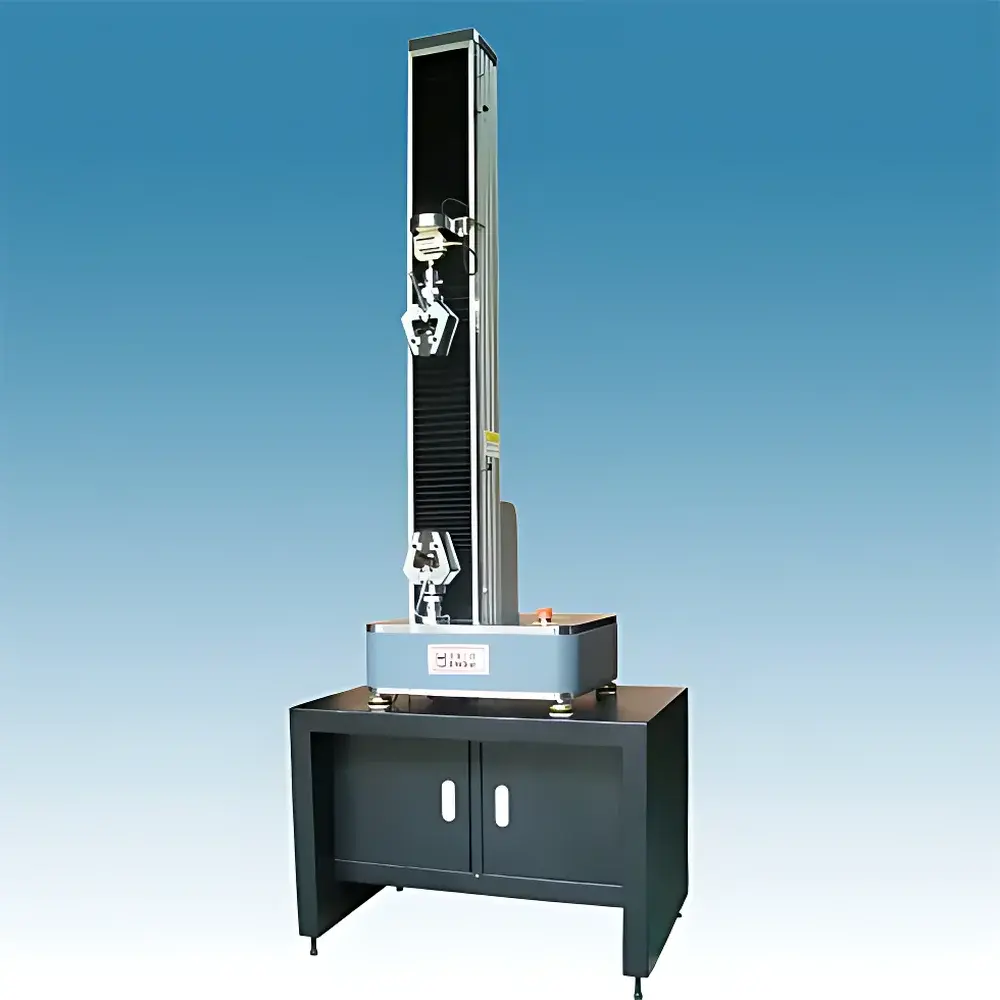
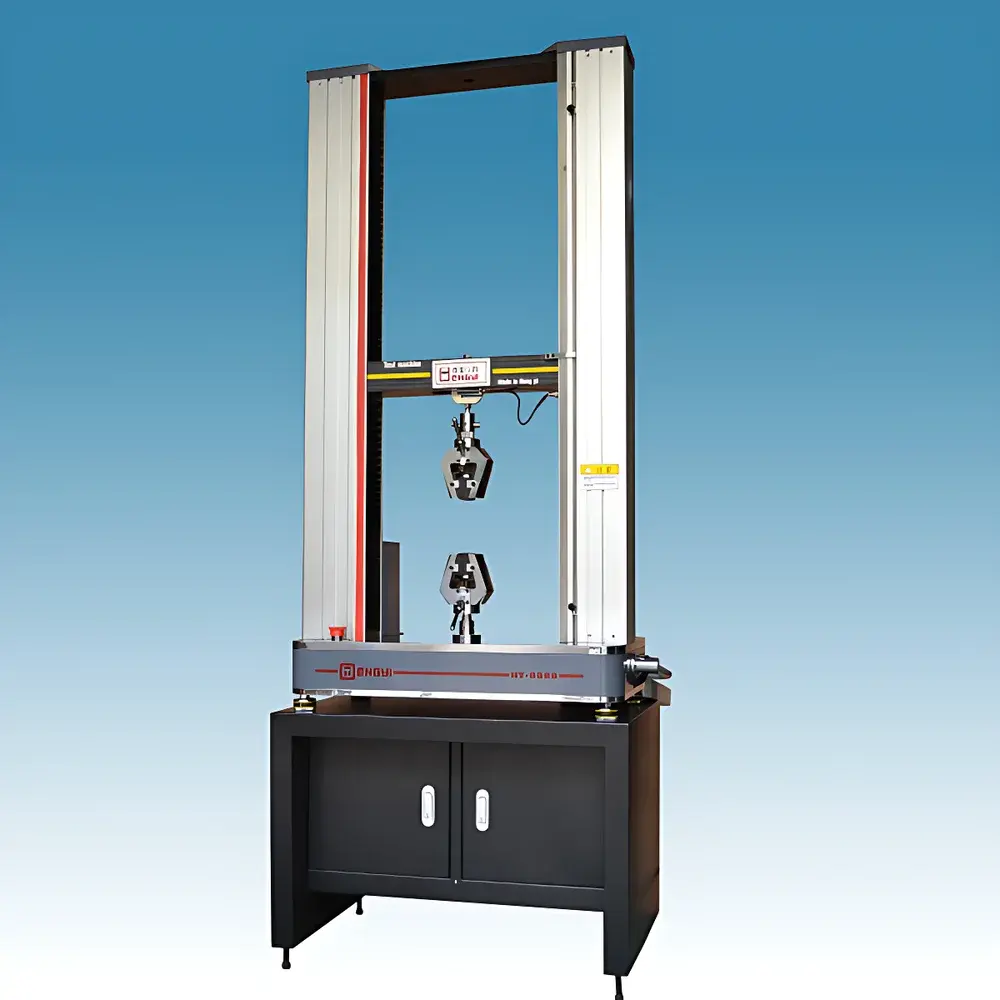
Hengyi Cardiovascular Biomaterials Universal Testing Machine HY-0580TBHBTG
| Brand | Hengyi |
|---|---|
| Origin | Shanghai, China |
| Manufacturer Type | Direct Manufacturer |
| Product Category | Domestic |
| Model | HY-0580TBHBTG |
| Instrument Type | Electromechanical Universal Testing Machine |
| Load Capacity Options | 5 N to 5000 N (selectable) |
| Force Accuracy Class | 0.5 |
| Effective Test Width | 120 mm |
| Effective Vertical Travel | 800 mm |
| Speed Range | 0.001–500 mm/min |
| Speed Accuracy | ±0.5% of indicated value |
| Displacement Measurement Accuracy | ±0.5% of indicated value |
| Strain Measurement Accuracy | ±0.5% of indicated value |
| Force Resolution | ±500,000 counts at full scale (no range switching) |
| Stress Control Rate Range | 0.005–6 %FS/S |
| Strain Control Rate Range | 0.002–6 %FS/S |
| Safety Features | Electronic limit protection, overload auto-stop (>110% FS), real-time system diagnostics |
| Power Supply | 220 V AC, 750 W |
| Dimensions (W×D×H) | 470 × 400 × 1510 mm |
| Weight | 100 kg |
| Compliance | GB/T 16491–2008, ISO 527, ASTM D638/D790/D3763, JIS K7113, EN 10002-1 |
Overview
The Hengyi Cardiovascular Biomaterials Universal Testing Machine HY-0580TBHBTG is an electromechanical universal testing system engineered for high-precision mechanical characterization of soft and hard biomaterials under static and quasi-static loading conditions. Based on closed-loop servo-controlled load, displacement, strain, and stress regulation, the system implements standardized tensile, compression, flexural, peel, tear, puncture, and relaxation protocols in accordance with ISO, ASTM, JIS, EN, and GB standards—including ISO 527 (plastics), ASTM D638 (tensile properties), ASTM D790 (flexural properties), ASTM F2100 (medical packaging), and GB/T 16491–2008 (electromechanical testing machines). Its modular architecture supports interchangeable fixtures—such as pneumatic grips, wedge clamps, three-point bending fixtures, suture holders, and micro-tensile jigs—enabling reproducible evaluation of specimens ranging from sub-millimeter hydrogels and collagen membranes to rigid metallic stents and polymer scaffolds. Designed specifically for cardiovascular and implantable biomaterial R&D, the HY-0580TBHBTG delivers traceable force resolution down to 0.001 N (at 5 N capacity) and sub-micron displacement repeatability, critical for quantifying viscoelastic behavior, yield onset, hysteresis, and time-dependent deformation in compliant biological tissues.
Key Features
- Four independent closed-loop control modes: load, displacement, strain, and stress—with automatic mode switching during multi-stage tests
- High-resolution force measurement: ±500,000 internal counts, no range switching, constant resolution across full capacity (5 N to 5000 N)
- Ultra-wide speed range: 0.001–500 mm/min, programmable in 0.001 mm/min increments, with ±0.5% speed accuracy
- Integrated electronic safety system: dual-axis limit switches, overload cut-off (>110% FS), real-time diagnostics for drive, sensor, and power subsystems
- Ergonomic alloy-frame construction with dual-layer baked enamel finish—optimized for rigidity, thermal stability, and long-term calibration retention
- Motorized crosshead with dual-speed actuation (fast jog + precision positioning) and programmable return-to-start functionality
- Compliance with GLP/GMP data integrity requirements: audit-trail enabled test logs, user-access controls, and timestamped raw data export (CSV, XML, PDF)
Sample Compatibility & Compliance
The HY-0580TBHBTG accommodates a broad spectrum of specimen geometries and mechanical classes relevant to cardiovascular and regenerative medicine research. Validated applications include uniaxial tensile testing of native and decellularized vascular tissues (e.g., aorta, vena cava), cyclic fatigue of nitinol stents, suture pull-out strength per ASTM D6828, hydrogel compressive modulus per ISO 11499, and peel adhesion of medical-grade pressure-sensitive adhesives (PSAs) per ASTM D903. The system meets regulatory expectations for preclinical device evaluation: it supports FDA 21 CFR Part 11-compliant data acquisition when paired with validated software modules, and its mechanical performance is certified against GB/T 16491–2008, ensuring metrological traceability to national standards. Fixture compatibility extends to custom-designed grips for fragile specimens (e.g., 200 µm-thick electrospun nanofibers), low-force elastomeric films (<100 kPa modulus), and miniature orthopedic implants requiring <1 N preload stabilization.
Software & Data Management
The embedded Windows-based control and analysis suite provides ISO/IEC 17025-aligned test sequencing, real-time curve overlay, and automated parameter extraction—including ultimate tensile strength (UTS), Young’s modulus, yield point (0.2% offset), elongation at break, fracture toughness (via J-integral approximation), and hysteresis area. All raw analog signals (load cell, encoder, extensometer) are acquired at ≥1 kHz sampling rate with hardware-triggered synchronization. Data files embed metadata such as operator ID, calibration certificate number, environmental temperature/humidity (optional sensor input), and test standard reference. Export formats include CSV (for MATLAB/Python post-processing), XML (for LIMS integration), and PDF reports with embedded digital signatures and revision-controlled templates. Software validation documentation (IQ/OQ/PQ protocols) and 21 CFR Part 11 configuration packages are available upon request for regulated laboratories.
Applications
- Mechanical phenotyping of native and engineered cardiovascular tissues: tensile strength, anisotropy ratio, toe-region stiffness, and stress-relaxation kinetics
- Regulatory submission support for ISO 10993-12 biocompatibility assessments via mechanical preconditioning protocols
- Quality control of medical device components: balloon catheter burst pressure, guidewire torsional rigidity, filter mesh tensile integrity
- Development of bioresorbable polymers: degradation-correlated modulus loss tracking over accelerated aging cycles
- Validation of additive-manufactured porous scaffolds: compressive yield strength, elastic recovery, and strut-level failure mapping
- Standardized testing of surgical meshes per ISO 19216 and ASTM D6828 for suture retention strength
FAQ
What standards does the HY-0580TBHBTG support for cardiovascular biomaterial testing?
It natively supports GB/T 16491–2008, ISO 527, ASTM D638/D790/D3763/D6828, JIS K7113, and EN 10002-1. Custom test methods can be programmed using the script editor.
Can the system perform cyclic fatigue testing on stent-like structures?
Yes—when equipped with optional high-frequency load cell and dynamic grip assemblies, it supports low-cycle fatigue (LCF) up to 5 Hz with force-controlled waveform generation (sinusoidal, trapezoidal, ramp-hold profiles).
Is extensometer integration supported for strain measurement?
Yes—the system accepts both contact-type clip-on extensometers (ASTM E83 Class B-1) and non-contact video extensometry (via optional HD camera module with edge-detection algorithm).
Does the software meet FDA 21 CFR Part 11 requirements?
Out-of-the-box, it provides audit trail, electronic signature, and role-based access control; full Part 11 compliance requires site-specific validation and documented configuration management.
What is the minimum measurable force at the 5 N capacity setting?
With 500,000-count resolution and 0.5% accuracy class, the system resolves forces down to 0.00001 N (10 µN) with repeatability ≤0.1% RSD under controlled lab conditions.



