
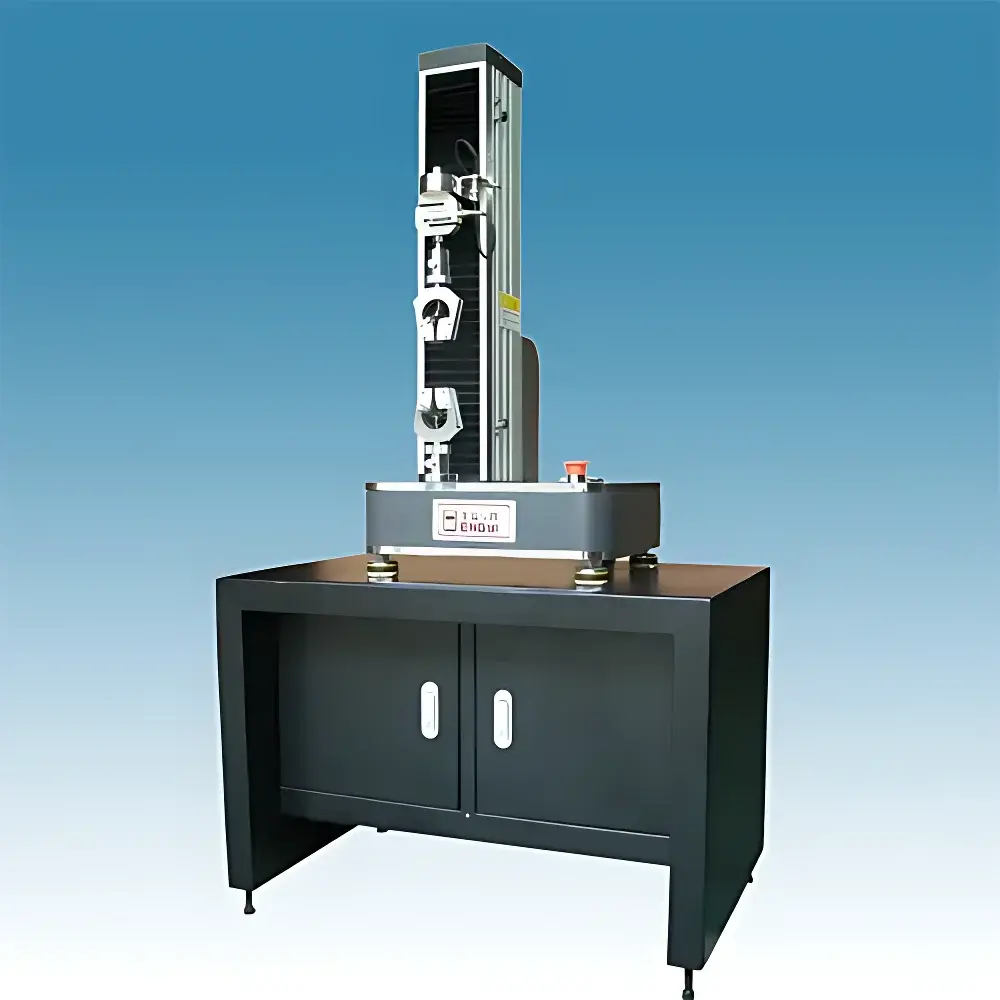
Hengyi HY-0230VB Compact Universal Testing Machine
| Brand | Hengyi |
|---|---|
| Origin | Shanghai, China |
| Manufacturer Type | Direct Manufacturer |
| Instrument Type | Electromechanical Universal Testing Machine |
| Model | HY-0230VB |
| Load Capacity Options | 1 N to 2000 N (interchangeable load cells) |
| Force Accuracy | ≤0.5% of reading |
| Force Resolution | ±500,000 counts (full-scale, no range switching) |
| Effective Test Width | 120 mm |
| Effective Vertical Travel | 300 mm |
| Speed Range | 0.001–300 mm/min (adjustable, ±0.5% speed accuracy) |
| Displacement & Strain Measurement Accuracy | ±0.5% of reading |
| Stress/Strain Control Rate Range | 0.002–6% FS/s |
| Constant-Load/Displacement/Deformation Control Range | 0.5–100% FS |
| Power Supply | 220 V AC, 200 W |
| Net Weight | 40 kg |
| Dimensions (W×D×H) | 430 × 315 × 855 mm |
Overview
The Hengyi HY-0230VB Compact Universal Testing Machine is an electromechanical static testing system engineered for precision mechanical property characterization of low-to-medium force-range materials. Based on the fundamental principles of uniaxial tensile and compressive loading under controlled displacement or force actuation, it operates in accordance with standardized test methodologies defined in ISO 527, ASTM D638, ASTM D790, ASTM D3410, ISO 178, ISO 6892-1, and GB/T 228.1. Its rigid single-column architecture, coupled with high-stiffness preloaded ball screws and a bidirectional load cell, ensures minimal frame compliance and high reproducibility across repeated measurements. Designed for laboratories with space constraints and diverse material portfolios—from thin films and biomedical polymers to fine metallic wires and photovoltaic interconnects—the HY-0230VB delivers traceable, GLP-compliant mechanical data without requiring dedicated floor space or hydraulic infrastructure.
Key Features
- Single-column, high-rigidity structural frame optimized for dimensional stability and minimal deflection during load application;
- High-performance Panasonic servo motor and digital drive system—maintenance-free, low-noise, and thermally stable;
- Precision preloaded recirculating ball screw with imported linear guidance for smooth, backlash-free motion transmission;
- U.S.-sourced bidirectional load cell with automatic transducer recognition and integrated temperature compensation (±0.5% accuracy, full-scale resolution up to 500,000 counts);
- Dual-mode controller supporting both open-loop speed control and closed-loop stress/strain/force regulation, with multi-language UI (English, German, French, Spanish, Chinese) and unit conversion (N, kN, lbf, MPa, psi, %, mm, inch);
- Handheld remote control unit enabling intuitive jog operation, emergency stop, and real-time parameter adjustment without PC dependency;
- Integrated electronic limit protection, overload cut-off (110% FS), and self-diagnostic routines for drive, sensor, and power subsystems;
- Programmable test termination criteria—including preset load, displacement, strain, or time—with auto-return functionality and configurable dwell periods.
Sample Compatibility & Compliance
The HY-0230VB accommodates specimens ranging from sub-millimeter filaments to standard ASTM/ISO-compliant coupons. Typical applications span polymer films (PET, PE, PP), elastomers, thin metal foils (Cu, Al), photovoltaic ribbons, biomedical sutures, hydrogels, paperboard, adhesives, foam cores, and composite laminates. Optional accessories—including pneumatic grips, wedge-action clamps, three/four-point bending fixtures, peel & tear fixtures, compression platens, and T-slot test tables—enable full alignment with ISO 1133, ASTM D882, ASTM D624, ISO 1421, and USP requirements. All configurations support audit-ready data capture per FDA 21 CFR Part 11 when paired with compliant software (e.g., Bluehill 3, TestXpert II, or custom OEM interface).
Software & Data Management
The system interfaces seamlessly with industry-standard testing software platforms via USB or RS-232, supporting real-time graphing of stress–strain, load–displacement, and creep/recovery curves. Raw data exports are provided in CSV, Excel, and XML formats with embedded metadata (operator ID, timestamp, calibration certificate ID, environmental conditions). Built-in statistical tools calculate modulus (E), yield strength (Rp0.2), ultimate tensile strength (UTS), elongation at break (%Eb), secant modulus, and tangent modulus—all traceable to NIST-traceable reference standards. Software-generated reports include pass/fail flags against user-defined specification limits and optional digital signature workflows compliant with ISO/IEC 17025 documentation requirements.
Applications
- Quality assurance of flexible packaging films and barrier layers in food/pharma manufacturing;
- Mechanical validation of battery electrode coatings, separator membranes, and current collector foils;
- Characterization of orthopedic suture tensile integrity and biodegradable polymer degradation kinetics;
- R&D evaluation of nanocomposite reinforcement efficiency under monotonic and cyclic loading;
- Process optimization of hot-melt adhesive bond strength and peel resistance in automotive assembly;
- Compliance testing of medical device components per ISO 10993-12 and ASTM F2129;
- Educational labs conducting hands-on mechanics of materials experiments with repeatable, low-risk instrumentation.
FAQ
What is the maximum allowable specimen thickness for compression testing?
The effective test space allows up to 300 mm vertical travel; however, practical compression height is limited by fixture geometry and buckling constraints—typically ≤50 mm for standard cylindrical specimens.
Can the system perform cyclic fatigue tests?
Yes—when equipped with appropriate software and configured for displacement or load control, it supports sinusoidal, triangular, or trapezoidal waveforms up to 5 Hz (dependent on mass and stiffness of test setup).
Is third-party calibration certification included?
A factory calibration report is supplied with each unit; optional Shanghai Metrology Institute (SMI)-issued verification certificates are available upon request and subject to additional lead time.
Does the controller support analog output for external DAQ systems?
Yes—standard 0–10 V analog outputs are provided for force, displacement, and strain signals, fully isolated and scaled per user configuration.
What safety certifications does the instrument meet?
Complies with IEC 61000-6-2 (EMC immunity) and IEC 61000-6-4 (EMC emission); CE marking applied per Machinery Directive 2006/42/EC and Low Voltage Directive 2014/35/EU.



