
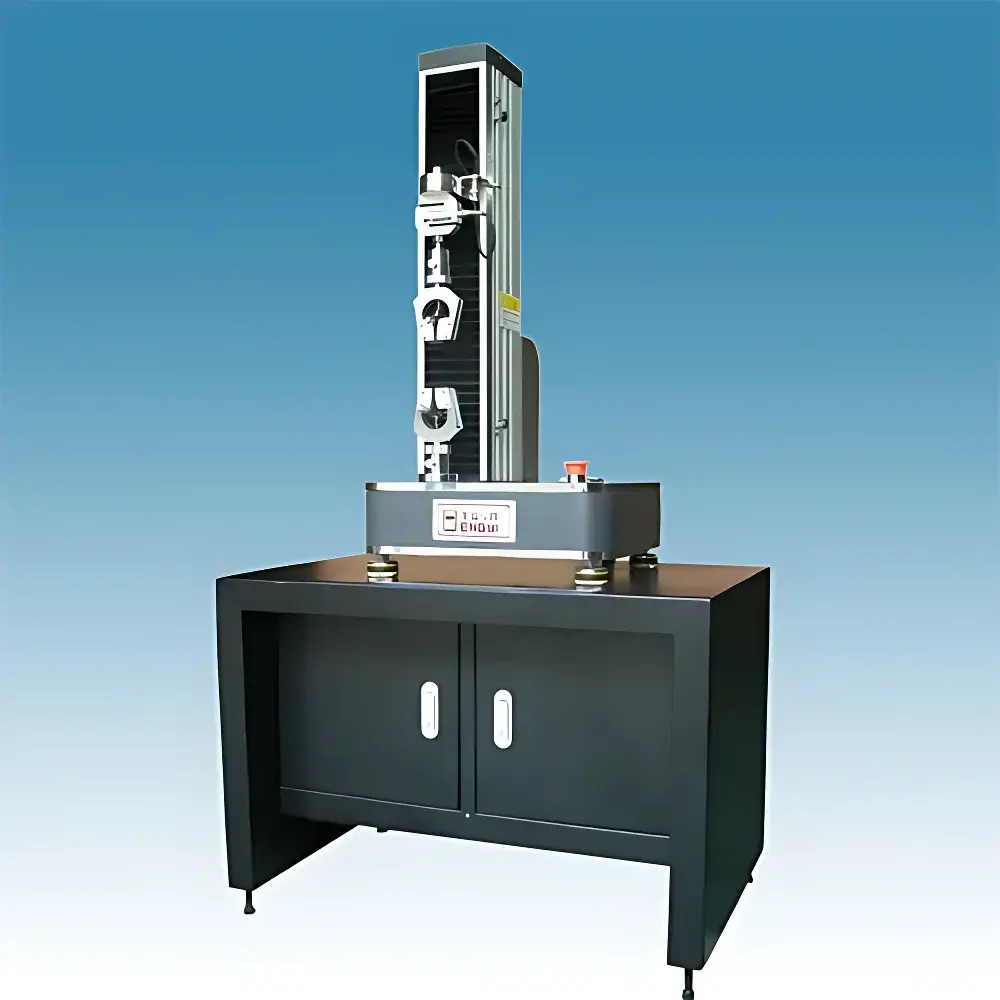
Hengyi HY-0230WX Micro Universal Testing Machine
| Brand | Hengyi |
|---|---|
| Origin | Shanghai, China |
| Manufacturer Type | Direct Manufacturer |
| Product Category | Domestic |
| Model | HY-0230WX |
| Instrument Type | Electromechanical Universal Testing Machine |
| Load Capacity Options | 1 N to 2000 N (multi-sensor configurable) |
| Force Accuracy | ≤0.5% of reading |
| Effective Test Width | 120 mm |
| Vertical Test Space | 300 mm |
| Speed Range | 0.001–300 mm/min (adjustable) |
| Speed Accuracy | ±0.5% of set value |
| Displacement & Strain Measurement Accuracy | ±0.5% of reading |
| Control Modes | Stress, strain, and displacement control |
| Power Supply | 220 V AC, single-phase, 200 W |
| Net Weight | 40 kg |
| Dimensions (W×D×H) | 430 × 315 × 855 mm |
Overview
The Hengyi HY-0230WX Micro Universal Testing Machine is a compact, high-stiffness, single-column electromechanical system engineered for precise static mechanical characterization of low-to-medium force-range specimens. It operates on the principle of controlled axial loading—applying tensile, compressive, flexural, shear, peel, tear, or cyclic loads under programmable displacement, force, or strain rate conditions. Designed for laboratories with space constraints yet demanding metrological integrity, the HY-0230WX delivers traceable mechanical property data in compliance with international test standards including ISO 527, ISO 6892-1, ASTM D638, ASTM D790, ASTM D3039, ISO 179, and ISO 1133. Its modular architecture supports seamless integration into quality control workflows across R&D, production QA, and regulatory submission environments.
Key Features
- Single-column structural frame with high rigidity and minimal deflection—optimized for sub-kN force fidelity and long-term dimensional stability.
- Panasonic servo motor and driver system (Japan-sourced), maintenance-free and rated for >10,000 hours of continuous operation under rated load.
- Precision preloaded ball screw (imported), providing smooth motion transmission and eliminating backlash during bidirectional testing.
- High-accuracy dual-range load cell (U.S.-sourced), capable of bidirectional force measurement with automatic sensor recognition and auto-zeroing calibration routines.
- Digital controller supporting open-loop and closed-loop control modes; configurable for multiple languages (English, German, French, Spanish, Chinese) and unit systems (N, lbf, kgf, MPa, psi).
- Ergonomic handheld remote control enabling rapid jog, start/stop, and emergency halt—ideal for benchtop operation and operator safety.
- Integrated electronic limit protection, overload cutoff (>110% FS), real-time self-diagnostic monitoring of drive voltage/current, load cell output, and encoder feedback.
Sample Compatibility & Compliance
The HY-0230WX accommodates a broad spectrum of miniature and thin-section specimens without requiring major hardware reconfiguration. Typical applications include mechanical evaluation of polymer films (e.g., PET, PE, PP), elastomeric strips, fine metallic wires (<0.5 mm diameter), photovoltaic interconnect ribbons, battery tab foils (Cu/Al), biomedical sutures, hydrogels, pharmaceutical tablet coatings, paperboard laminates, adhesive tapes, foam density gradients, and composite prepreg coupons. All test fixtures—including tensile grips, compression platens, 3-/4-point bend assemblies, peel blocks, and shear fixtures—are designed to ISO 204 and ASTM E8/E9 alignment tolerances. Optional extensometers (contact and non-contact) and large-strain transducers enable full stress–strain curve capture per ISO 527-2 and ASTM D638 Annex A2 requirements. The system is compatible with GLP/GMP documentation protocols when paired with validated software and audit-trail-enabled controllers.
Software & Data Management
Control and analysis are performed via Hengyi’s proprietary WinTest Suite v4.x—a Windows-based application compliant with FDA 21 CFR Part 11 requirements when deployed with user role management, electronic signatures, and immutable audit trails. The software supports real-time plotting of force–displacement, stress–strain, and modulus vs. time curves; automatic calculation of Young’s modulus (E), yield strength (Rp0.2), ultimate tensile strength (UTS), elongation at break (%EB), secant modulus, and tangent modulus. Raw data export is available in CSV, Excel (.xlsx), and universal .txt formats. Batch testing templates allow standardized method recall across shifts and operators. Calibration certificates—including traceability to CNAS-accredited national standards—are generated automatically upon completion of sensor verification procedures.
Applications
- Thin-film mechanical integrity assessment in flexible electronics and packaging R&D
- Tensile strength validation of medical device components (catheter tubing, suture threads)
- Compression modulus mapping of soft biomaterials and hydrogel scaffolds
- Peel adhesion quantification for pressure-sensitive adhesives and laminated pouches
- Bending stiffness evaluation of PCB substrates and solar cell encapsulants
- Cyclic fatigue characterization of shape-memory alloys and elastomeric connectors
- Quality conformance testing per IEC 61215 (photovoltaic module qualification)
FAQ
What is the maximum allowable specimen thickness for compression testing?
The effective vertical test space is 300 mm; however, compression platen clearance limits practical specimen height to ≤280 mm when using standard 25 mm-diameter platens.
Can the system be integrated with third-party LIMS or MES platforms?
Yes—WinTest Suite supports OPC UA and TCP/IP communication protocols for bi-directional data exchange with laboratory information management systems (LIMS) and manufacturing execution systems (MES). Custom API development is available upon request.
Is the load cell calibrated and certified prior to shipment?
Each unit ships with a factory calibration report traceable to NIM (National Institute of Metrology, China); optional CNAS-accredited calibration certificate is available as an add-on service.
Does the controller support strain-controlled ramp-hold testing?
Yes—the system implements closed-loop strain rate control per ISO 6892-1 Annex C, with programmable hold segments and automatic transition between ramp and dwell phases.
What maintenance intervals are recommended for the servo drive and ball screw?
No scheduled lubrication or mechanical servicing is required for the Panasonic servo system or preloaded ball screw within the first 5 years or 10,000 test cycles, assuming ambient laboratory conditions (23 ± 5 °C, RH < 70%).



