
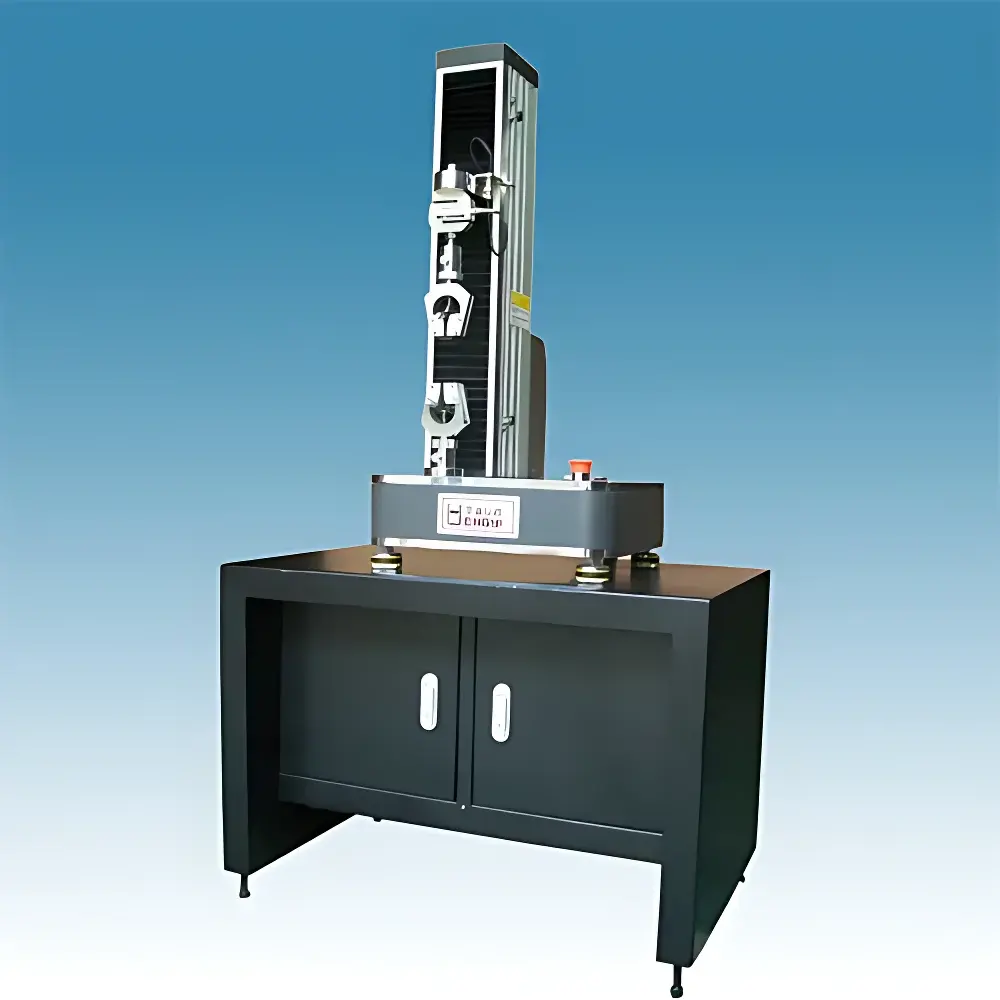
Hengyi HY-0350SM Graphene Fiber Tensile Testing Machine
| Brand | Hengyi |
|---|---|
| Origin | Shanghai, China |
| Manufacturer Type | Direct Manufacturer |
| Product Category | Domestic |
| Model | HY-0350SM |
| Instrument Type | Electromechanical Universal Testing Machine |
| Load Capacity Options | 1 N to 3000 N (multi-sensor configurable) |
| Accuracy Class | ≤0.5% |
| Effective Test Width | 120 mm |
| Effective Stroke | 500 mm |
| Speed Range | 0.001–500 mm/min |
| Speed Accuracy | ±0.5% of indicated value |
| Displacement & Strain Measurement Accuracy | ±0.5% of indicated value |
| Force Resolution | ±500,000 counts (full-scale, no range switching) |
| Power Supply | 220 V AC, 400 W |
| Weight | 75 kg |
| Dimensions (W×D×H) | 440 × 380 × 1100 mm |
Overview
The Hengyi HY-0350SM Graphene Fiber Tensile Testing Machine is a precision-engineered electromechanical universal testing system designed for high-resolution mechanical characterization of ultra-thin, high-strength fibrous materials—including graphene-based fibers, carbon nanotube yarns, electrospun polymers, and advanced composite filaments. Built upon a rigid single-column load frame architecture, it implements quasi-static uniaxial loading in tension, compression, peel, tear, and flexural modes per ASTM D638, ISO 527, ISO 179, ISO 1133, and GB/T 1040 series standards. Its core measurement principle relies on closed-loop servo-controlled displacement actuation coupled with bidirectional high-fidelity load transduction, enabling traceable force quantification from sub-newton (1 N) to 3 kN levels with ≤0.5% uncertainty across the full dynamic range. The system is optimized for micro-scale specimen handling—supporting gauge lengths as short as 5 mm and cross-sectional areas down to <10 µm²—making it particularly suited for R&D laboratories evaluating next-generation conductive, lightweight, or multifunctional fibers where conventional macro-scale testers lack resolution and stability.
Key Features
- Rigid single-column structural frame with preloaded high-precision ground ball screw (imported) and integrated anti-backlash design for minimal axial deflection under load.
- Industrial-grade Panasonic AC servo motor and digital drive system—maintenance-free, low-noise, and thermally stable for long-duration creep and relaxation tests.
- U.S.-sourced bidirectional load cell with automatic sensor recognition and thermal compensation; calibrated to ISO/IEC 17025-accredited standards.
- Dual-mode controller supporting both open-loop speed control and closed-loop stress/strain/displacement rate regulation, with real-time PID tuning capability.
- Multi-language (English, German, French, Spanish, Chinese) and multi-unit (N, lbf, kgf, MPa, psi) interface; compliant with GLP audit trail requirements for data integrity.
- Ergonomic handheld remote control for rapid jog positioning, emergency stop activation, and test initiation without PC dependency.
- Integrated electronic limit switches, overload protection (110% FS), and self-diagnostic routines for drive voltage, current, temperature, and sensor signal integrity.
Sample Compatibility & Compliance
The HY-0350SM accommodates specimens ranging from brittle monofilaments (<20 µm diameter) to ductile metallic ribbons (up to 10 mm wide), including but not limited to: graphene oxide fibers, reduced graphene oxide (rGO) yarns, PBO and aramid microfilaments, biomedical sutures, hydrogel threads, PVDF piezoelectric fibers, and metallized polymer foils. Standard夹具 (fixtures) include pneumatic tensile grips, wedge-action compression platens, 3-point bending fixtures (span adjustable 10–100 mm), peel adhesion jigs (90°/180°), and shear fixtures conforming to ASTM D1002. Optional accessories include video extensometry (for non-contact strain mapping), environmental chambers (−40 °C to +200 °C), and humidity-controlled enclosures. All hardware and firmware comply with CE Machinery Directive 2006/42/EC, EMC Directive 2014/30/EU, and support FDA 21 CFR Part 11-compliant electronic signatures when paired with validated software modules.
Software & Data Management
The system operates with Hengyi TestSuite v4.2—a Windows-based, modular application certified for ISO 17025 traceability workflows. It provides real-time plotting of stress–strain, load–displacement, and creep compliance curves; automated calculation of Young’s modulus, yield point (0.2% offset), ultimate tensile strength (UTS), elongation at break, and toughness (area under curve). Raw data export is supported in CSV, XML, and HDF5 formats; metadata embedding includes operator ID, calibration certificate ID, environmental conditions (optional sensor input), and instrument configuration logs. Audit trails record all parameter changes, test aborts, and manual interventions with timestamp, user login, and IP address. Optional validation packages include IQ/OQ documentation, GAMP 5-aligned risk assessments, and 21 CFR Part 11 compliance kits (electronic signature, role-based access control, immutable archive).
Applications
- Quantitative tensile evaluation of graphene fiber batches for quality control in pilot-scale production lines.
- Mechanical screening of functionalized carbon nanomaterials under controlled humidity and temperature gradients.
- Interfacial adhesion strength measurement between graphene-coated substrates and polymer matrices (peel & shear).
- Creep and stress-relaxation behavior analysis of biodegradable electrospun scaffolds for tissue engineering.
- Standardized mechanical certification of photovoltaic interconnect ribbons (e.g., copper-tinned solar weld tapes) per IEC 61215.
- Fatigue life assessment of micro-scale metallic springs and MEMS-compatible thin films using programmable cyclic loading profiles.
- Validation of ASTM D3822 (Single-Filament Tensile Properties of Textile Fibers) and ISO 11566 (Determination of Breaking Force of Single Filaments).
FAQ
What is the minimum measurable force resolution for graphene fiber testing?
The system achieves force resolution of ≤0.002 N (0.2 mN) at the 1 N load cell setting, enabled by 500,000-count A/D conversion and noise-rejecting signal conditioning.
Can the HY-0350SM be integrated into an automated lab environment?
Yes—it supports TCP/IP and RS-232 communication protocols, SCPI command set, and LabVIEW™ driver libraries for seamless integration with LIMS, MES, or robotic sample handlers.
Is third-party calibration and metrological traceability available?
All standard load cells ship with NIST-traceable calibration certificates; optional on-site recalibration services are provided by CNAS-accredited partners in APAC and EU regions.
Does the system meet regulatory requirements for pharmaceutical or medical device testing?
When configured with Part 11-compliant software, audit trail logging, and qualified accessories, it satisfies GMP Annex 11 and USP requirements for material qualification in regulated environments.
What safety certifications does the mechanical frame carry?
The frame complies with EN ISO 13857 (safety distances) and EN 60204-1 (electrical equipment of machines); CE marking is affixed following full conformity assessment by TÜV Rheinland.
Related Products



