
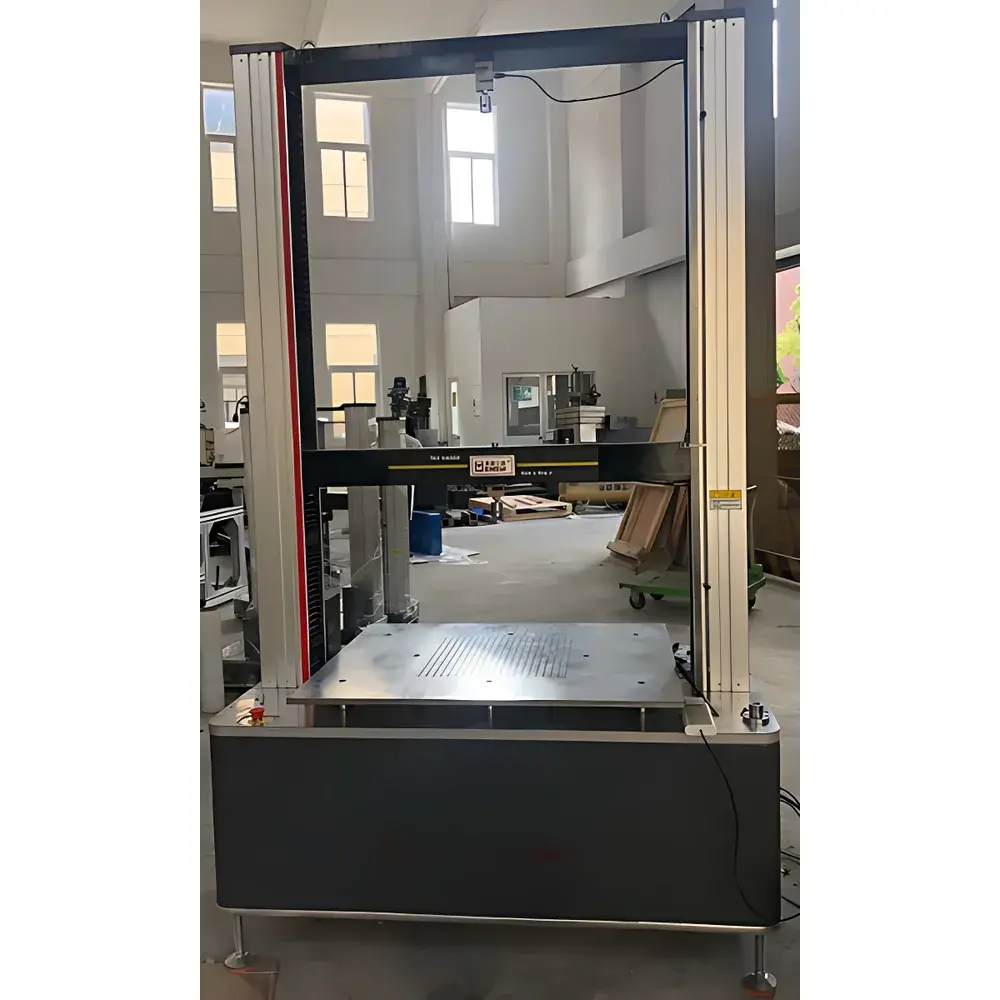
Hengyi HY-0580TYRT Dual-Arm Automotive Seat Foam Indentation Hardness Tester
| Brand | Hengyi |
|---|---|
| Origin | Shanghai, China |
| Manufacturer Type | Direct Manufacturer |
| Country of Origin | China |
| Model | HY-0580TYRT |
| Instrument Type | Electromechanical Universal Testing Machine |
| Load Capacity | 5000 N |
| Accuracy Class | 0.5 |
| Effective Test Width | 380 mm (expandable) |
| Effective Test Height | 800 mm |
| Speed Range | 0.001–500 mm/min |
| Speed Accuracy | ±0.5% of reading |
| Force Resolution | ±500,000 counts at full scale (5000 N), no range switching |
| Force Measurement Range | 0.1–99.999% of full scale |
| Displacement & Strain Accuracy | ±0.5% of reading |
| Stress/Strain Control Range | 0.002–6% FS/s |
| Overload Protection | +10% of full scale |
| Power Supply | 220 V AC, 750 W |
| Net Weight | 120 kg (frame), 208 kg (total system) |
| Dimensions (W×D×H) | 680 × 400 × 1420 mm |
Overview
The Hengyi HY-0580TYRT Dual-Arm Automotive Seat Foam Indentation Hardness Tester is a precision-engineered electromechanical universal testing machine designed specifically for standardized indentation hardness evaluation of polyurethane and viscoelastic foams used in automotive seating systems. It operates on the principle of controlled quasi-static compression, applying a defined force or displacement to a foam specimen under ISO 2439, ASTM D3574, JIS K6400, and QC/T 566-compliant test protocols. Unlike general-purpose tensile testers, the HY-0580TYRT integrates dual-arm mechanical architecture and dedicated indentation fixtures—such as the 38 mm and 100 mm diameter indenters—to ensure repeatable, geometry-specific load application conforming to seat cushion indentation resistance (IR) and support stiffness requirements. Its closed-loop servo control system enables high-fidelity force, displacement, and strain synchronization with sub-millisecond data acquisition, supporting both single-cycle indentation and multi-cycle fatigue profiling up to low-frequency regimes (0.01–5 Hz). The system meets structural and metrological requirements for GLP-compliant materials laboratories engaged in Tier 1 supplier qualification, OEM validation, and regulatory conformance reporting.
Key Features
- Dual-arm rigid frame construction with preloaded ball screws and high-stiffness crosshead guidance—engineered to minimize lateral deflection and maintain alignment during indentation up to 5000 N.
- Force measurement system calibrated to Class 0.5 accuracy per ISO 7500-1, featuring a single-range, 500,000-count resolution load cell with no auto-ranging artifacts across the full 0.1–100% FS span.
- Programmable speed control from 0.001 to 500 mm/min, with real-time feedback regulation ensuring ≤±0.5% deviation from setpoint—critical for rate-sensitive foam viscoelastic response characterization.
- Integrated safety subsystems: electronic travel limits, overload cutoff (+10% FS), automatic return-to-start post-test, and hardware-triggered emergency stop.
- Modular fixture interface compatible with standard indentation dies (38 mm, 100 mm, and custom diameters), compression platens, and auxiliary grips for auxiliary mechanical tests (e.g., tensile strength of foam skin layers).
- Self-diagnostic firmware that continuously monitors drive current, encoder integrity, thermal load, and power rail stability—logging anomalies and initiating protective shutdown prior to measurement drift.
Sample Compatibility & Compliance
The HY-0580TYRT accommodates rectangular foam specimens up to 380 mm wide × 800 mm height, with standard test configurations aligned to ISO 2439 Method A (constant-rate indentation) and Method B (constant-load hold). It supports conditioned samples per ASTM D618 (23 °C / 50% RH, 48 h minimum) and enables sequential testing of multiple specimens without recalibration. The system satisfies traceability requirements under ISO/IEC 17025:2017 for accredited testing labs and provides audit-ready calibration records compliant with ISO 9001 and IATF 16949 quality management systems. All firmware and control logic are structured to support FDA 21 CFR Part 11 readiness when paired with validated third-party LIMS integration—enabling electronic signatures, audit trails, and data immutability for automotive safety-critical documentation.
Software & Data Management
The embedded Windows-based control software (v4.2+) delivers synchronized acquisition of force, displacement, and optional extensometer-derived strain at up to 1 kHz sampling rate. Raw data is stored in ASCII CSV and proprietary .HDT binary formats, with metadata embedding test method ID, operator ID, environmental conditions, and calibration certificate references. Analysis modules include automatic yield point detection (tangent offset, 0.2% strain), indentation modulus calculation (slope of linear region), residual deformation quantification, and hysteresis loop integration. Users may define and save custom test methods—including multi-step indentation profiles with dwell periods, relaxation segments, and cyclic loading sequences—via intuitive drag-and-drop workflow editor. Export options include PDF reports with embedded stress–strain curves, Excel-compatible summaries, and XML files for enterprise MES or PLM ingestion. All software updates undergo regression testing against ASTM D3574 Annex A1 and ISO 2439 Annex C verification suites.
Applications
- Indentation Load Deflection (ILD) testing of automotive seat cushions per SAE J2712 and GMW15624.
- Support stiffness mapping across zonal foam sections (lumbar, thigh, backrest) for ergonomic design validation.
- Creep and recovery analysis under sustained loads (e.g., 25% compression for 30 min) to assess long-term seating comfort degradation.
- Comparative evaluation of bio-based vs. petroleum-based PU foams for VOC emission and mechanical aging studies.
- Pre-compliance screening of foam suppliers against OEM-specific material specifications (e.g., Ford WSS-M99P20-A1, VW TL 226).
- Research-grade characterization of temperature-dependent viscoelasticity using optional environmental chamber integration (-20 °C to +70 °C).
FAQ
What standards does the HY-0580TYRT directly support for automotive foam testing?
It natively implements test routines aligned with ISO 2439, ASTM D3574, JIS K6400-5, and QC/T 566, including all required indentation rates, dwell times, and specimen conditioning protocols.
Can the system perform both indentation hardness and tensile testing on the same platform?
Yes—the dual-arm architecture and modular fixture interface allow rapid reconfiguration between indentation (using die sets) and uniaxial tensile/compression (using wedge or pneumatic grips), though separate calibration certificates apply for each configuration.
Is the force transducer certified to international metrological standards?
Yes—the load cell is factory-calibrated per ISO 7500-1 Class 0.5, with NIST-traceable documentation provided; annual recalibration is recommended per ISO/IEC 17025 Clause 6.5.
Does the software support 21 CFR Part 11 compliance for regulated environments?
Out-of-the-box functionality includes user access levels, electronic signatures, and audit trail logging; full Part 11 compliance requires site-specific validation protocol execution and integration with qualified LIMS or ELN platforms.
What maintenance intervals are recommended for optimal long-term accuracy?
Lubrication of lead screws and guideways every 500 operational hours; visual inspection of belt tension and limit switch actuation weekly; full mechanical and metrological verification annually or after 10,000 test cycles—whichever occurs first.



