
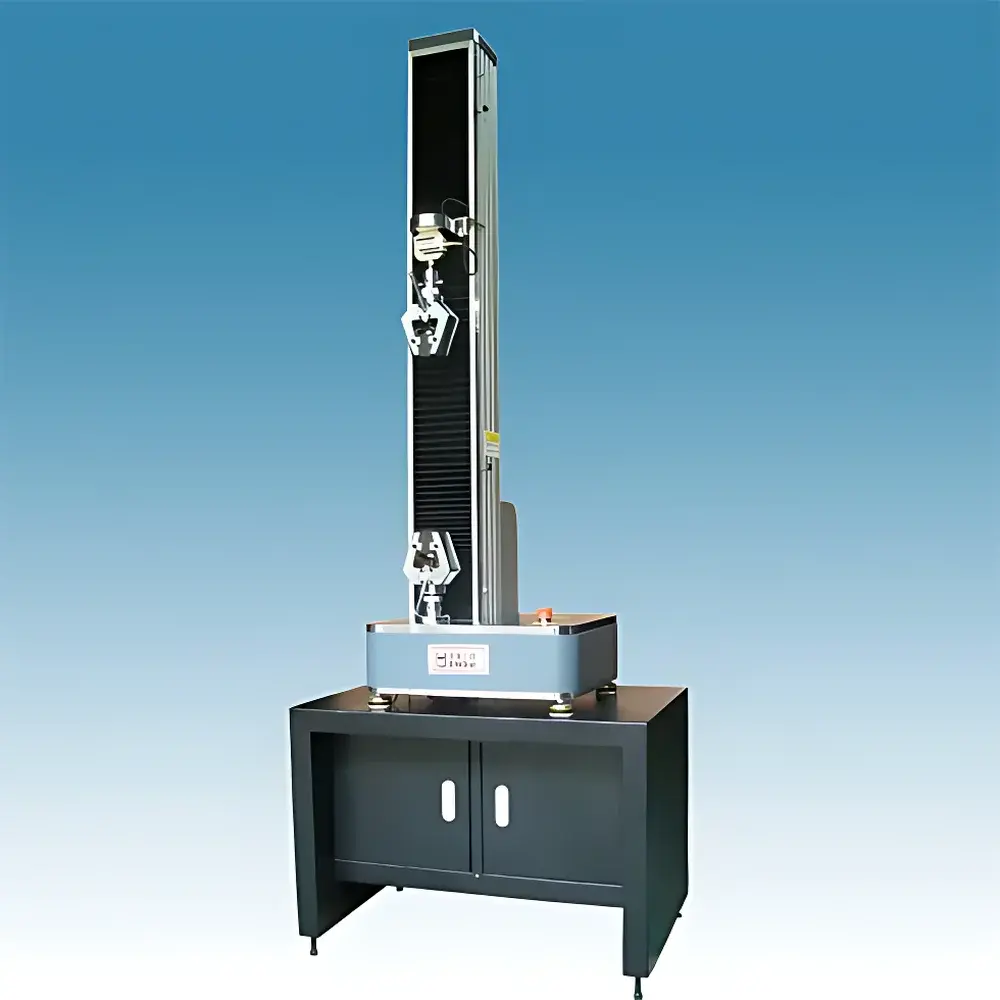
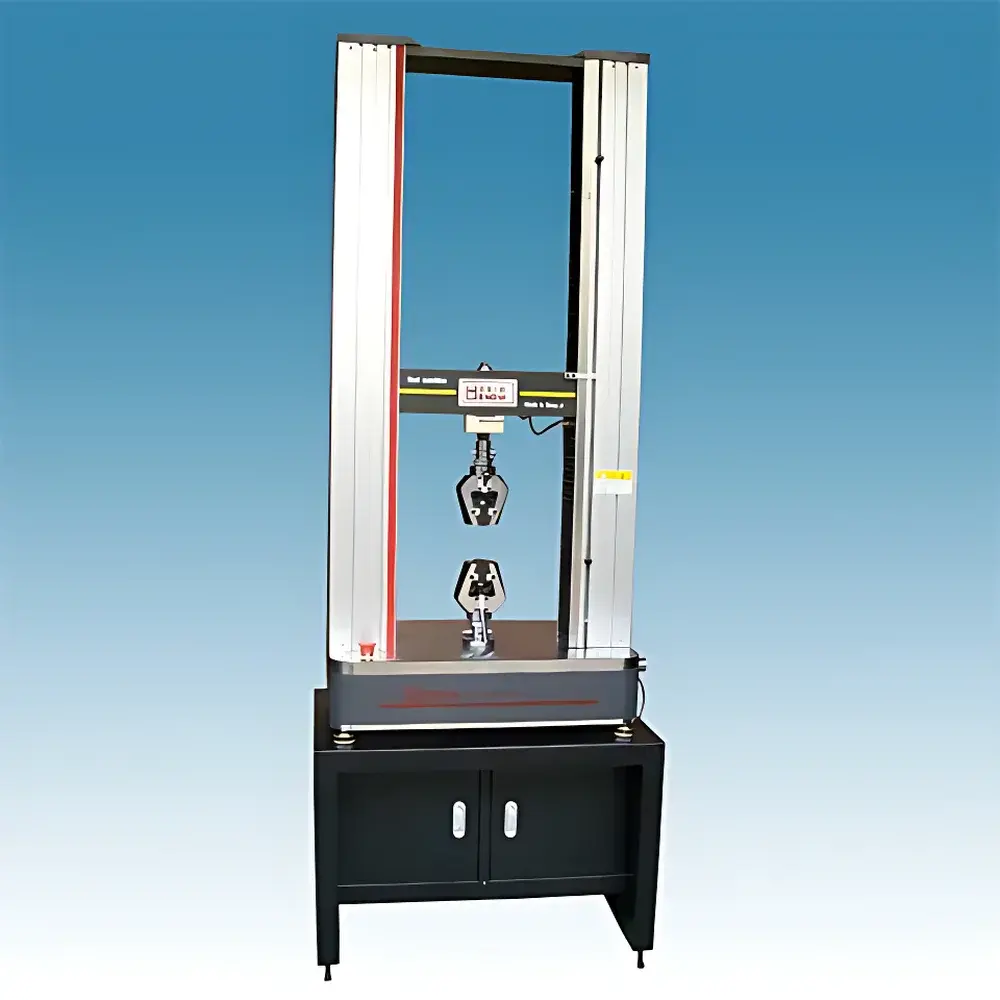
Hengyi HY-0580UUII Medical Syringe Plunger Pull-Out Force Testing Machine
| Brand | Hengyi / Hengyitest |
|---|---|
| Origin | Shanghai, China |
| Manufacturer Type | Direct Manufacturer |
| Regional Classification | Domestic (China) |
| Model | HY-0580UUII |
| Instrument Type | Electromechanical Tensile Testing Machine |
| Maximum Test Load | 5 kN |
| Load Measurement Range | 0.001–100% of Full Scale (FS) |
| Load Accuracy | ±0.5% of reading |
| Test Stroke | 800 mm |
| Displacement Resolution | 0.001 mm |
| Speed Range | 0.001–500 mm/min (adjustable) |
| Speed Accuracy | ±0.5% of set value |
| Displacement Measurement Accuracy | ±0.5% of reading |
| Load Cell Options | 5 N, 10 N, 20 N, 50 N, 100 N, 200 N, 500 N, 1000 N, 5000 N |
| Effective Test Width | 120 mm |
| Power Supply | 220 V AC, 750 W |
| Net Weight | 95 kg |
| Dimensions (W×D×H) | 470 × 400 × 1510 mm |
Overview
The Hengyi HY-0580UUII Medical Syringe Plunger Pull-Out Force Testing Machine is a precision-engineered electromechanical tensile testing system designed specifically for evaluating the mechanical integrity and functional performance of medical syringes in compliance with international regulatory expectations. It operates on the principle of controlled uniaxial force application to measure plunger pull-out force—the critical parameter defining the ease of plunger movement, seal integrity, and resistance to unintended disengagement during clinical use. Built as a single-column, floor-standing universal tester, the HY-0580UUII supports static mechanical testing modes including tension, compression, peel, and shear—making it suitable not only for ISO 7886-1 (Syringes for Medical Use) and ASTM D3763 (High-Speed Impact Properties of Plastics), but also for broader biocompatible polymer and elastomer characterization in R&D and quality control environments.
Key Features
- High-resolution load measurement system with selectable transducers (5 N to 5 kN), enabling traceable force quantification across low-force syringe plunger applications and higher-load structural validation tasks.
- Full-scale displacement resolution of 0.001 mm and closed-loop speed control (0.001–500 mm/min), ensuring reproducible test profiles for both slow, physiologically relevant actuation and rapid qualification screening.
- Dual-speed motorized crosshead with manual jog function and electronic limit protection, enhancing operational safety and positional repeatability during multi-step test protocols.
- Integrated overload protection (10% above full scale), real-time self-diagnostic monitoring of drive and sensing subsystems, and automatic halt triggers based on preset load, displacement, or time thresholds—supporting robust GLP-aligned test execution.
- Compact footprint (470 × 400 × 1510 mm) and modular frame architecture, facilitating installation in regulated laboratory spaces without requiring dedicated structural reinforcement or environmental isolation.
Sample Compatibility & Compliance
The HY-0580UUII accommodates standard Luer-lock and Luer-slip syringes (1 mL to 60 mL), as well as pre-filled cartridge systems, auto-injectors, and pen-type delivery devices. Fixturing options include custom-designed plunger-grip jaws, syringe barrel clamps, and axial alignment fixtures to minimize eccentric loading and ensure ISO 7886-1–compliant axisymmetric force transmission. The system meets essential requirements for medical device testing under ISO 13485:2016 quality management systems and supports audit-ready documentation for FDA 21 CFR Part 820 submissions. While not certified to ISO/IEC 17025, its metrological traceability path aligns with national standards (e.g., CNAS-accredited calibration certificates for load cells and displacement encoders).
Software & Data Management
Control and analysis are performed via Hengyi’s proprietary Windows-based testing software, compliant with basic data integrity principles per ALCOA+ guidelines. The interface enables programmable multi-stage test sequences (e.g., preload → dwell → ramp → hold → return), real-time curve overlay, and export of raw ASCII data (CSV/TXT) for third-party statistical analysis. Audit trail functionality logs user actions, method changes, and calibration events; however, full 21 CFR Part 11 compliance (electronic signatures, role-based access control) requires optional software licensing and local IT validation. All test reports include timestamped metadata, instrument ID, operator ID, environmental conditions (user-entered), and pass/fail flags against configurable acceptance criteria.
Applications
- Quantitative assessment of plunger pull-out force per ISO 7886-1 Clause 6.3 and Annex A.
- Evaluation of lubricant efficacy (e.g., silicone oil migration, coating uniformity) across syringe batches and shelf life studies.
- Comparative testing of alternative barrel materials (glass vs. cyclic olefin copolymer vs. polypropylene) under temperature-controlled conditions.
- Mechanical validation of novel needle-shield engagement mechanisms and auto-disable features.
- Supporting design verification (DV) and process validation (PV) activities for Class II and III injectable delivery systems.
FAQ
What standards does the HY-0580UUII support for syringe testing?
It is configured to execute tests aligned with ISO 7886-1, ISO 8536-4, and ASTM D882 (tensile properties of thin plastic sheeting used in syringe packaging). Custom test methods can be implemented via software scripting.
Can the system perform cyclic or fatigue testing?
No—it is optimized for static and quasi-static mechanical testing only. For dynamic or high-cycle fatigue evaluation, a servo-hydraulic or resonant fatigue system is recommended.
Is calibration certification included with shipment?
A factory calibration report (traceable to Chinese national standards) is provided. ISO/IEC 17025-accredited calibration must be arranged separately through an authorized third-party lab.
What maintenance is required for long-term accuracy?
Annual verification of load cell linearity, encoder resolution, and crosshead alignment is advised. Routine cleaning of guide rails and periodic inspection of jaw serrations are sufficient for daily operation.
Does the machine support automated sample loading?
Not natively. Integration with robotic sample handlers requires external I/O modules and custom PLC interfacing—available upon engineering consultation.



