
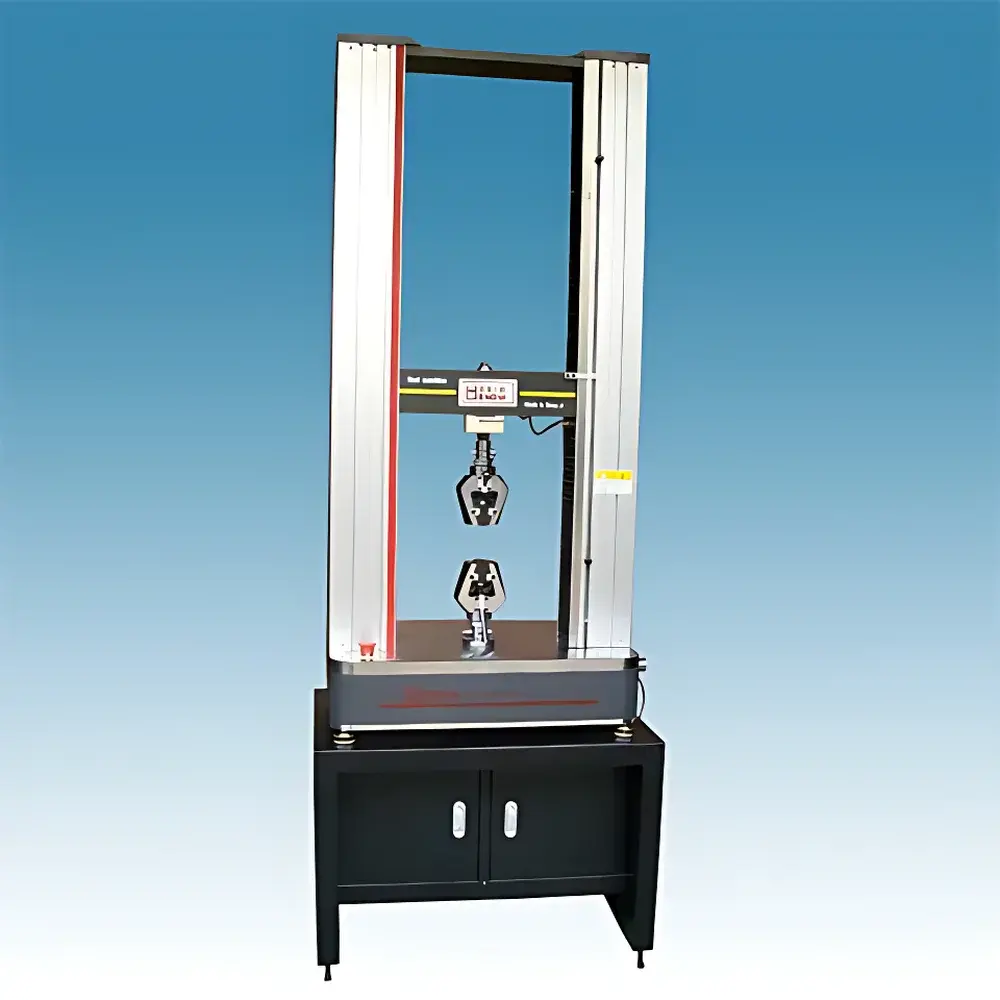
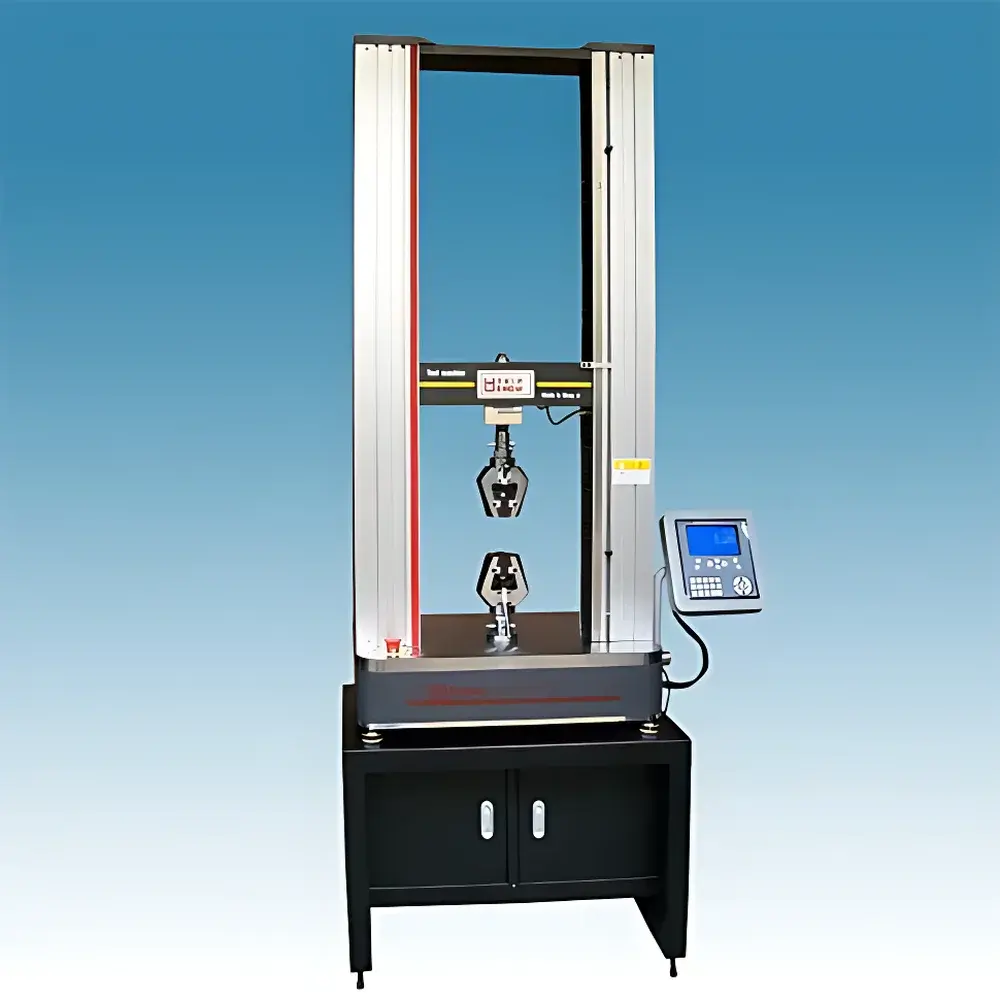
Hengyi HY-3080AAAE Universal Tensile Testing Machine
| Brand | Hengyi |
|---|---|
| Origin | Shanghai, China |
| Manufacturer Type | Direct Manufacturer |
| Product Category | Domestic |
| Model | HY-3080AAAE |
| Instrument Type | Electromechanical Tensile Tester |
| Maximum Test Load | 30 kN |
| Force Measurement Range | 0.001–500 % FS |
| Force Accuracy | ±0.5 % of reading |
| Test Stroke | 800 mm |
| Displacement Resolution | 0.001 mm |
| Speed Range | 0.001–500 mm/min (fully adjustable) |
| Position Accuracy | ±0.5 % of reading |
| Strain Control Range | 0.002–6 % FS/s |
| Stress Control Range | 0.005–6 % FS/s |
| Load Cell Options | 1 N to 30 kN (interchangeable) |
| Effective Test Width | 380 mm (expandable) |
| Power Supply | 220 V AC, 0.75 kW |
| Machine Weight | 210 kg |
| Dimensions (W×D×H) | 700 × 420 × 1600 mm |
Overview
The Hengyi HY-3080AAAE is a high-precision, dual-column electromechanical universal testing machine engineered for static mechanical characterization under tension, compression, bending, shear, peel, tear, and cyclic loading conditions. Designed according to ISO 7500-1 (Class 0.5 accuracy), ASTM E4, ASTM E8/E8M, and GB/T 228.1 standards, it employs a closed-loop servo-controlled load train with high-stiffness crosshead guidance and precision ball-screw actuation. The system delivers repeatable force control (±0.5 % of reading) and displacement resolution down to 0.001 mm across its full 800 mm stroke — enabling rigorous evaluation of metallic wires, thin foils, photovoltaic ribbons, biomedical sutures, polymer films, and composite reinforcements. Its rigid C-frame architecture minimizes deflection during high-load testing, ensuring fidelity in modulus, yield strength, ultimate tensile strength (UTS), elongation at break, and stress–strain hysteresis measurements.
Key Features
- Modular load cell configuration supporting interchangeable transducers from 1 N to 30 kN — optimized for fine-wire testing (e.g., copper, steel, NiTi) and bulk component validation.
- True dual-range displacement measurement: high-resolution optical encoder (0.001 mm) combined with calibrated potentiometric feedback for traceable position tracking.
- Full-range force resolution of ±500,000 counts without internal range switching — eliminating zero-shift artifacts during low-force (20 kN) transitions.
- Programmable rate control covering 0.001–500 mm/min with speed accuracy ±0.5 % of setpoint — compliant with ASTM D638 ramp-rate requirements and ISO 6892-1 strain-rate protocols.
- Integrated safety architecture including electronic limit switches, overload protection (110 % FS), real-time drive diagnostics, and emergency stop interlocks meeting IEC 61800-5-2 functional safety guidelines.
- Motorized crosshead with independent fast/slow jog modes and programmable return-to-start — reducing operator intervention and enhancing throughput consistency.
Sample Compatibility & Compliance
The HY-3080AAAE accommodates specimens ranging from sub-0.1 mm diameter metal filaments (e.g., stainless steel wire, aluminum alloy strands, PV ribbon) to rigid structural components up to 380 mm wide and 800 mm tall. Standard fixtures include wedge-action grips for metallic wires, pneumatic clamps for thin films, bend supports for three/four-point flexure, and peel/tear jigs per ASTM D1876 and ISO 8510-2. All test methods are fully traceable to ISO/IEC 17025-accredited calibration practices. The system satisfies regulatory documentation requirements for GLP and GMP environments through audit-ready test logs, user-access-level permissions, and electronic signature support — aligning with FDA 21 CFR Part 11 principles when paired with validated HYtestV7.0 software configurations.
Software & Data Management
HYtestV7.0 is a multilingual (9-language) PC-based control and analysis platform built on VB.NET and SQL Server backend architecture. It provides real-time synchronized acquisition of force, displacement, and optional extensometer-derived strain data at up to 1 kHz sampling rate. Users define custom test sequences using intuitive drag-and-drop logic blocks (e.g., “hold at 10 kN for 60 s”, “ramp to 5 % strain at 0.1 %/s”). Post-test analysis includes automatic yield point detection (0.2 % offset, tangent, or maximum curvature methods), modulus calculation via linear regression over user-defined elastic regions, and statistical reporting across batches. Raw data exports to CSV, XML, and PDF formats; all metadata (operator ID, timestamp, environmental conditions, calibration certificate IDs) are embedded and immutable within the database schema.
Applications
This system serves as a primary mechanical characterization tool across quality assurance, R&D, and regulatory compliance workflows. Typical use cases include: tensile verification of automotive steel cord and tire bead wire per ISO 6892-1; peel strength validation of medical device adhesive laminates (ISO 11607-2); compression testing of thermal interface materials per ASTM D575; cyclic fatigue assessment of orthopedic implant wires (ISO 14801); and modulus determination of photovoltaic interconnect ribbons per IEC 61215-2 MQT 17. It is routinely deployed in third-party certification labs accredited to ISO/IEC 17025, university materials science departments, and Tier-1 supplier QC laboratories serving aerospace, medical device, and renewable energy sectors.
FAQ
What international standards does the HY-3080AAAE support out-of-the-box?
It natively implements test method templates aligned with ASTM E8/E8M, ISO 6892-1, ISO 7500-1, GB/T 228.1, JIS Z2241, and DIN 50125 — with parameter presets for strain rate, hold times, and failure criteria.
Can the system be validated for regulated environments such as pharmaceutical or medical device manufacturing?
Yes — when configured with HYtestV7.0’s 21 CFR Part 11-compliant mode (including electronic signatures, audit trails, and role-based access control), it meets FDA and EU MDR requirements for documented mechanical testing.
Is extensometer integration supported for true strain measurement?
Yes — the controller features two analog input channels compatible with contact and non-contact extensometers (LVDT, video, or laser), enabling Poisson’s ratio and plastic strain calculations beyond crosshead displacement.
How is calibration traceability maintained?
Each load cell ships with an ISO/IEC 17025-accredited calibration certificate (NIST-traceable), and the software enforces mandatory recalibration reminders based on usage cycles or time intervals.
What maintenance is required for long-term accuracy retention?
Annual verification against certified reference loads and mechanical alignment checks (per ISO 7500-1 Annex B) are recommended; no routine lubrication or belt replacement is needed due to brushless servo motor and preloaded ball-screw design.



