
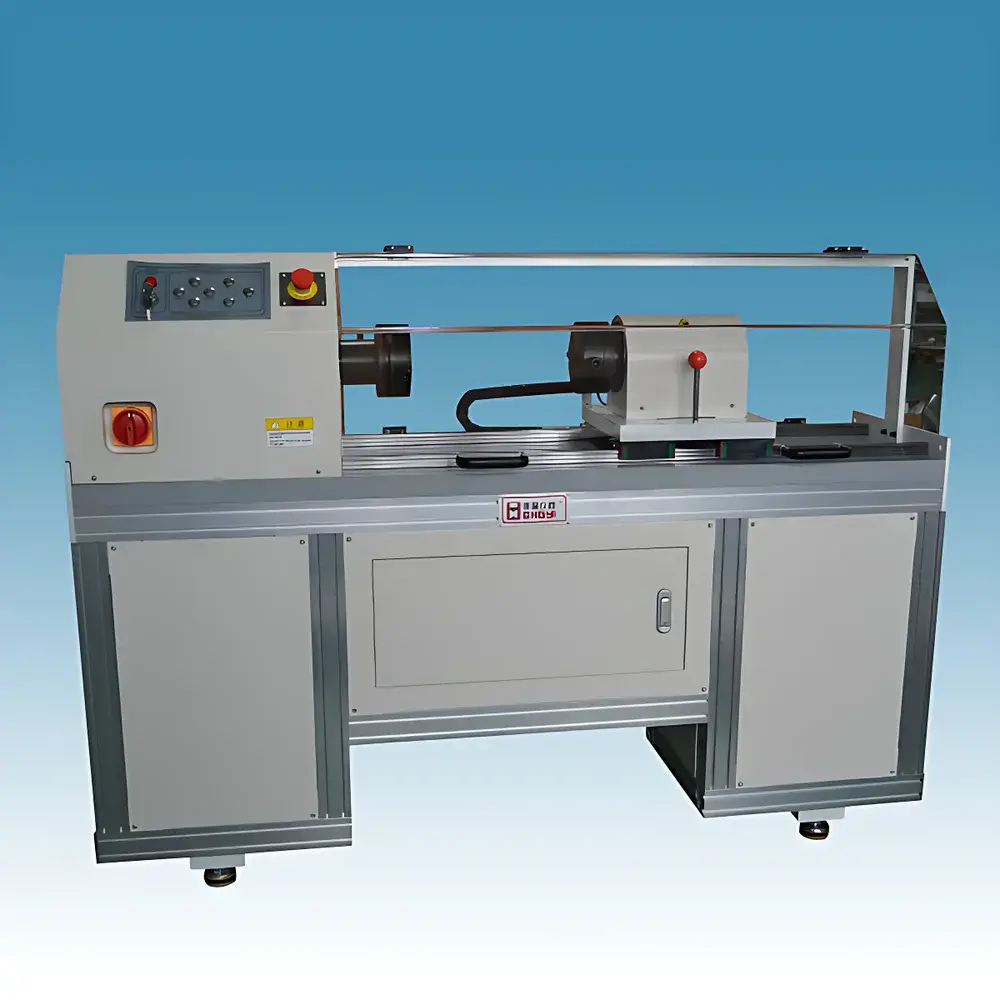
Hengyi HY1000N·m Computer-Controlled Electronic Torsion Testing Machine
| Brand | Hengyi (Hengyitest) |
|---|---|
| Origin | Shanghai, China |
| Manufacturer Type | Direct Manufacturer |
| Product Category | Domestic |
| Model | HY1000N·m |
| Price Range | USD 2,800 – 7,000 |
| Torque Capacity | 1000 N·m |
| Torque Measurement Accuracy | ±0.5% FS |
| Angular Displacement Range | 0–100,000° (or continuous rotation) |
| Angular Measurement Accuracy | ±0.5% FS |
| Twist Speed Range | 0–1000 °/min |
| Speed Control Accuracy | ±0.5% |
| Gauge Length Adjustment | 550 mm max |
| Specimen Clamping Diameter | Φ6–Φ32 mm (customizable) |
| Host Dimensions (L×W×H) | ≈1500×420×1250 mm |
| Power Supply | Single-phase 1.5 kW |
| Weight | 500 kg |
Overview
The Hengyi HY1000N·m Computer-Controlled Electronic Torsion Testing Machine is a precision-engineered, horizontal-axis torsion testing system designed for static and quasi-static mechanical characterization of metallic wires, rods, shafts, fasteners, composite laminates, and structural components under pure torsional loading. It operates on the principle of controlled angular displacement actuation combined with high-fidelity torque and rotational angle feedback—enabling direct determination of torsional stiffness, shear modulus (G), proportional limit shear stress (τp), yield torque, ultimate torque, and post-yield plastic behavior per ASTM E143, ISO 7800, GB/T 10128, and DIN 50121. Its rigid welded steel frame, integrated high-inertia flywheel design, and low-backlash transmission architecture ensure minimal dynamic compliance and exceptional repeatability across extended test durations.
Key Features
- High-precision torque measurement via calibrated 1000 N·m load cell with ±0.5% full-scale accuracy, traceable to national metrological standards;
- Optical rotary encoder with sub-arcsecond resolution for angular position feedback, enabling reliable twist-angle quantification up to 100,000° or continuous rotation mode;
- Japanese Panasonic AC servo motor and drive system delivering speed control ratio of 1:2,000,000, precise positioning, and stable low-speed operation down to 0.01 °/min;
- Dual-closed-loop digital control architecture based on a 32-bit ARM microprocessor (56 MIPS), supporting real-time PID regulation of torque, angle, and speed;
- Data acquisition at 100 Hz sampling rate with 24-bit A/D conversion, ensuring capture of transient torsional events and hysteresis loops;
- Built-in high-speed RS422 serial interface operating at 115.2 kbps, minimizing communication latency between controller and host PC;
- Modular fixture system accommodating specimens from Φ6 mm to Φ32 mm diameter; optional custom jaw designs available for non-circular or threaded components;
- Compliance with electromagnetic compatibility (EMC) Class B requirements and safety-rated emergency stop circuitry per IEC 60204-1.
Sample Compatibility & Compliance
The HY1000N·m accommodates solid and hollow cylindrical specimens, wire ropes, torsion springs, drive shafts, and miniature orthopedic implants. With auxiliary fixtures—including spline clamps, universal joint adapters, and high-temperature furnace integration kits—it supports testing under elevated temperature (up to 300 °C), environmental chambers, or vacuum conditions. All test protocols and reporting outputs conform to internationally recognized standards including ASTM E143 (Shear Modulus), ASTM F568M (Mechanical Properties of Fasteners), ISO 7800 (Torsion Testing of Metallic Materials), GB/T 10128 (Metallic Materials—Torsion Test), and JIS Z 2244. The system supports audit-ready data logging compliant with GLP and GMP environments when paired with validated software configurations.
Software & Data Management
Control and analysis are performed using Windows-based proprietary software developed exclusively for this platform. The application provides real-time graphical display of torque vs. twist angle, torque vs. time, and angle vs. time curves—with on-the-fly zoom, segment-based parameter extraction (e.g., maximum torque within user-defined angular window), and automatic calculation of G, τp, τy, τu, and angle of twist at failure. Raw data exports in CSV and XML formats support third-party statistical analysis tools. Software versioning, electronic signatures, and audit trail functionality align with FDA 21 CFR Part 11 requirements when configured with role-based access controls and secure database storage.
Applications
- Quality assurance of automotive driveline components (propeller shafts, CV joints, steering columns);
- Mechanical property validation of aerospace-grade titanium and nickel-based superalloys;
- Research into torsional fatigue mechanisms and cyclic softening/hardening behavior;
- Calibration and verification of torque transducers and reference standards;
- Educational laboratories conducting fundamental mechanics of materials experiments;
- Standards laboratories performing inter-laboratory comparison studies under ISO/IEC 17025 accreditation scope.
FAQ
What standards does the HY1000N·m support for torsion testing?
It natively supports test method execution and report generation per ASTM E143, ISO 7800, GB/T 10128, DIN 50121, and JIS Z 2244.
Can the system perform constant-torque rate or constant-angle-rate tests?
Yes—dual-mode closed-loop control enables both torque-controlled (dτ/dt) and angle-controlled (dθ/dt) ramp profiles, as well as hybrid step-and-hold sequences.
Is the software compatible with modern Windows OS versions?
The current release supports Windows 10 and Windows 11 (64-bit) with .NET Framework 4.8 and TLS 1.2 security protocols enabled.
Does the machine require external cooling or compressed air?
No—fully self-contained operation; only single-phase 220 VAC / 1.5 kW power input is required.
What documentation is provided with the system?
Each unit ships with factory calibration certificate, CE Declaration of Conformity, operation manual, maintenance schedule, and traceable torque sensor calibration report.



