
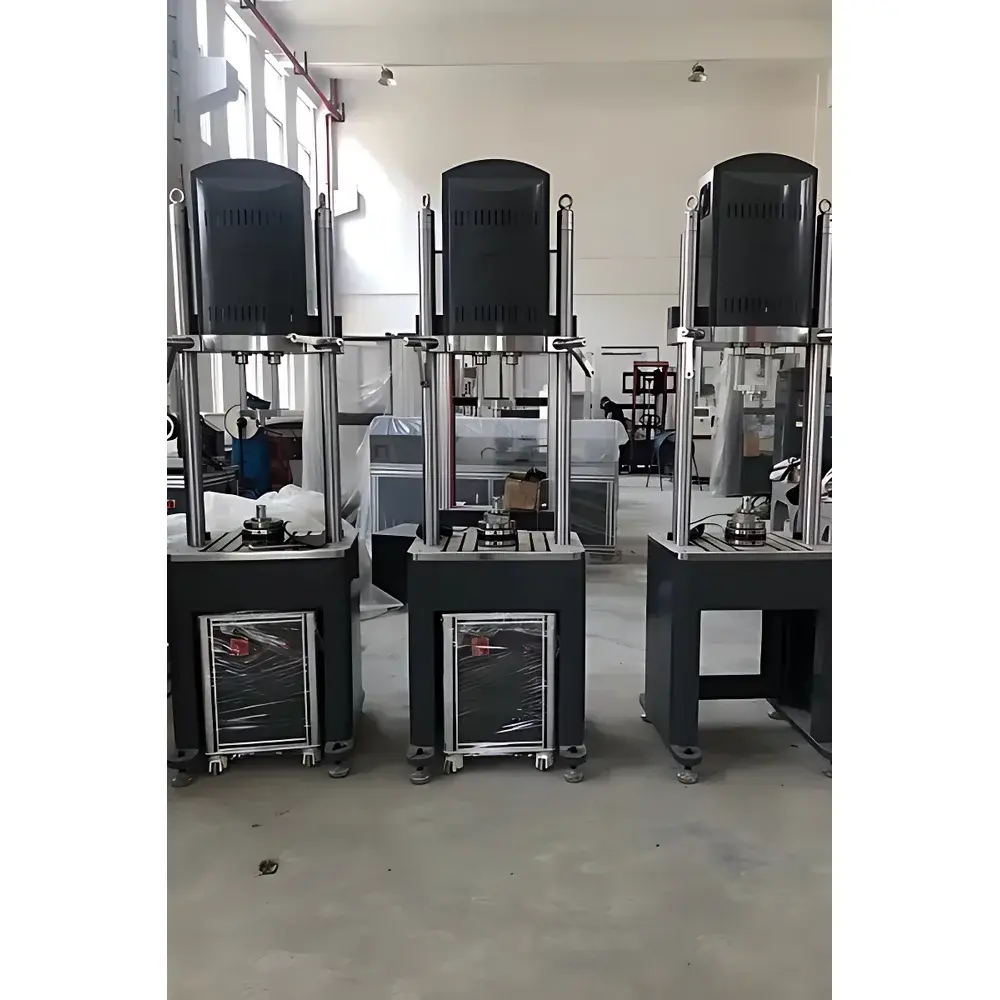
Hengyi HY(DP)5020 Hip Joint Dynamic Tension-Compression Fatigue Testing Machine
| Brand | Hengyi |
|---|---|
| Origin | Shanghai, China |
| Manufacturer Type | Direct Manufacturer |
| Product Category | Domestic |
| Model | HY(DP)5020 |
| Instrument Type | High-Frequency Electromechanical Fatigue Testing Machine |
| Maximum Test Load | ±5000 N |
| Force Measurement Range | 50–5000 N |
| Force Resolution | 0.01 N |
| Force Accuracy | Class 1 (±1% of reading) |
| Displacement Measurement Accuracy | Class 1 |
| Displacement Range | 0–200 mm (or ±100 mm) |
| Displacement Resolution | 0.01 mm |
| Displacement Accuracy | ±1% |
| Frequency Range | 0–30 Hz |
| Waveform Options | Sine, Cosine, Square, Triangle, Sawtooth |
| Test Space (Tension/Compression) | 300 mm / 500 mm |
| Horizontal Clearance (Left–Right) | 450 mm |
| Vertical Test Height | 500 mm |
| Overall Dimensions (L×W×H) | ≈680 × 700 × 2500 mm |
| Power Supply | 380 V AC, 5 kW |
| Net Weight | 600 kg |
| Host Frame Weight | 850 kg |
Overview
The Hengyi HY(DP)5020 Hip Joint Dynamic Tension-Compression Fatigue Testing Machine is an electromechanical servo-controlled fatigue system engineered for biomechanical evaluation of orthopedic implants—specifically hip joint prostheses and related fixation components—under cyclic axial loading conditions. It operates on the principle of closed-loop electrodynamic actuation, where a high-stiffness linear actuator applies precisely controlled tensile and compressive loads in accordance with user-defined waveform profiles (sine, cosine, square, triangle, or sawtooth). Designed to replicate physiological loading frequencies observed in gait analysis and long-term implant durability studies, the system supports test frequencies up to 30 Hz, enabling accelerated fatigue protocols while maintaining mechanical fidelity. Its modular load frame architecture accommodates standardized ASTM F1800, ISO 7206-4, and ISO 14879-1 test configurations for femoral stem and acetabular cup fatigue assessment under simulated in vivo boundary conditions.
Key Features
- Electrodynamic actuation system with integrated force and displacement transducers, calibrated to Class 1 accuracy per ISO 7500-1 and ASTM E4.
- Dual-range force measurement capability (50–5000 N) with 0.01 N resolution and real-time digital feedback control at ±1% setpoint accuracy.
- High-resolution displacement sensing (0.01 mm resolution, ±1% full-scale accuracy) compatible with extensometer mounting for localized strain monitoring.
- Programmable multi-waveform generation supporting sinusoidal, triangular, square, and custom duty-cycle waveforms for complex loading spectra.
- Adjustable test envelope: 300 mm tensile stroke and 500 mm compression stroke, with 450 mm lateral clearance and 500 mm vertical working height—optimized for hip prosthesis assembly fixtures and bone-simulant composite holders.
- Rigid welded steel frame (850 kg total mass) with vibration-damped base mount to ensure stability during high-cycle (>10⁶ cycles) endurance tests.
- Integrated safety interlocks including over-travel limit switches, thermal overload protection, emergency stop circuitry, and software-based load/displacement clamping thresholds.
Sample Compatibility & Compliance
The HY(DP)5020 is configured to accommodate standard hip implant test specimens per ISO 14242-1 (metallic femoral stems), ISO 14242-3 (polymeric acetabular liners), and ASTM F2996 (cemented stem fatigue testing). Fixture interfaces comply with ISO 14879-1 mounting requirements for proximal femur analogs. The system supports both cemented and cementless fixation simulation using validated polyurethane bone analogs (e.g., Sawbones® models #3403, #3406) and titanium-alloy test specimens. All hardware and firmware meet CE Machinery Directive 2006/42/EC essential health and safety requirements. Force and displacement calibration certificates are traceable to national metrology institutes (NIM, China) and support GLP-compliant audit trails when paired with optional data logging modules.
Software & Data Management
Control and acquisition are managed via Hengyi’s proprietary FatigueTest Pro v3.x software suite, running on Windows 10 IoT Enterprise. The interface provides real-time oscilloscope-style visualization of load vs. displacement hysteresis loops, cycle counting, peak/valley tracking, and automatic termination triggers (e.g., stiffness drop >10%, displacement drift >0.5 mm, or cycle count threshold). Raw data exports to CSV, ASCII, and MATLAB-compatible .mat formats. Audit trail functionality complies with FDA 21 CFR Part 11 requirements when configured with electronic signatures, role-based access control, and immutable event logs. Optional integration with LabVIEW™ or Python-based APIs enables automated test sequencing within larger QA/QC workflows.
Applications
- Fatigue life evaluation of uncemented and cemented hip stem designs under ISO 7206-4 bending fatigue conditions.
- Cyclic compression testing of acetabular cup–liner interfaces per ISO 14242-3.
- Dynamic mechanical analysis (DMA) of polymer-based bearing surfaces under variable amplitude loading.
- Validation of finite element model predictions for stress distribution in proximal femur–implant systems.
- Pre-clinical screening of novel surface coatings (e.g., hydroxyapatite, DLC) under combined tension–compression fatigue.
- Supporting regulatory submissions (FDA 510(k), CE Marking) through reproducible, standards-aligned test reports.
FAQ
What standards does the HY(DP)5020 support for hip implant testing?
It is configured for ASTM F1800, ISO 7206-4, ISO 14242-1/3, ISO 14879-1, and ISO 14242-2 test methods.
Can the system perform variable-amplitude or spectrum loading?
Yes—via user-defined waveform tables imported as CSV files, enabling block-loading sequences and staircase fatigue protocols.
Is third-party calibration certification included?
Factory calibration is provided with NIM-traceable certificates; annual recalibration services are available under service contract.
What is the maximum achievable cycle count per test session?
The system supports continuous operation for ≥10⁷ cycles without interruption, subject to thermal management and maintenance intervals.
Does the machine support extensometer integration for local strain measurement?
Yes—standard M4 threaded mounting points are provided on the crosshead and base for clip-on or non-contact extensometers.



