
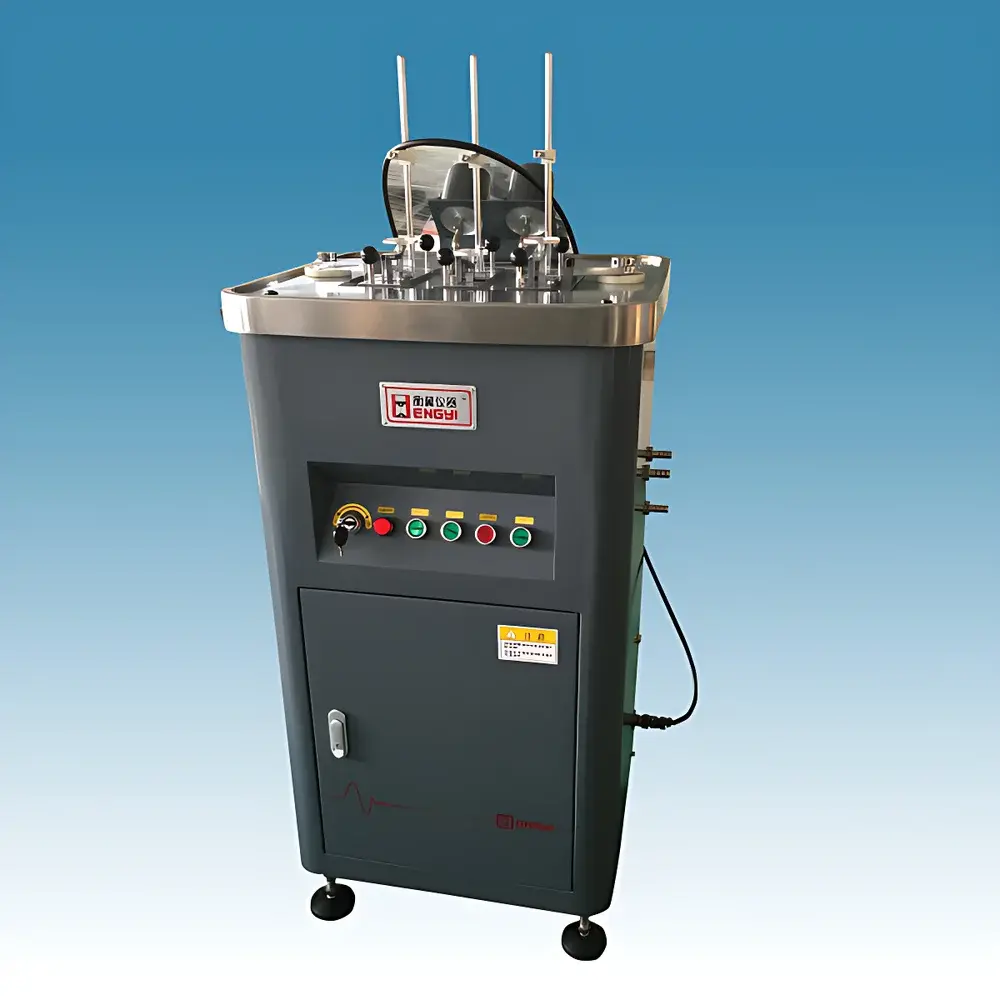
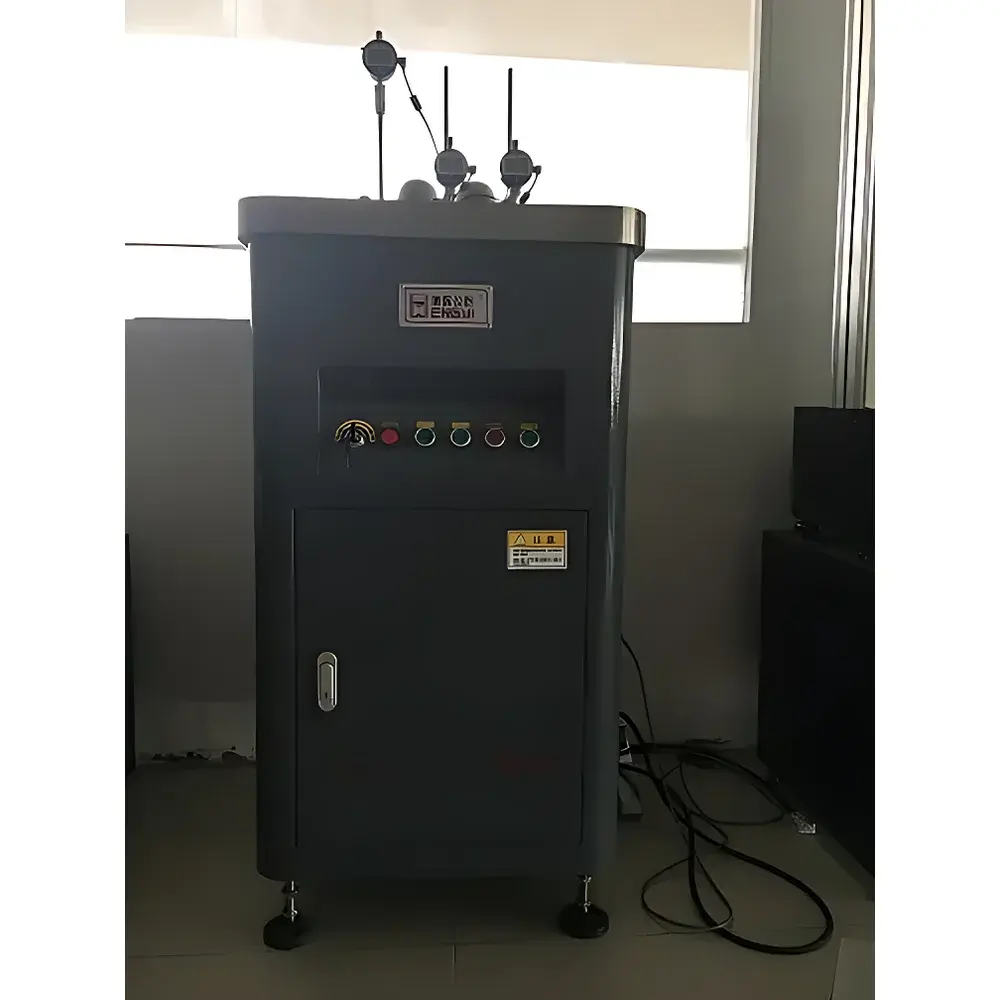
Hengyi HY(RW)-300HB Heat Deflection Temperature (HDT) and Vicat Softening Temperature (VST) Tester
| Brand | Hengyi |
|---|---|
| Origin | Shanghai, China |
| Manufacturer Type | Direct Manufacturer |
| Regional Classification | Domestic (China) |
| Model | HY(RW)-300HBRTHG |
| Pricing | Upon Request |
Overview
The Hengyi HY(RW)-300HB is a precision-engineered benchtop instrument designed for standardized determination of two critical thermal performance parameters in thermoplastic and thermosetting polymers: Heat Deflection Temperature (HDT) per ISO 75-1/2/3 (E) and ASTM D648, and Vicat Softening Temperature (VST) per ISO 306 (E) and ASTM D1525. It operates on the principle of controlled thermal loading under defined flexural stress (for HDT) or needle penetration under constant load (for VST), with real-time monitoring of dimensional response as temperature increases at specified linear ramp rates. The system employs a high-stability silicone oil or transformer oil bath as the heating medium, ensuring uniform thermal transfer to test specimens. Its architecture integrates a second-generation ARM Cortex-M3 microcontroller (120 MHz core), Σ-Δ 16-bit error-free ADCs, and CRC-secured master-slave communication—delivering deterministic timing, sub-millisecond sampling resolution, and robust immunity to electromagnetic interference common in industrial lab environments.
Key Features
- Triple independent test stations (configurable to 4 or 6 stations upon request), enabling parallel evaluation of multiple specimens under identical thermal profiles for improved statistical reliability
- PLC-based closed-loop temperature control with PID algorithm optimization, achieving ±0.5 °C thermal stability over the full 20–300 °C operating range
- High-resolution deformation measurement via calibrated dial indicators (0–5 mm range, ±0.001 mm accuracy), synchronized with temperature acquisition at 100 ms intervals
- Dual cooling modes: natural convection above 150 °C; programmable water-cooling activation below 150 °C to accelerate cycle turnaround time
- Integrated thermal safety interlocks including overtemperature cutoff (310 °C hard limit), dry-run detection, and oil-level monitoring
- Comprehensive data logging: automatic timestamped storage of temperature, deformation, and load status; exportable CSV and PDF report generation with embedded test curves
Sample Compatibility & Compliance
The HY(RW)-300HB accommodates standard rectangular bars (80 × 10 × 4 mm per ISO 75) and cylindrical specimens (10 mm diameter × ∼10 mm height per ISO 306), supporting materials including polypropylene (PP), polyethylene (PE), polycarbonate (PC), ABS, PVC, nylon (PA6/PA66), PEEK, and electrically insulating composites. All mechanical and thermal calibration procedures adhere to traceable NIST-equivalent reference standards. The instrument meets full compliance requirements for ISO 75-2:2013 (HDT), ISO 306:2020 (VST), GB/T 1633–2000, GB/T 1634.2–2004, and GB/T 8802–2001. Its control firmware supports audit-ready operation under GLP and ISO/IEC 17025 laboratory accreditation frameworks, with configurable user access levels and electronic signature capability for test initiation and report approval.
Software & Data Management
The embedded PC application provides a Windows-compatible interface with dual operational modes: manual setup for method development and automated batch execution for routine QA/QC workflows. All raw sensor data—including thermocouple voltage, LVDT displacement, relay states, and heater duty cycle—is stored locally with SHA-256 checksum integrity verification. Data export conforms to ASTM E1447 and ISO/IEC 17025 Annex A3 requirements, including metadata such as operator ID, environmental conditions (lab temperature/humidity), calibration certificate numbers, and instrument serial traceability. Optional 21 CFR Part 11 compliance package available, featuring role-based permissions, electronic signatures with biometric or token authentication, and immutable audit trails for all parameter modifications and result approvals.
Applications
This instrument serves as a primary qualification tool in polymer formulation labs, injection molding process validation, incoming raw material inspection, and regulatory submission dossiers (e.g., FDA 510(k) for medical-grade plastics). Typical use cases include comparative ranking of heat resistance across polymer grades, validation of annealing protocols, assessment of filler-reinforcement effects on thermal rigidity, and failure analysis of thermally degraded components in automotive under-hood applications. Universities utilize it for teaching fundamental polymer physics concepts—including glass transition behavior, viscoelastic creep under load, and structure–property relationships in semi-crystalline systems.
FAQ
What heating media are compatible with the HY(RW)-300HB?
Methyl silicone oil (kinematic viscosity ~200 cSt at 40 °C) is recommended for optimal thermal uniformity up to 300 °C; transformer oil may be used for applications ≤150 °C.
Is calibration certification included with shipment?
Yes—a factory-issued calibration certificate traceable to CNAS-accredited standards is provided, covering temperature (Pt100 probe), deformation (micrometer gauge), and load (deadweight砝码 set).
Can the system be integrated into a LIMS environment?
Yes—via TCP/IP or RS-485 Modbus RTU protocol; API documentation and HL7/FHIR-compliant middleware adapters are available upon request.
What maintenance intervals are recommended for long-term accuracy?
Thermocouple verification every 6 months; oil bath replacement every 12 months or after 200 test cycles; annual full-system metrological recalibration by authorized service center.
Does the instrument support custom ramp profiles beyond standard ISO/ASTM rates?
Yes—the controller firmware allows user-defined multi-segment heating profiles (up to 5 segments), including dwell steps and variable ramp rates, for advanced material characterization studies.



