
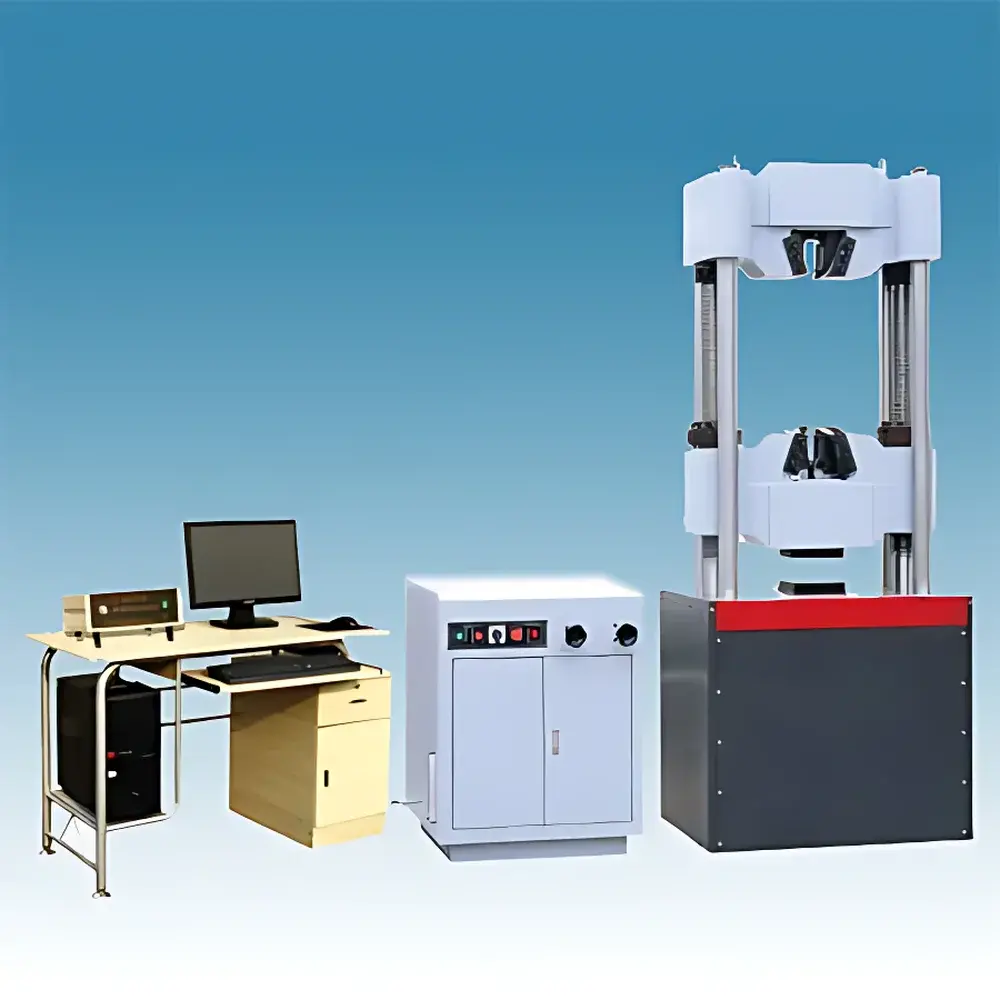
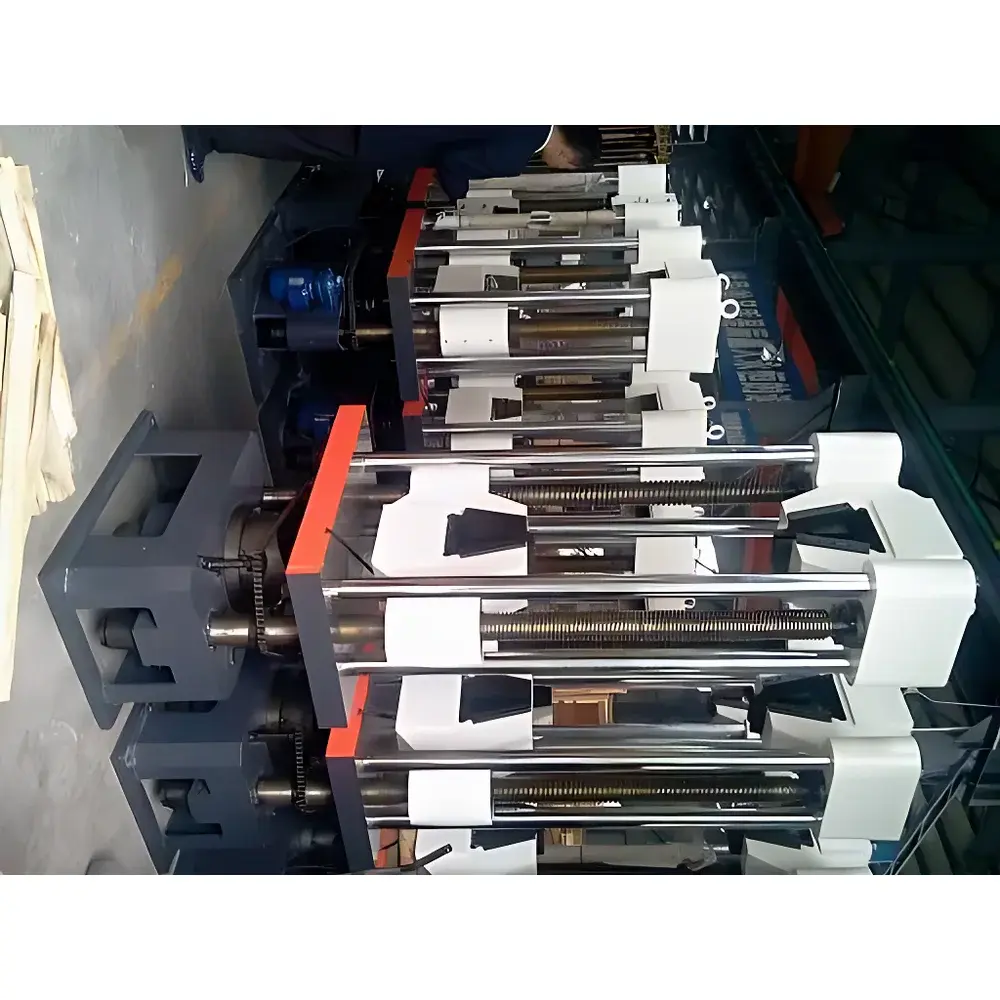
Hengyi HY(WE)-100060 High-Strength Bolt Tensile Testing Machine
| Brand | Hengyi |
|---|---|
| Origin | Shanghai, China |
| Manufacturer Type | Direct Manufacturer |
| Country of Origin | China |
| Model | HY(WE)-100060GH |
| Instrument Type | Hydraulic Universal Testing Machine |
| Load Capacity | 0–1000 kN |
| Accuracy | ±1% FS |
| Resolution | ≤0.5% FS |
| Tensile Space | 600 mm |
| Compression Space | 600 mm |
| Piston Stroke | 150 mm |
| Round Specimen Clamping Range | Φ20–60 mm |
| Flat Specimen Clamping Thickness | 0–40 mm |
| Max. Bend Support Span | 100–600 mm |
| Shear Specimen Diameter | Φ10 mm |
| Host Dimensions (W×D×H) | 880×580×2260 mm |
| Motor Power | 1.5 kW, 3-phase |
| Weight | 3500 kg |
Overview
The Hengyi HY(WE)-100060 High-Strength Bolt Tensile Testing Machine is a heavy-duty hydraulic universal testing system engineered for precise mechanical characterization of high-strength fasteners, structural bolts, and metallic components under static axial loading conditions. Designed in accordance with the fundamental principles of load-frame mechanics and hydraulic force amplification, it delivers controlled, repeatable tensile, compression, bending, and shear forces up to 1000 kN. Its rigid four-column frame, precision-machined load train, and servo-controlled hydraulic actuation ensure minimal deflection and high reproducibility—critical for compliance with international standards such as ISO 7500-1 (class 1 calibration), ASTM E4, ASTM F606 (for bolt testing), and GB/T 228.1–2021 (metallic materials — tensile testing). The machine integrates real-time load-cell feedback, high-resolution displacement tracking via optical encoder, and synchronized data acquisition at 50 Hz—enabling accurate determination of yield strength, ultimate tensile strength, elongation, reduction of area, and proof load behavior per ISO 898-1 and EN 14399.
Key Features
- Hydraulic loading system with dual-range pressure control for stable force application across full capacity (0–1000 kN), minimizing thermal drift and hysteresis.
- Four-column rigid frame with precision-ground guide columns and hardened crossheads ensures alignment accuracy better than 0.1 mm/m over full stroke.
- Dual-mode clamping system: hydraulically actuated wedge-type grips for round specimens (Φ20–60 mm) and adjustable mechanical jaws for flat specimens (0–40 mm thickness).
- Integrated bending assembly with adjustable support span (100–600 mm) and standardized roller/die sets compliant with ISO 7438 and GB/T 232.
- Shear test capability using dedicated Φ10 mm punch-and-die fixture, traceable to ASTM F1470 for fastener shear evaluation.
- Real-time deformation measurement via Japan-made photoelectric encoder (resolution: 1 µm), synchronized with load acquisition for true stress–strain curve generation.
- Modular accessory architecture supporting rapid tooling changeover—including eleven standardized bolt tension fixtures (M10 to M30), compression platens, and bending dies—all calibrated and certified.
Sample Compatibility & Compliance
The HY(WE)-100060 accommodates a broad spectrum of metallic fasteners and structural specimens, including ASTM A325/A490 high-strength bolts, EN 14399 preloaded assemblies, stainless steel anchor bolts (ISO 3506), and cold-formed steel connectors. Its clamping geometry, grip surface hardness (>60 HRC), and parallelism control meet the geometric tolerances specified in ISO 6892-1 Annex B for tensile specimen alignment. All test configurations comply with mandatory requirements of GB/T 228.1–2021, GB/T 5224–2014 (prestressed steel wires), GB/T 232–2010 (bend testing), and ISO 898-1:2013 (mechanical properties of fasteners). Calibration certificates are provided per ISO/IEC 17025-accredited procedures, and system verification includes load verification (ASTM E4), displacement verification (ISO 7500-1), and repeatability assessment (≤0.5% RSD at 50% FS).
Software & Data Management
The system operates with proprietary Windows-based testing software fully compliant with GLP and GMP documentation requirements. It supports 21 CFR Part 11–ready user authentication, electronic signatures, audit trails, and secure data encryption. Test sequences are programmable with multi-step profiles (preload → ramp → hold → unload), automatic peak detection, and real-time curve overlay. Raw data (load, displacement, time, strain) are logged at 50 Hz and exportable in CSV, XML, or PDF formats. Reporting templates adhere to ISO 5893 and ASTM E2382 conventions, auto-generating certified test reports with metadata (operator ID, calibration date, environmental conditions, equipment ID). Software includes built-in statistical analysis tools for batch comparison, tolerance banding, and Weibull modulus estimation—essential for quality control laboratories performing routine fastener certification.
Applications
- Proof load and tensile strength verification of structural bolts used in bridge construction, wind turbine towers, and offshore platforms.
- Compliance testing of high-strength fasteners per ISO 898-1, ISO 3506, and ASTM F3125 Grade A325/A490 specifications.
- Mechanical property evaluation of prestressing tendons (GB/T 5224), anchor rods (ASTM A449), and shear connectors in composite floor systems.
- Quality assurance in automotive chassis component manufacturing, where bolt preload consistency directly impacts fatigue life.
- R&D validation of new alloy formulations and surface treatments (e.g., hot-dip galvanizing, Dacromet coating) under standardized loading protocols.
- Third-party certification testing for CE marking, CCC, and ASME BPVC Section II material acceptance.
FAQ
What standards does this machine support for high-strength bolt testing?
It fully supports ISO 898-1, ASTM F606, GB/T 3098.1, EN 14399, and ASTM F3125 for tensile, proof load, and yield testing of structural fasteners.
Is the system compatible with external LIMS or ERP integration?
Yes—the software provides ODBC-compliant database connectivity and RESTful API endpoints for bidirectional data exchange with laboratory information management systems.
Can the machine perform cyclic or low-cycle fatigue tests?
No; the HY(WE)-100060 is a static-load hydraulic UTM optimized for monotonic tests. For fatigue applications, a dedicated electrodynamic or servo-hydraulic fatigue system is recommended.
What maintenance intervals are recommended for hydraulic components?
Hydraulic oil (N68 grade) should be replaced every 2,000 operating hours or annually; filter elements every 500 hours; and pressure transducer recalibration every 12 months or after 5,000 test cycles.
Does the system include factory calibration documentation?
Yes—each unit ships with an ISO/IEC 17025-accredited calibration certificate covering load, displacement, and strain channels, traceable to NIM (China National Institute of Metrology).



