
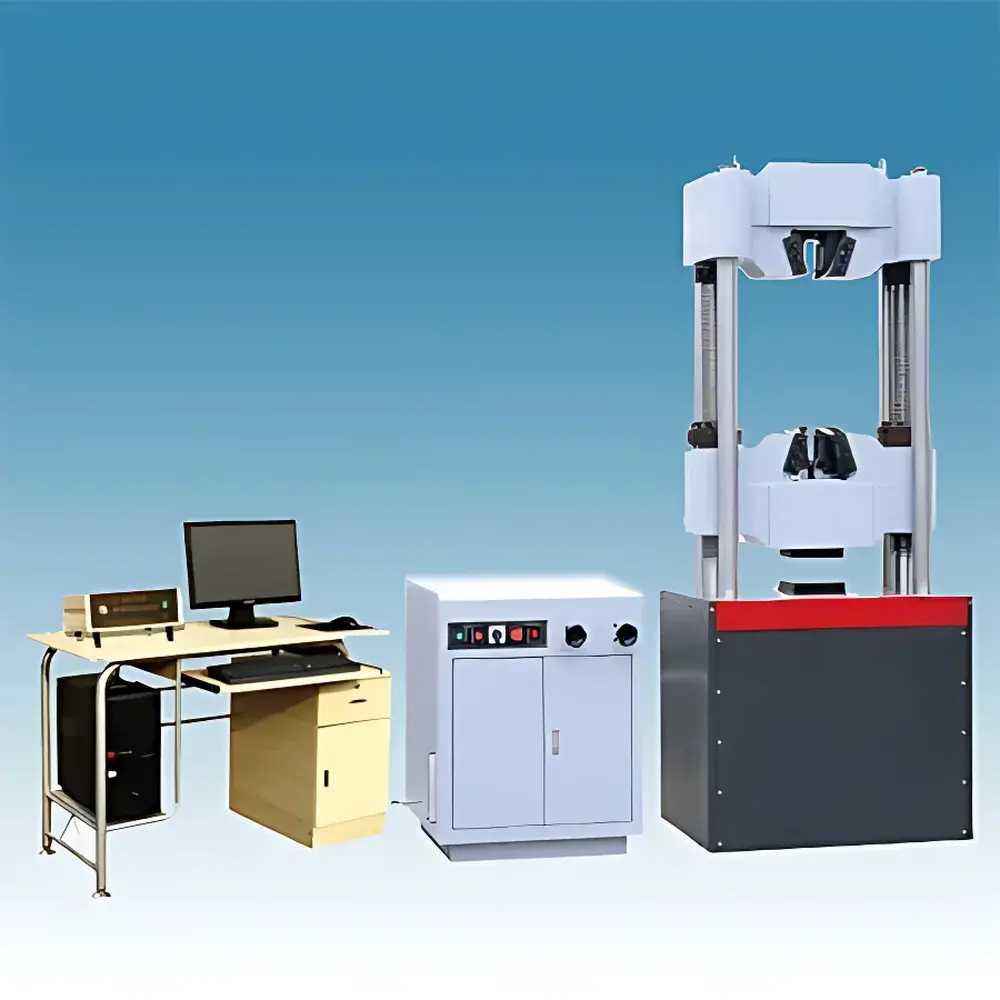
Hengyi HY(WE)100060 Hydraulic Universal Testing Machine
| Brand | Hengyi |
|---|---|
| Origin | Shanghai, China |
| Manufacturer Type | Direct Manufacturer |
| Equipment Type | Hydraulic Universal Testing Machine |
| Model | HY(WE)100060R |
| Max Load Capacity | 1000 kN |
| Load Accuracy | ±0.5% of reading |
| Resolution | ≤0.5% of full scale |
| Compression Space | 600 mm |
| Tensile Space | 600 mm |
| Round Specimen Grip Range | Φ20–Φ60 mm |
| Flat Specimen Thickness Range | 0–40 mm |
| Piston Stroke | 150 mm |
| Bend Support Span Adjustment | 100–600 mm |
| Shear Specimen Diameter | Φ10 mm |
| Deformation Measurement Accuracy | ±0.5% of reading |
| Displacement Measurement Error | ±0.5% of reading |
| Stress Rate Control Range | 1–60 N/mm²/s |
| Strain Rate Control Range | 0.00025–0.0025 s⁻¹ |
| Closed-Loop Control Accuracy (Force/Displacement/Deformation) | ±1% of setpoint |
| Dimensions (W×D×H) | 880 × 580 × 2260 mm |
| Motor Power | 1.5 kW, 3-phase |
| Weight | 3500 kg |
Overview
The Hengyi HY(WE)100060 Hydraulic Universal Testing Machine is a high-capacity, microprocessor-controlled electro-hydraulic testing system engineered for precision mechanical characterization of metallic and non-metallic structural materials under tension, compression, bending, and shear loading conditions. Based on the classical servo-controlled hydraulic actuation principle—where load is applied via a bottom-mounted piston cylinder and regulated by a proportional electro-hydraulic valve—the system delivers stable, low-noise force application with real-time feedback from high-accuracy load cells and linear displacement transducers. Its dual-column rigid frame architecture ensures minimal deflection during high-load testing (up to 1000 kN), while the adjustable test space accommodates standardized specimen geometries per ASTM E4, ISO 7500-1, and GB/T 228.1. Designed for laboratory and industrial quality control environments, the machine complies with static loading accuracy requirements defined in ISO 7500-1 Class 1 and meets essential metrological traceability criteria for force measurement calibration.
Key Features
- Bottom-mounted hydraulic cylinder with optimized piston stroke (150 mm) and robust load train geometry for enhanced column stability and reduced lateral deflection
- Electro-hydraulic proportional servo control system utilizing an AOTOS (Italy) high-bandwidth proportional valve for precise stress/strain rate regulation across wide dynamic ranges
- Dual-sensor measurement architecture: calibrated S-type load cell (±0.5% FS accuracy) and imported draw-wire displacement sensor for independent deformation tracking
- Modular grip system supporting round specimens (Φ20–Φ60 mm), flat specimens (0–40 mm thickness), and standardized shear (Φ10 mm) and bend configurations (adjustable span: 100–600 mm)
- Real-time closed-loop control modes: constant load, constant displacement, and constant strain—with control fidelity within ±1% of setpoint
- Integrated extensometer interface for high-resolution elongation measurement compliant with ISO 9513 Class 1 requirements
- Industrial-grade 3-phase 1.5 kW drive unit ensuring thermal stability and consistent pressure delivery during extended test cycles
Sample Compatibility & Compliance
The HY(WE)100060 supports standardized test specimens conforming to international material standards including ASTM A370 (steel products), ASTM C39 (concrete compression), ISO 6892-1 (tensile testing of metals), and GB/T 228.1–2021 (Chinese national standard for metallic tensile testing). Its mechanical design satisfies structural rigidity requirements per ISO 7500-1 for Class 1 verification, and its measurement subsystems are traceable to national standards through certified calibration protocols. The system enables full compliance with GLP documentation workflows when paired with audit-trail-enabled software configurations. While not inherently 21 CFR Part 11 compliant out-of-the-box, the control software architecture supports configurable electronic signature modules and data integrity enhancements required for regulated QA/QC environments.
Software & Data Management
The included Hengyi proprietary test control software—localized for English-language operation—is built on a real-time Windows-based platform supporting multi-curve synchronized acquisition (load vs. displacement, stress vs. strain, time-series event logging). It provides automated test sequencing, parameter scripting, and post-test analysis tools including modulus calculation, yield point detection (0.2% offset method), ultimate tensile strength derivation, and fracture energy integration. All raw data files are stored in ASCII-compatible formats (.csv, .txt) for third-party statistical analysis or LIMS integration. The software supports export of fully formatted reports—including header metadata, graphical plots, tabulated results, and pass/fail annotations—compatible with ISO/IEC 17025 reporting templates. Dell OEM workstation and inkjet printer ensure seamless local output without dependency on proprietary hardware.
Applications
This testing machine serves as a primary verification tool in metallurgical laboratories, construction material certification centers, and aerospace component suppliers. Typical use cases include: tensile property validation of structural steel plates and reinforcing bars per ASTM A615; compressive strength assessment of concrete cylinders (ASTM C39) and cement mortars (ASTM C109); three-point bending evaluation of welded joints and cast alloys (ASTM E290); and shear strength determination of riveted or bolted assemblies. Its 1000 kN capacity also supports mechanical qualification of heavy-duty fasteners, railway rails, and offshore structural weldments where high-force monotonic loading is required.
FAQ
What standards does the HY(WE)100060 comply with for force measurement accuracy?
It meets ISO 7500-1 Class 1 requirements for static force verification, with load cell accuracy certified to ±0.5% of reading and resolution ≤0.5% of full scale.
Can the system perform strain-controlled tests at low rates suitable for creep studies?
Yes—the strain rate range extends down to 0.00025 s⁻¹, enabling quasi-static and slow-rate deformation protocols aligned with ASTM E292 and ISO 6892-3 Annex A.
Is third-party calibration support available for this model?
Hengyi provides factory calibration certificates traceable to CNAS-accredited reference standards; users may engage ISO/IEC 17025-accredited external labs for periodic verification.
Does the software support automated report generation for ISO/IEC 17025 accreditation?
Yes—customizable report templates include operator ID, equipment ID, environmental conditions, uncertainty statements, and digital signatures compatible with accredited lab documentation systems.
What maintenance intervals are recommended for the hydraulic power unit?
Oil filtration and level checks every 500 operational hours; full hydraulic fluid replacement and valve inspection every 2,000 hours or annually—whichever occurs first.



