
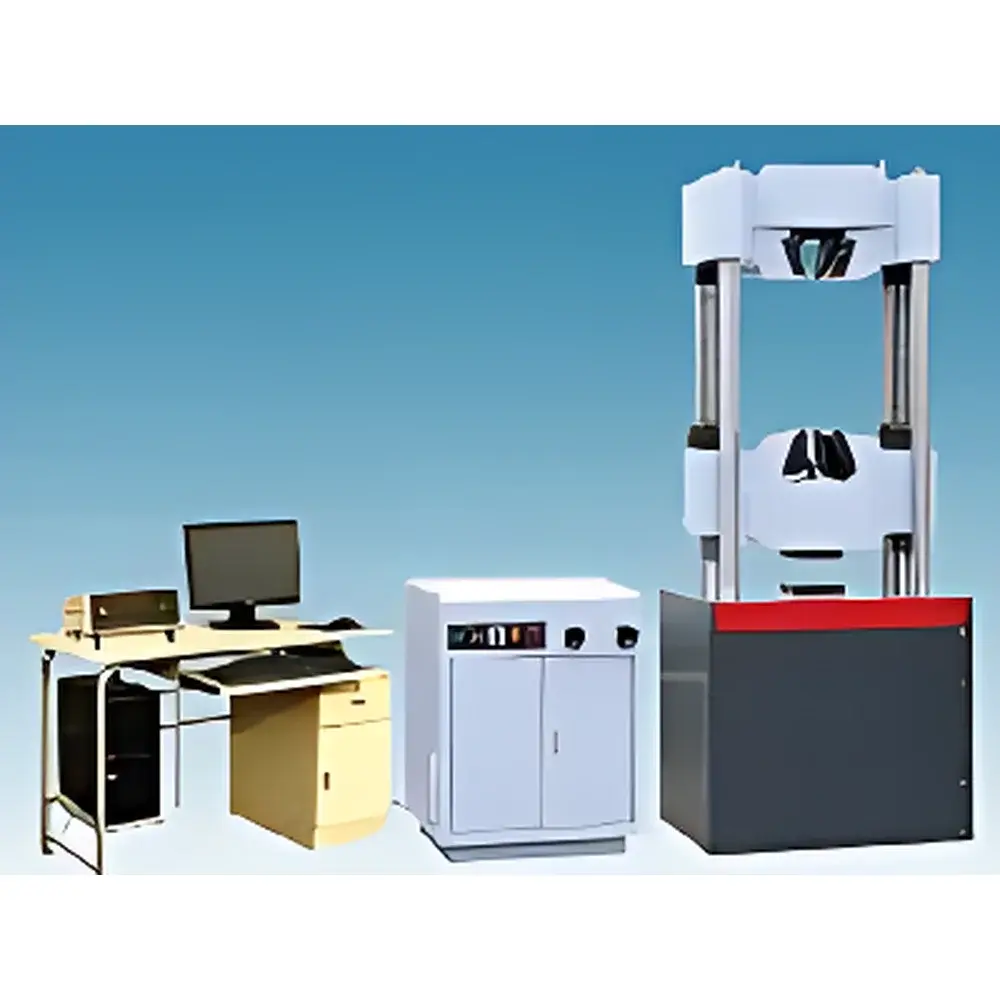
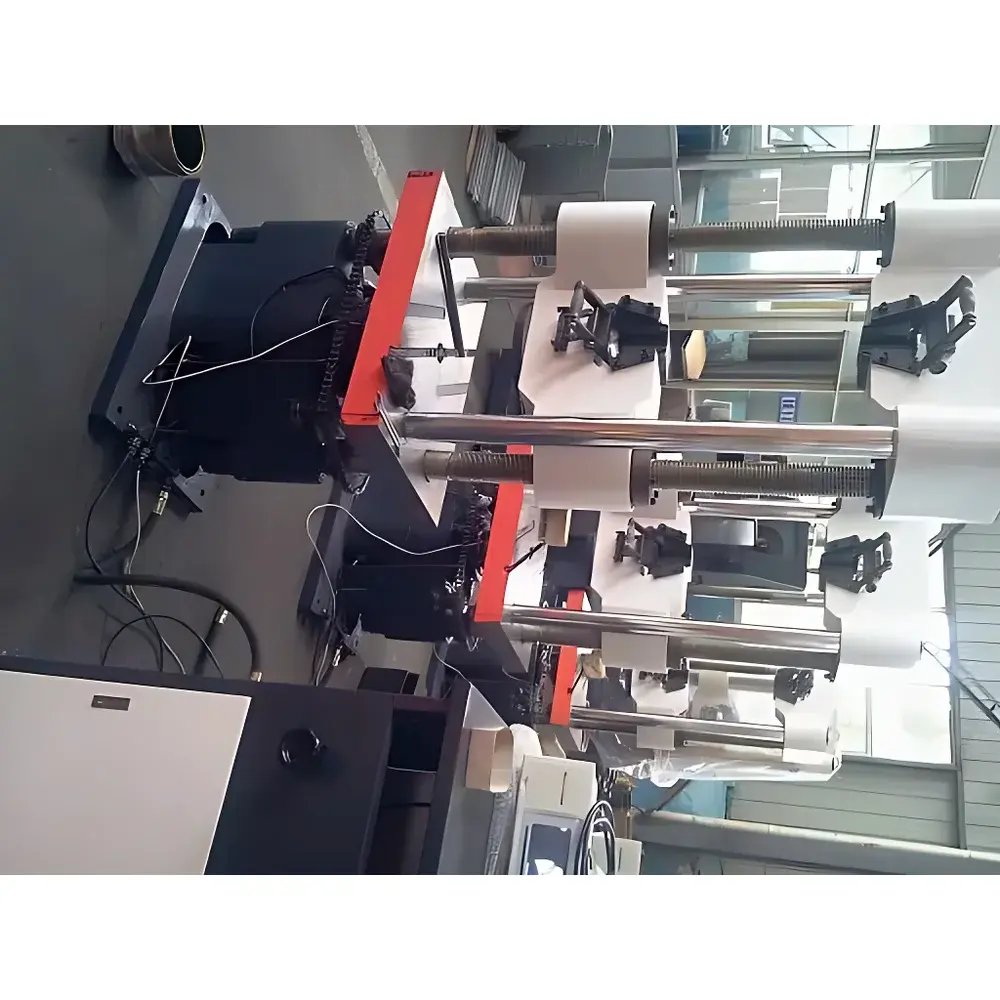
Hengyi HY(WE)60060SD Electro-Hydraulic Proportional Universal Testing Machine
| Brand | Hengyi |
|---|---|
| Origin | Shanghai, China |
| Manufacturer Type | Direct Manufacturer |
| Country of Origin | China |
| Model | HY(WE)60060SD |
| Instrument Type | Electro-Hydraulic Universal Testing Machine |
| Load Capacity | 0–600 kN |
| Force Accuracy | ±1% of reading |
| Deformation Accuracy | ±0.5% of reading |
| Displacement Accuracy | ±0.5% of reading |
| Compression Space | 600 mm |
| Tensile Space | 600 mm |
| Round Specimen Grip Range | Φ13–Φ40 mm |
| Flat Specimen Thickness Capacity | 0–30 mm |
| Piston Stroke | 150 mm |
| Maximum Bend Span | 100–540 mm |
| Shear Specimen Diameter | Φ10 mm |
| Stress Rate Range | 1–60 N/mm²/s |
| Strain Rate Range | 0.00025–0.0025 s⁻¹ |
| Control Mode Accuracy (Constant Load/Deformation/Displacement) | ±1% of setpoint |
| Host Dimensions (W×D×H) | 820 × 540 × 2180 mm |
| Motor Power | 1.5 kW, 3-phase |
| Weight | 2500 kg |
Overview
The Hengyi HY(WE)60060SD Electro-Hydraulic Proportional Universal Testing Machine is a high-stability, load-frame-based mechanical testing system engineered for precision static mechanical characterization of metallic and non-metallic materials under tension, compression, bending, and shear loading conditions. It operates on the principle of electro-hydraulic proportional control — where digital command signals modulate hydraulic flow via high-bandwidth proportional servo valves, enabling smooth, programmable force and displacement trajectories without mechanical feedback loops. The machine features a bottom-mounted hydraulic cylinder with adjustable test space, dual-column rigid frame architecture, and integrated high-accuracy load cells and linear variable differential transformers (LVDTs) for synchronized multi-channel measurement of force, displacement, and axial deformation. Designed for compliance with ISO 7500-1 (Class 1), ASTM E4, ASTM E8/E21, and GB/T 228.1–2021, it delivers traceable, repeatable results suitable for QC laboratories, R&D centers, and third-party certification facilities requiring full audit trails and regulatory documentation.
Key Features
- Electro-hydraulic proportional control system with real-time digital closed-loop regulation of force, displacement, and strain — eliminating analog drift and enabling precise ramp-and-hold protocols.
- Adjustable test space (600 mm tensile/compression clearance) accommodates extended specimens and custom fixtures without hardware reconfiguration.
- High-rigidity dual-column frame with precision-ground guide columns and reinforced crosshead assembly ensures minimal deflection (<0.02 mm/kN) during high-load testing.
- Imported high-stability load cell (600 kN capacity, ±1% FS accuracy) and LVDT-based extensometer interface support both standard and advanced strain measurement per ASTM E83 or ISO 9513 Class 1 requirements.
- Multi-mode control capability: constant stress rate (1–60 N/mm²/s), constant strain rate (0.00025–0.0025 s⁻¹), and closed-loop constant load/deformation/displacement control with ±1% setpoint fidelity.
- Integrated safety interlocks including overload cutoff, emergency stop circuitry compliant with EN ISO 13850, and hydraulic pressure relief protection.
Sample Compatibility & Compliance
The HY(WE)60060SD supports standardized metallic specimens (round: Φ13–Φ40 mm; flat: up to 30 mm thick), concrete cylinders (up to Ø150 × 300 mm), cement mortar prisms, and polymer composites. Standardized grips include wedge-action tensile jaws, three-point bending fixtures (span adjustable from 100–540 mm), and platens for uniaxial compression. All mechanical configurations conform to specimen geometry tolerances specified in ISO 6892-1, ASTM E8, GB/T 228.1, GB/T 232, and GB/T 5224. The system is validated for use in GLP-compliant environments and supports 21 CFR Part 11–ready electronic signatures when paired with audit-trail-enabled software configuration.
Software & Data Management
The system runs Hengyi’s proprietary Windows-based test control and analysis software — fully localized in English and compatible with Windows 10/11 (64-bit). It provides real-time graphical display of force–displacement, stress–strain, and time-based curves; automatic yield point detection (0.2% offset, tangent, or maximum load methods); and export of raw ASCII/CSV data for post-processing in MATLAB, Python, or statistical packages. Data integrity safeguards include encrypted database logging, user-level access permissions (admin/operator/guest), electronic signature capture, and full audit trail generation (user action, timestamp, parameter change). Reports comply with ISO/IEC 17025 documentation requirements and can be exported as PDF or printed with embedded calibration certificates and environmental metadata.
Applications
- Mechanical property validation of structural steels, aluminum alloys, titanium grades, and high-strength fasteners per ASTM A370 or EN 10002.
- Quality assurance of welded joints, castings, and forged components in automotive and aerospace supply chains.
- Compression testing of concrete, grout, and refractory ceramics per ASTM C39, C109, and ISO 4108.
- Bending modulus and fracture toughness evaluation of fiber-reinforced polymer laminates (ASTM D7264, ISO 14125).
- Shear strength determination of rivets, pins, and adhesive bonds using standardized Φ10 mm shear coupons.
- Educational use in university materials science labs for hands-on instruction in mechanical behavior fundamentals.
FAQ
What standards does this machine support out-of-the-box?
It meets core requirements of ISO 7500-1 (Class 1), ASTM E4, ASTM E8/E21, GB/T 228.1–2021, GB/T 232–2010, and GB/T 5224–2014. Custom protocol templates for other standards (e.g., ISO 6892-2, ASTM D695) are available upon request.
Is the system compatible with external extensometers or video-based DIC systems?
Yes — the controller provides TTL-sync outputs and analog voltage inputs for synchronization with clip-on extensometers (e.g., Zwick Roell Xforce P) and digital image correlation (DIC) systems (e.g., Correlated Solutions VIC-2D).
Can test sequences be automated across multiple specimens without operator intervention?
Yes — batch testing mode allows pre-programmed sequence execution (grip change → zeroing → preload → ramp → hold → unload → report generation) with configurable pass/fail criteria and auto-rejection logic.
What maintenance is required for long-term accuracy retention?
Annual calibration of load cell and displacement transducers per ISO 376 is recommended; hydraulic oil replacement every 24 months; and periodic verification of valve hysteresis and pump pressure stability using internal diagnostic routines.
Does the software support LIMS integration?
Yes — via configurable ODBC/JDBC drivers and RESTful API endpoints for bidirectional data exchange with major laboratory information management systems (e.g., LabWare, Thermo Fisher SampleManager, STARLIMS).



