
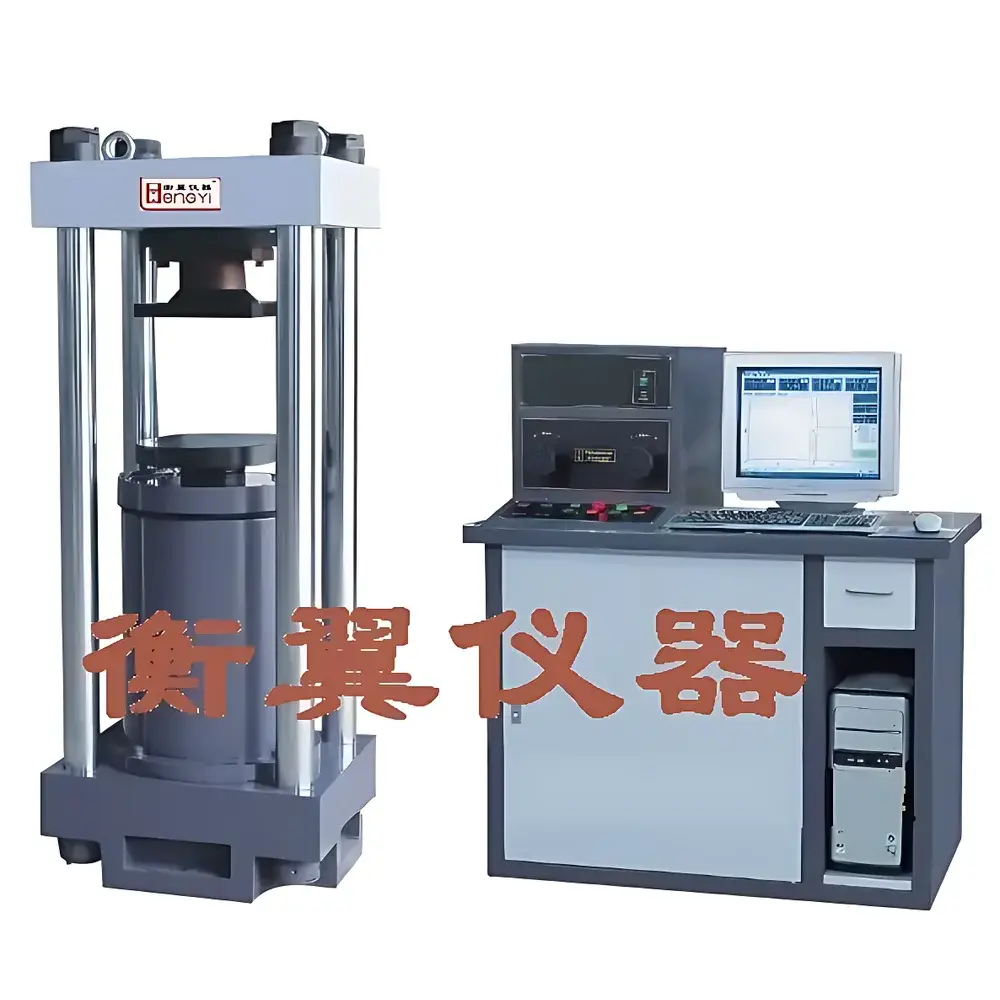
Hengyi HY(YE)-200008A Microcomputer-Controlled Electro-Hydraulic Compression Testing Machine
| Brand | Hengyi |
|---|---|
| Origin | Shanghai, China |
| Manufacturer Type | Direct Manufacturer |
| Model | HY(YE)-200008A |
| Max Load Capacity | 2000 kN |
| Accuracy Class | Class 1 (per GB/T 3159 & ISO 7500-1) |
| Force Measurement Range | 200–2000 kN |
| Relative Indicated Error | ±1% |
| Clear Distance Between Columns | 450 mm |
| Upper/Lower Platen Dimensions | 240 × 240 mm |
| Piston Stroke | 80 mm |
| Motor Power | 0.75 kW |
| Net Weight | ~800 kg |
| Overall Dimensions (W×D×H) | 850 × 500 × 1480 mm |
| Deformation Measurement Accuracy | ±0.5% of reading |
| Displacement Measurement Error | ±0.5% of reading |
| Stress Rate Control Range | 1–60 N/mm²/s |
| Strain Rate Control Range | 0.00025–0.0025 s⁻¹ |
| Closed-Loop Control Accuracy (Force/Displacement/Deformation) | ±1% of set value |
| Hydraulic Control | High-Precision Electro-Hydraulic Proportional Valve |
| Sensors | High-Accuracy Load Cell & Linear Displacement Transducer |
| Control System | Dedicated Microcomputer-Based Electro-Hydraulic Proportional Closed-Loop Controller |
| Software | Full-featured Test Management Suite with A4 Color Report Generation, Data Archiving, and Audit-Trail-Capable Export |
Overview
The Hengyi HY(YE)-200008A is a fully automated, microcomputer-controlled electro-hydraulic compression testing machine engineered for high-reliability mechanical characterization of construction materials under uniaxial compressive loading. It operates on the principle of servo-controlled hydraulic actuation, where a precision electro-hydraulic proportional valve regulates oil flow to maintain programmable stress or strain rate profiles in real time. Designed in accordance with national and international standards—including GB/T 3159 (Chinese standard for universal testing machines), ISO 7500-1 (static calibration of force-proving instruments), and ASTM C39/C109 for concrete and mortar compression testing—the system delivers traceable, repeatable, and auditable test outcomes essential for quality assurance in civil engineering laboratories, precast concrete plants, and third-party certification bodies.
Key Features
- Class 1 force measurement accuracy (±1% indicated value), validated per ISO 7500-1 and supported by dual-channel high-stability load cell and LVDT displacement transducers
- Electro-hydraulic proportional closed-loop control architecture enabling precise regulation of stress rate (1–60 N/mm²/s) and strain rate (0.00025–0.0025 s⁻¹) with ≤±1% deviation from setpoint
- Dual-platen configuration with hardened 240 × 240 mm steel platens and 450 mm column clearance—optimized for standard 150 mm concrete cubes, 100 mm cylinders, bricks, and natural stone specimens
- Motor-driven vertical adjustment mechanism (80 mm stroke) ensures rapid, repeatable specimen alignment without manual jacking or shimming
- Integrated test management software with full GLP-compliant data handling: timestamped raw data logging, user-accessible audit trails, customizable A4 color report templates (PDF/Excel export), and password-protected operator levels
- Self-diagnostic hydraulic subsystem with pressure monitoring, thermal overload protection, and emergency stop interlock compliant with IEC 60204-1 safety standards
Sample Compatibility & Compliance
The HY(YE)-200008A accommodates standard and non-standard compression specimens used across construction material testing protocols, including but not limited to: 150 mm × 150 mm × 150 mm concrete cubes (GB/T 50081, ASTM C39), 100 mm × 200 mm concrete cylinders (ASTM C469), solid/hollow clay bricks (GB/T 2542), autoclaved aerated concrete blocks (GB/T 11969), and natural dimension stone samples (EN 1926). All hardware and firmware configurations meet mandatory requirements for ISO/IEC 17025-accredited laboratories, supporting documented calibration intervals, uncertainty budgeting, and instrument qualification (IQ/OQ/PQ) documentation packages. The system supports 21 CFR Part 11–compliant electronic signatures when deployed in regulated QA/QC environments.
Software & Data Management
The embedded Windows-based test control software provides real-time graphical display of load–displacement, stress–strain, and rate-controlled profiles during active testing. All raw acquisition channels (load, displacement, time) are sampled at ≥1 kHz and stored in binary format with metadata (operator ID, sample ID, environmental conditions, calibration certificate ID). Data export functions include CSV for statistical analysis, XML for LIMS integration, and PDF/A-1b for archival compliance. Built-in report modules generate standardized outputs aligned with GB, ASTM, and EN formats—including compressive strength (MPa), modulus of elasticity (GPa), Poisson’s ratio, and failure mode annotation. Audit logs record all parameter changes, test starts/stops, and user logins—retained for ≥12 months unless manually purged under retention policy.
Applications
This machine serves as a primary verification tool in structural material evaluation workflows: compressive strength determination of ready-mix and high-performance concrete; quality conformance testing of masonry units prior to site delivery; long-term strength development studies (e.g., 7-day, 28-day, 90-day curing); validation of admixture efficacy; and comparative assessment of recycled aggregate or supplementary cementitious materials. It is routinely deployed in provincial construction quality supervision stations, highway engineering labs certified under JTG E30, and R&D centers conducting durability-related investigations such as freeze-thaw resistance and chloride ion penetration correlation studies.
FAQ
What standards does this machine comply with for calibration and operation?
It conforms to GB/T 3159, ISO 7500-1, JJG 139, and supports test execution per GB/T 50081, ASTM C39, ASTM C109, EN 12390-3, and JTG E30-2005.
Can the system be integrated into an existing LIMS or ERP platform?
Yes—via configurable ODBC drivers and RESTful API endpoints for bidirectional data exchange, including sample registration, test initiation, and result ingestion.
Is remote diagnostics and software update support available?
Firmware and application updates are delivered via secure HTTPS channel; remote troubleshooting is enabled through optional TeamViewer QuickSupport module with customer-authorized access windows.
What maintenance intervals are recommended for hydraulic and sensor subsystems?
Hydraulic oil replacement every 24 months or 2000 operating hours; annual recalibration of load cell and displacement transducer per ISO 17025 procedures; quarterly functional verification using certified reference load blocks.
Does the machine support multi-step loading protocols (e.g., hold-and-relax, cyclic compression)?
Yes—the closed-loop controller supports up to 16 programmable segments per test, including ramp, dwell, and step-down phases, with independent control of force, displacement, or strain targets.



