
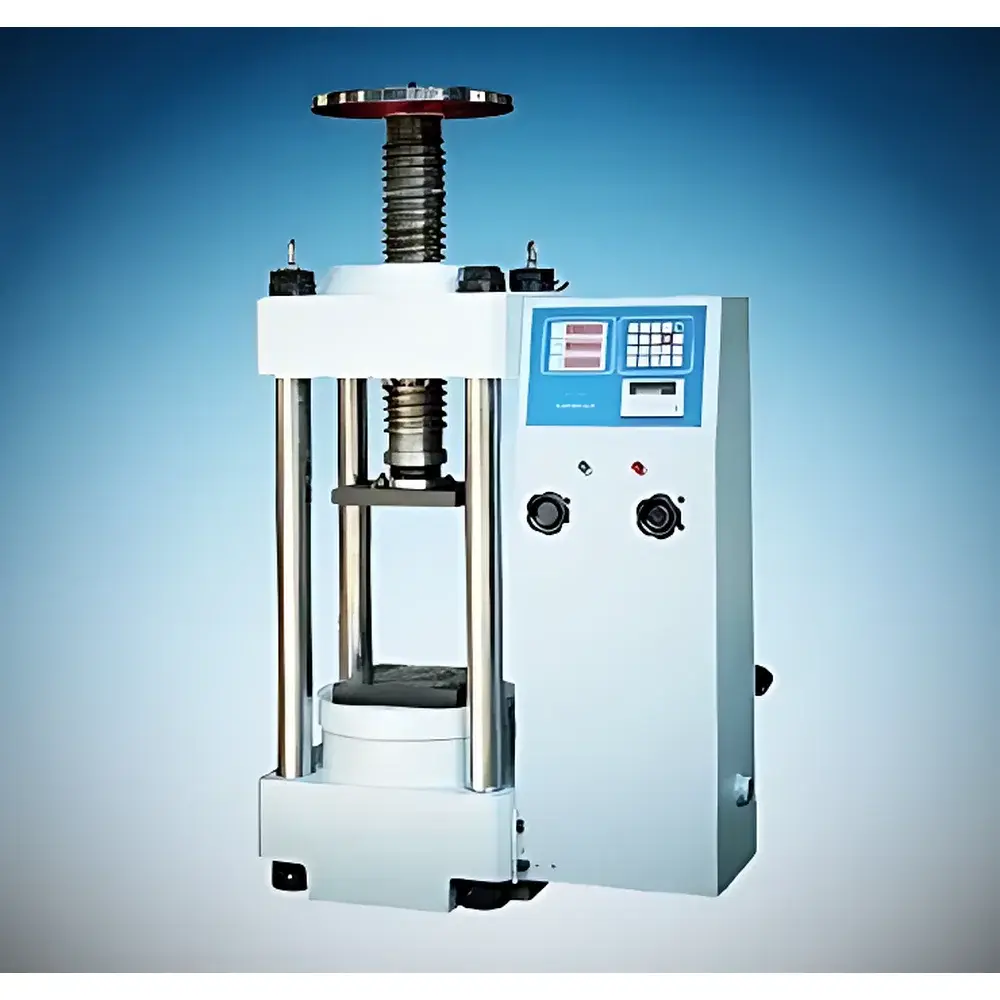
Hengyi HY(YE)-200008TYH 2000 kN Digital Hydraulic Compression Testing Machine
| Brand | Hengyi |
|---|---|
| Origin | Shanghai, China |
| Manufacturer Type | Direct Manufacturer |
| Country of Origin | China |
| Model | HY(YE)-200008TYH |
| Price | Upon Request |
| Max Load Capacity | 2000 kN |
| Accuracy Class | Class 1 (per ISO 7500-1 & ASTM E4) |
| Force Measurement Range | 200–2000 kN |
| Indicated Relative Error | ±1% |
| Loading Rate Adjustment | 1–15 mm/s (mechanically regulated via manual oil valve) |
| Internal Clear Span | 450 mm |
| Upper Platen Dimensions | 240 × 240 mm |
| Lower Platen Dimensions | 240 × 240 mm |
| Piston Stroke | 80 mm |
| Motor Power | 0.75 kW |
| Net Weight | ~800 kg |
| Overall Dimensions (W×D×H) | 850 × 500 × 1480 mm |
| Standard Fixture | One set of compression platens |
Overview
The Hengyi HY(YE)-200008TYH is a Class 1-compliant digital hydraulic compression testing machine engineered for precise, repeatable mechanical evaluation of rigid construction materials under uniaxial compressive loading. It operates on a proven hydraulic actuation principle—where controlled oil displacement drives a piston to apply axial force to test specimens—combined with electronic load transduction and real-time digital display. Unlike servo-hydraulic or electromechanical systems, this machine employs manually regulated hydraulic flow control via an adjustable oil inlet valve, enabling stable, constant-rate loading without closed-loop feedback. Its architecture prioritizes operational robustness, long-term calibration stability, and compliance with foundational static compression standards including ISO 7500-1 (metallic materials), ASTM E4 (verification of force-measuring instruments), and GB/T 3159 (Chinese national standard for hydraulic compression testers). Designed for environments where deterministic mechanical behavior—not dynamic response—is the primary measurement objective, it delivers high reproducibility in routine quality control and conformity assessment workflows.
Key Features
- Class 1 accuracy per ISO 7500-1 and ASTM E4, verified across 10–100% of full scale (200–2000 kN)
- Digital load readout with simultaneous display of applied force (kN), loading rate (mm/s), and peak hold function
- Manually adjustable hydraulic loading system with calibrated oil valve for precise, stepless control of loading speed (1–15 mm/s)
- Electrically driven screw lift mechanism for rapid, motorized crosshead positioning (80 mm stroke)
- Integrated data retention: automatic storage of test results upon completion; power-loss memory preserves last recorded value
- Overload protection circuitry prevents mechanical damage during accidental over-force application
- Structurally reinforced frame with dual vertical guide columns, rigid upper/lower beams, and cast-iron base for minimal deflection under maximum load
- Standardized 240 × 240 mm hardened steel platens optimized for uniform stress distribution on concrete cubes, bricks, and mortar specimens
Sample Compatibility & Compliance
This tester accommodates standard civil engineering specimens per widely adopted international protocols: 150 mm concrete cubes (ASTM C39, EN 12390-3), 100 mm brick units (ASTM C67, ISO 10545-1), and cylindrical cement mortar samples (ASTM C109). The 450 mm internal clear span ensures compatibility with oversized prismatic specimens up to 400 mm in height. All force measurement components are traceably calibrated against national metrological standards, and the system supports documentation required for ISO/IEC 17025-accredited laboratories. While not equipped with audit-trail software or 21 CFR Part 11 compliance features, its analog-digital hybrid design meets GLP requirements for non-regulated QC labs performing routine compressive strength verification in accordance with GB/T 50081, ASTM C39, and EN 12390 series.
Software & Data Management
The HY(YE)-200008TYH utilizes an embedded microcontroller-based digital indicator with dedicated firmware—no external PC or proprietary software is required for basic operation. Test data (peak load, loading rate, date/time stamp) is stored internally and can be exported via RS-232 serial interface to third-party spreadsheet or LIMS platforms. The unit supports automated thermal-printed report generation (via integrated thermal printer) including specimen ID, test date, load value, and operator signature field. For laboratories requiring enhanced traceability, optional USB data logging modules and CSV-compatible output drivers are available through Hengyi’s OEM integration program. Calibration parameters are password-protected and editable only by authorized service personnel using hardware key codes.
Applications
- Compressive strength testing of Portland cement concrete (cubes, cylinders, prisms) per ASTM C39, EN 12390-3, and GB/T 50081
- Masonry unit evaluation (clay bricks, concrete blocks, autoclaved aerated concrete) per ASTM C67, ISO 10545-1, and GB/T 2542
- Cement mortar strength validation (flexural and compressive) per ASTM C109 and EN 196-1
- Quality assurance of precast structural elements, grouts, and refractory ceramics
- Teaching and research applications in civil engineering departments, focusing on stress-strain behavior of brittle materials
- Third-party inspection and certification services requiring ISO 17025-aligned static compression verification
FAQ
What standards does this machine comply with for force calibration?
It conforms to ISO 7500-1:2018 (static calibration of tensile/compression testing machines) and ASTM E4-23 (verification of force-measuring systems), with Class 1 accuracy certified over 10–100% of its 2000 kN capacity.
Is the loading rate truly adjustable during a test?
No—the loading speed is preset prior to test initiation via manual oil valve adjustment and remains constant throughout the compression cycle; real-time rate modulation is not supported.
Can it perform flexural or tensile tests?
Not natively. It is configured exclusively for compression. Flexural or splitting tensile tests require separate fixtures (e.g., third-point bending rig or Brazilian disc setup), which are available as optional accessories but not included in the base configuration.
What maintenance is required for long-term accuracy?
Annual recalibration of the load cell and pressure transducer is recommended; hydraulic oil should be replaced every 24 months or after 5,000 test cycles, and all guide surfaces must be lubricated quarterly per the maintenance log provided in the technical manual.
Does it support network connectivity or remote monitoring?
No built-in Ethernet or Wi-Fi capability exists. Remote data access requires external serial-to-Ethernet converters or integration via Modbus RTU (available upon request with optional communication module).



