
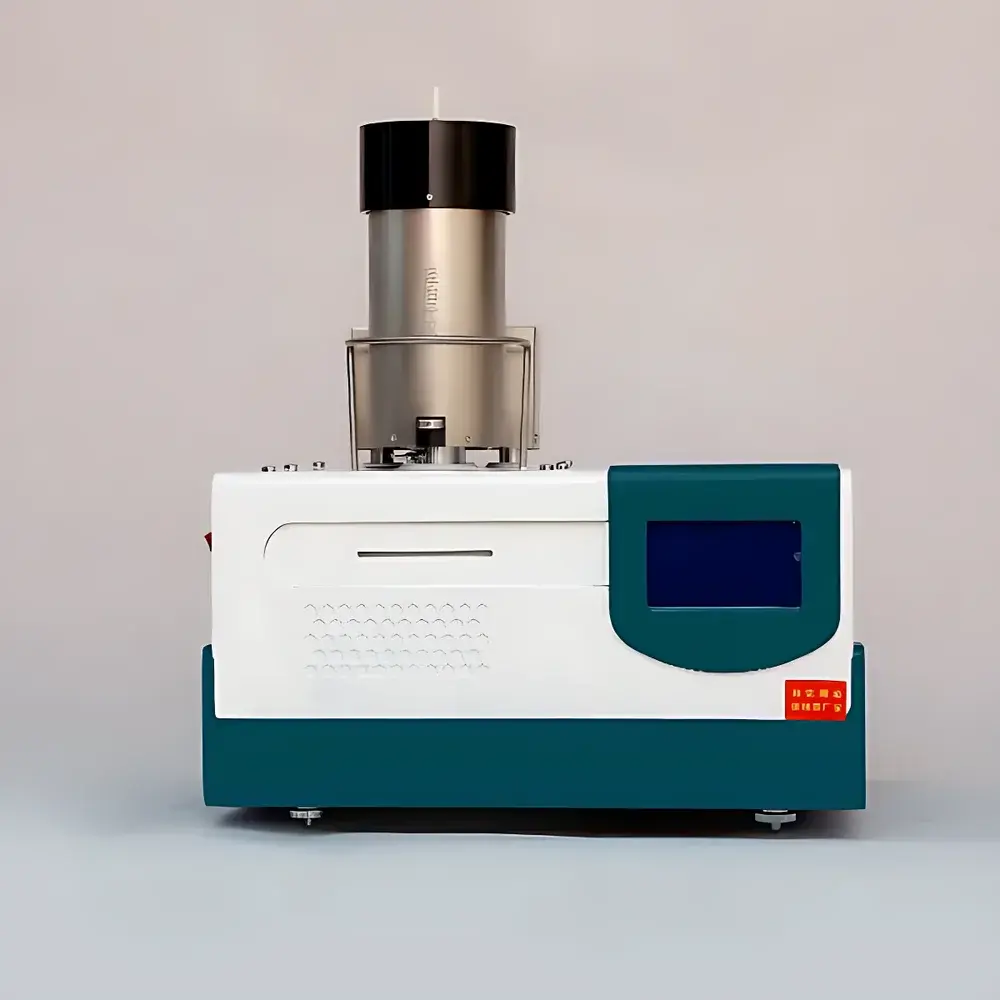
Henven HCT-2 Simultaneous Thermal Analyzer
| Brand | Henven |
|---|---|
| Origin | Beijing, China |
| Manufacturer Type | Direct Manufacturer |
| Region of Origin | Domestic (China) |
| Model | HCT-2 |
| Price Range | USD 14,000 – 20,000 (FOB Beijing) |
| Temperature Range | Ambient to 1250 °C |
| Heating Rate | 0.1–100 °C/min (programmable) |
| Temperature Stability | ±0.1 °C |
| Maximum Sample Mass | 5 g |
| Atmosphere Control | Dual-channel mass flow controller (MFC) |
Overview
The Henven HCT-2 Simultaneous Thermal Analyzer is an integrated thermogravimetric analyzer (TGA) and differential thermal analyzer (DTA), engineered for precision measurement of mass change and thermal effects occurring concurrently in a single sample under controlled temperature programs. Based on the principle of simultaneous thermogravimetry–differential thermal analysis (TG–DTA), the instrument captures real-time mass loss (via high-sensitivity microbalance) and endo-/exothermic transitions (via dual thermocouple differential sensing) in one experimental run. This architecture eliminates inter-sample variability and ensures strict thermal history correlation between weight and heat-flow signals—critical for kinetic modeling, phase transition validation, and decomposition mechanism studies. Designed for laboratory environments operating under ISO/IEC 17025-aligned workflows, the HCT-2 supports method development compliant with ASTM E1131, ASTM E1641, ISO 11358, and USP for thermal stability assessment.
Key Features
- High-stability furnace system with dual thermocouple monitoring: one continuously measures furnace block temperature (active or idle), while the second tracks actual sample temperature during operation—enabling precise thermal lag compensation.
- Microbalance with 0.1 μg resolution and <0.1 μg RMS noise; full-scale range 1 mg–200 mg; calibrated per ASTM E2550 for mass accuracy verification.
- Dual-channel mass flow controller (MFC) for independent, programmable gas delivery (e.g., N₂, Ar, O₂, synthetic air); optional chemically resistant MFC modules and gas lines available for aggressive atmospheres including HCl, Cl₂, SO₂, and HF.
- Modular crucible support: accommodates standard 0.06 mL and 0.12 mL ceramic crucibles; optional crucibles include Al, quartz, graphite, and Pt–Rh (up to 1600 °C).
- Programmable isothermal capability: stable hold at any temperature point within 0–1250 °C for up to 72 hours, with active drift correction enabled.
- Real-time signal scaling: automatic range switching during acquisition based on output amplitude; user-definable x-axis (temperature or time) and y-axis (absolute mass or % mass loss) units.
- Integrated cryo-cooled DTA sensor with ±10 μV to ±2000 μV full-scale range and 0.01 μV resolution; no manual gain adjustment required.
Sample Compatibility & Compliance
The HCT-2 accepts solid, powder, granular, and thin-film samples (0.1–5 g, depending on crucible geometry and thermal conductivity). It supports inert, oxidative, reductive, and reactive atmospheres—including custom-configured corrosion-resistant gas manifolds certified to ISO 8502-9 for halogenated gas compatibility. The system meets mechanical and electrical safety requirements per IEC 61010-1 and electromagnetic compatibility (EMC) standards EN 61326-1. Optional vacuum interface (2.5 × 10⁻² Pa with external pump) enables low-pressure pyrolysis studies. All firmware and software modules comply with audit-trail and electronic signature requirements outlined in FDA 21 CFR Part 11 when configured with password-protected user roles and timestamped data logging.
Software & Data Management
The proprietary HenvenTherm v4.x software provides full control of temperature ramping, gas switching, data acquisition, and post-run analysis. Supported calculations include: derivative thermogravimetry (DTG), second-derivative DTA (DDTA), peak deconvolution, crystallization kinetics (Avrami, Ozawa–Flynn–Wall), activation energy estimation (Kissinger, Friedman, Ozawa–Doyle), glass transition determination (midpoint/tangent methods), specific heat calculation (via comparative method using sapphire reference), and oxidation induction time (OIT) per ASTM D3895. Raw data are stored in ASCII-delimited format (.txt) and HDF5 (.h5) for third-party interoperability. Software supports GLP/GMP-compliant reporting with customizable templates, electronic signatures, and revision-controlled method storage.
Applications
- Thermal stability and decomposition pathway analysis of polymers, pharmaceuticals, and battery cathode materials.
- Quantification of filler content, moisture, solvent residue, and volatile organic compounds (VOCs) in composites and coatings.
- Phase transition characterization (melting, crystallization, solid–solid transitions) in metallurgical alloys and ceramics.
- Oxidation resistance evaluation of carbon-based refractories and catalyst supports under dynamic air/N₂ switching.
- Reaction enthalpy determination for solid-state synthesis, hydration/dehydration, and adsorption/desorption processes.
- Compatibility screening for drug–excipient interactions in preformulation studies (ICH Q5C).
FAQ
What calibration standards are supported for temperature and enthalpy verification?
NIST-traceable standards including indium (156.6 °C), tin (231.9 °C), zinc (419.5 °C), and alumina (for baseline correction) are recommended. Users may perform multi-point calibration using built-in routines.
Can the HCT-2 be coupled to GC or MS systems?
Yes—optional heated transfer line (ambient to 200 °C), vacuum-tight GC/MS interface, and temperature-stabilized coupling zone are available as factory-installed accessories.
Is remote operation and data export supported?
The system supports Ethernet-based remote monitoring via TCP/IP; data export includes CSV, Excel, PDF report generation, and HDF5 for MATLAB/Python integration.
What maintenance intervals are recommended for the microbalance and furnace?
Balance zero-check and sensitivity verification every 30 days; furnace calibration annually or after 500 thermal cycles; MFC recalibration every 6 months per ISO 6145-7.
Does the software support automated method sequencing for unattended overnight runs?
Yes—batch mode allows up to 99 sequential methods with auto-start, email notification on completion, and error-triggered shutdown logic.



