
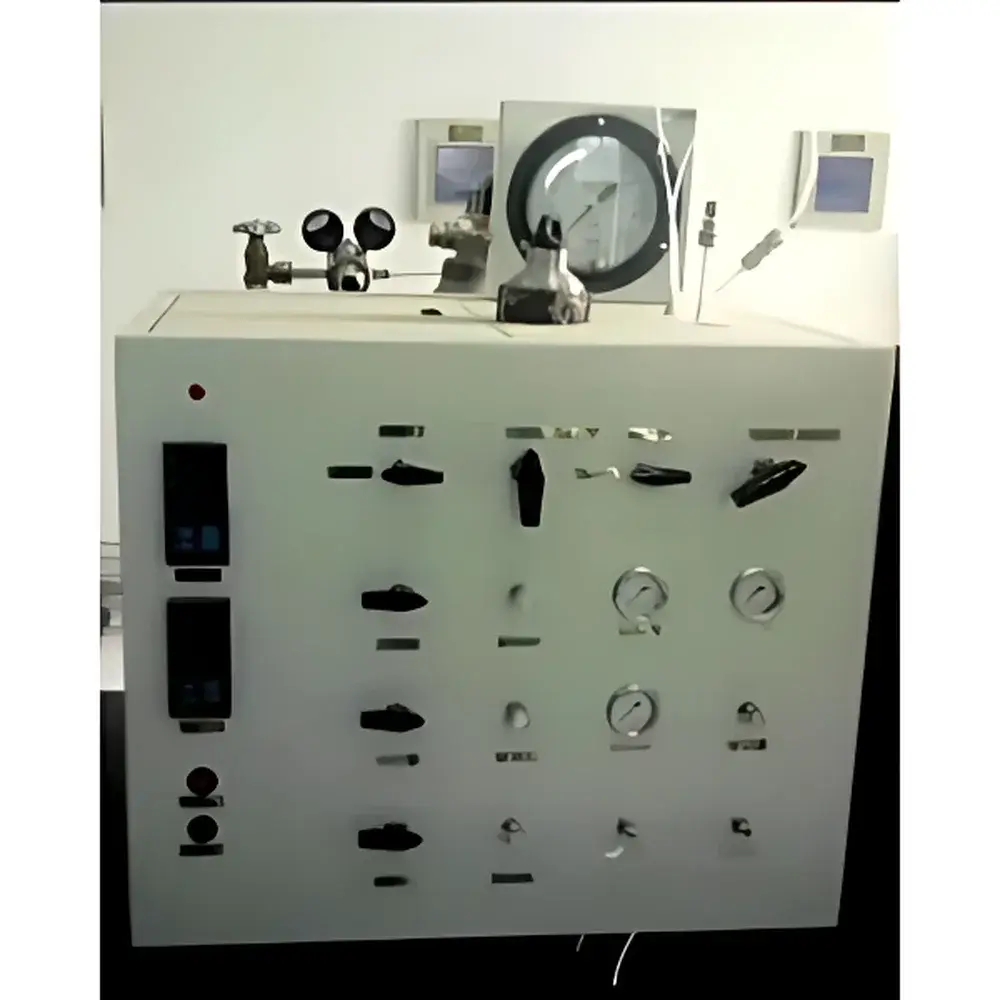
Henven HJ0 Multi-Function Small-Scale Catalyst Evaluation System
| Brand | Henven |
|---|---|
| Origin | Beijing, China |
| Manufacturer Type | Direct Manufacturer |
| Model | HJ0 |
| Temperature Range | Ambient to 100 °C |
| Temperature Control Accuracy | ±0.1 °C |
| Operating Pressure | 0.1–0.4 MPa |
| Butadiene Feed Rate | 0–100 mL/min |
| Cyclohexane Feed Rate | 500 mL/min |
| Catalyst Feed Rate | 0–50 mL/min |
| Termination Agent Feed Rate | 0–50 mL/min |
| Total Residence Time (3 Reactors in Series) | 1.5–4 hr |
| Coagulation Vessel Volume | 200 L |
| Reactor Effective Volume (per unit) | 15 L |
| Configuration | 3 Polymerization Reactors + 1 Termination Reactor + 2 Latex Storage Vessels + 1 Particle Formation Vessel |
| Real-Time Monitoring | Temperature, Pressure, Flow (Multi-Point) |
| Structural Frame | High-Strength Integrated Stainless Steel |
Overview
The Henven HJ0 Multi-Function Small-Scale Catalyst Evaluation System is a purpose-engineered continuous solution-phase polymerization platform designed for rigorous catalyst screening and kinetic process development in synthetic elastomer research. Built upon Couette-flow reactor architecture and modular cascade configuration, the system enables precise replication of industrial-scale solution polymerization conditions—including sequential monomer addition, controlled chain growth, and targeted termination—at laboratory scale. Its core design integrates seven functionally distinct vessels (three polymerization reactors, one termination reactor, two latex storage tanks, and one particle formation vessel) arranged in series to emulate residence time distribution (RTD) profiles typical of commercial butadiene rubber (BR) and styrene-butadiene rubber (SBR) production lines. Each 15 L reactor operates under tightly regulated thermal and pressure conditions (ambient to 100 °C; 0.1–0.4 MPa), supported by a high-stability water-bath temperature control system delivering ±0.1 °C uniformity across all zones. The system’s fluidized-bed control module—developed in collaboration with Renmai—enables dynamic, sensor-driven actuation of gas flow, bed height, and heat exchange parameters, facilitating reproducible heterogeneous catalysis studies.
Key Features
- Fully automated touchscreen human-machine interface (HMI) with real-time visualization of all operational parameters including temperature gradients, pressure differentials, and volumetric feed rates across six independent liquid delivery channels
- Modular cascade reactor train with individually programmable linear ramping and hold profiles—supporting multi-stage reaction protocols such as staged initiator injection or gradient comonomer addition
- Integrated fault detection and mitigation subsystem with independent thermocouple and pressure transducer monitoring at critical nodes; automatic alarm triggering and emergency shutdown sequence activation upon threshold violation
- High-integrity mechanical construction: fully welded 316L stainless steel frame and operator panel; IP65-rated instrumentation enclosures; ASME B31.3-compliant fluid handling pathways
- Native compatibility with third-party analytical instrumentation via analog/digital I/O and Modbus TCP interfaces—enabling synchronized online GC/FID or GPC data acquisition during active runs
- Onboard data logging with timestamped CSV export and optional integration into LIMS environments through OPC UA protocol support
Sample Compatibility & Compliance
The HJ0 system is validated for use with low-to-medium volatility organic solvents (e.g., cyclohexane, hexane), conjugated dienes (butadiene, isoprene), aromatic monomers (styrene), and transition-metal-based Ziegler–Natta or neodymium catalyst systems. All wetted surfaces comply with ASTM A240 and EN 10088-1 standards for corrosion resistance. Pressure containment components meet PED 2014/68/EU Category II requirements. Software operation supports audit trail generation per FDA 21 CFR Part 11 for electronic records and signatures, and data integrity features—including user access levels, change history logs, and immutable raw data archives—are configurable to align with GLP and GMP laboratory practices.
Software & Data Management
The embedded control software provides deterministic real-time scheduling (100 ms cycle time) for coordinated valve sequencing, pump actuation, and thermal setpoint modulation. Users define experiment protocols using a graphical workflow editor—specifying feed rate ramps, temperature profiles, and interlock logic without coding. All sensor inputs are sampled at ≥10 Hz and stored with millisecond-resolution timestamps. Export options include IEEE 754-compliant binary files for MATLAB/Python post-processing and ISO/IEC 17025-aligned calibration metadata embedding. Remote monitoring is supported via secure TLS 1.3-enabled web interface, allowing authorized personnel to review live trends or initiate manual overrides from off-site locations.
Applications
- Catalyst activity and selectivity benchmarking under industrially relevant residence time distributions (1.5–4 hr total)
- Kinetic modeling of living anionic or coordination polymerizations using in situ flow-through sampling
- Process intensification studies involving solvent recovery loops, heat integration, and inline viscosity monitoring
- Scale-up correlation analysis between lab-scale cascade performance and pilot-plant continuous stirred-tank reactor (CSTR) trains
- Development of low-cobalt or cobalt-free catalyst formulations for sustainable SBR/BR synthesis
- Validation of process safety parameters—including adiabatic temperature rise, MTSR, and runaway onset thresholds—under controlled exothermic conditions
FAQ
What types of catalysts can be evaluated on the HJ0 system?
Transition metal complexes (e.g., Nd-, Ti-, Co-, or Ni-based Ziegler–Natta systems), rare-earth catalysts, and single-site metallocenes compatible with hydrocarbon solvents are routinely tested. Heterogeneous supported catalysts may be evaluated using the integrated fluidized-bed module.
Is the system suitable for hazardous monomer handling (e.g., butadiene)?
Yes—the entire feed and reactor train is rated for Class I, Division 1 hazardous area operation per NEC Article 500. All pumps and valves feature double mechanical seals with inert gas purge capability; vent streams are routed to dedicated flare or scrubber interfaces.
Can the HJ0 interface with third-party chromatography systems?
Standard analog 4–20 mA and digital RS-485 outputs enable direct synchronization with GC, HPLC, or FTIR analyzers. Optional OEM SDK allows custom API integration for automated peak-triggered sampling or closed-loop composition control.
What maintenance intervals are recommended for long-term reliability?
Preventive maintenance is scheduled every 500 operational hours, including recalibration of mass flow controllers (per ISO 6976), verification of pressure transducer linearity (per ISO 5725), and inspection of gasket integrity in high-cycle valves.



