
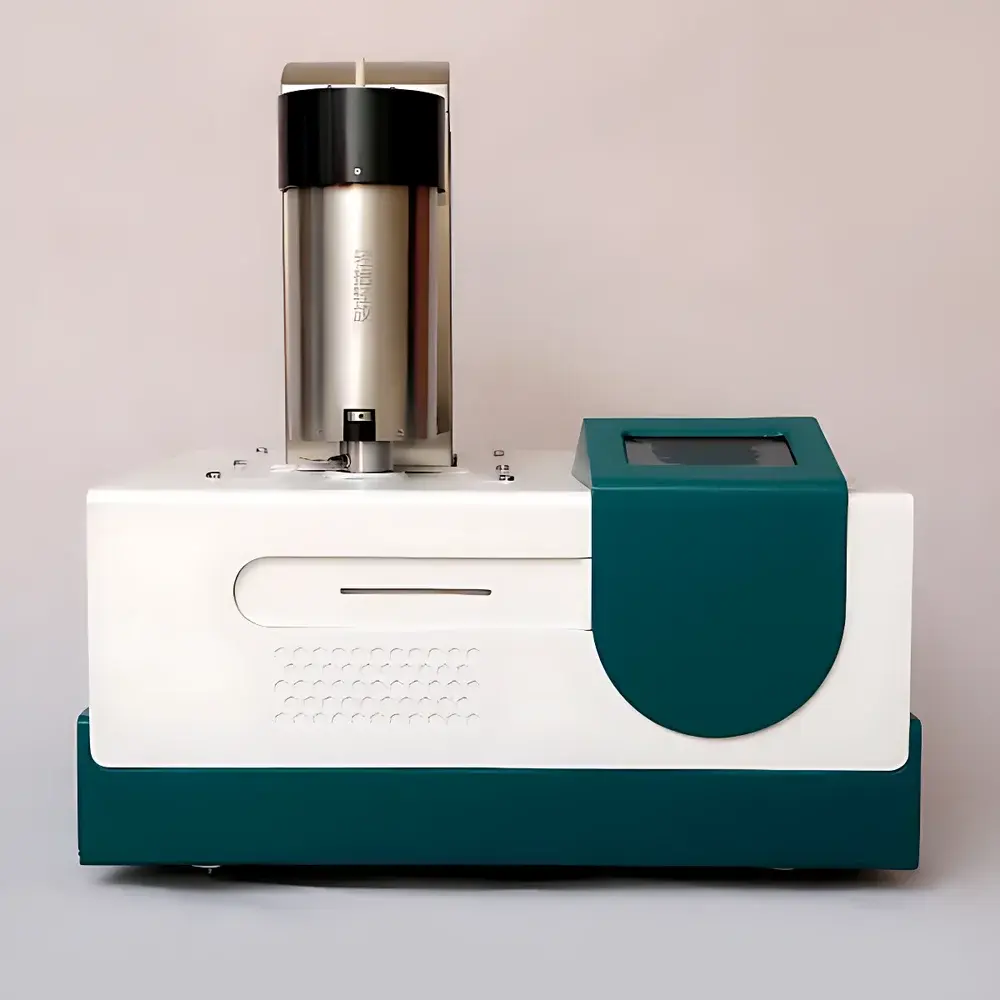
Henven HQT-2 Automated Simultaneous Thermal Analyzer
| Brand | Henven |
|---|---|
| Origin | Beijing, China |
| Manufacturer Type | Direct Manufacturer |
| Model | HQT-2 |
| Price Range | USD 18,000 – 25,000 (FOB Beijing) |
| Temperature Range | Ambient to 1250 °C |
| Heating Rate | 0.1–100 °C/min (user-definable) |
| Temperature Stability | ±0.1 °C |
| Max Sample Mass | 5 g |
| Atmosphere Control | Dual-channel mass flow controller (MFC) |
Overview
The Henven HQT-2 Automated Simultaneous Thermal Analyzer is an integrated thermogravimetric analyzer (TGA) and differential thermal analyzer (DTA), engineered for high-precision, real-time concurrent measurement of mass change and thermal effects in a single sample under controlled atmospheric conditions. Based on the principle of simultaneous thermogravimetry–differential thermal analysis (TG–DTA), the instrument enables synchronized acquisition of weight loss/gain (TG), derivative thermogravimetry (DTG), and endo-/exothermic transition signals (DTA) across a broad temperature domain—from ambient up to 1250 °C. Its modular furnace design, coupled with dual thermocouple monitoring (furnace temperature and sample temperature), ensures traceable thermal calibration and minimizes thermal lag. The system operates under programmable dynamic or isothermal conditions, supporting both inert (N₂, Ar), oxidative (air, O₂), reductive (H₂, CO), and highly corrosive atmospheres when equipped with optional chemically resistant MFCs and sealed gas lines.
Key Features
- Automated lift-and-lock furnace mechanism with repeatable vertical positioning—enhancing inter-run reproducibility and minimizing mechanical drift.
- Dual independent thermocouples: one continuously monitors furnace block temperature (active or idle), the other measures actual sample temperature during heating—enabling accurate ΔT correction and kinetic modeling.
- High-resolution microbalance with 0.1 μg resolution, <0.1 μg RMS noise, and 1–200 mg dynamic range; auto-ranging signal amplification adapts to evolving sample mass loss profiles.
- Two-channel mass flow controller (MFC) system with pressure-compensated flow regulation; supports fully automated gas switching during a run (e.g., N₂ → air → O₂) with sub-second response time and ≤1% full-scale accuracy.
- Configurable crucible support system accommodating 0–5 g samples via interchangeable rods; standard ceramic crucibles (0.06 mL and 0.12 mL), with optional Al, quartz, graphite, and Pt crucibles for specialized applications.
- Integrated vacuum interface (base vacuum: 2.5×10⁻² Pa with optional vacuum pump); compatible with GC, MS, and FTIR coupling via thermostatted transfer line (room temperature to 200 °C, optional).
Sample Compatibility & Compliance
The HQT-2 accommodates diverse solid and powdered materials—including polymers, pharmaceuticals, catalysts, ceramics, metals, composites, and geological specimens—without requiring pre-drying or pelletization in most cases. Its wide thermal range and configurable atmosphere enable compliance with multiple international test standards, including ASTM E1131 (TG), ASTM E1269 (heat capacity), ISO 11358 (polymer degradation), and USP (thermal analysis of drug substances). When operated with audit-trail-enabled software and electronic signature modules, the system supports GLP and GMP environments per FDA 21 CFR Part 11 requirements. Optional corrosion-resistant gas handling components meet ASTM D5865 and ISO 1716 specifications for halogen- or sulfur-containing fuel analysis.
Software & Data Management
The proprietary HQT-Analysis Suite provides full instrument control, real-time visualization, and advanced post-processing. It supports simultaneous display of TG, DTG, DTA, and derivative curves with user-defined axes (temperature/time × absolute mass/% mass/Δm/mW). Built-in algorithms enable quantitative evaluation of melting enthalpy, crystallization kinetics (Avrami, Ozawa), activation energy (Kissinger, Flynn–Wall–Ozawa), glass transition (Tg) via second-derivative inflection, and oxidation induction time (OIT). All raw data are stored in vendor-neutral ASCII format; export options include CSV, Excel, and universal .tdms for third-party integration. Software supports screenshot capture at any timepoint, automatic baseline correction, peak deconvolution, and comparative overlay of up to 16 runs. Custom scripting (Python/Lua API) allows implementation of user-defined calculation protocols—such as specific heat ratio determination or multi-step reaction modeling—upon request.
Applications
- Thermal stability assessment of battery cathode/anode materials under N₂/O₂ cycling.
- Decomposition kinetics and residue quantification in flame-retardant polymers.
- Hydration/dehydration behavior and stoichiometric water loss in pharmaceutical hydrates (ICH Q5C).
- Oxidation onset temperature and char yield evaluation of carbon-based catalysts.
- Phase transition mapping in shape-memory alloys and ferroelectric ceramics.
- In-situ evolved gas analysis (EGA) via coupled FTIR or MS for identification of decomposition volatiles (e.g., NH₃, HCl, CO, H₂O).
- Quality control of inorganic pigments and fillers by quantifying organic binder burn-off and metal oxide content.
FAQ
Can the HQT-2 perform DSC measurements?
No—the HQT-2 implements DTA (differential thermal analysis), not DSC. It measures temperature difference between sample and reference, not heat flow. For true DSC capability, Henven offers the HDS series.
Is vacuum operation standard or optional?
Base vacuum sealing is built-in; ultimate vacuum down to 2.5×10⁻² Pa requires optional two-stage rotary vane pump assembly.
What calibration standards are supported?
The system accepts certified reference materials per ASTM E967 (indium, tin, zinc, alumina) for temperature calibration, and nickel oxide or calcium oxalate monohydrate for mass/energy validation.
Does the software comply with 21 CFR Part 11?
Yes—when deployed with optional electronic signature module, role-based access control, and full audit trail logging, the software meets FDA 21 CFR Part 11 requirements for regulated laboratories.
Can I connect the HQT-2 to my existing GC–MS system?
Yes—via the thermostatted GC/MS interface option (0–200 °C heated transfer line, Swagelok fittings, and vacuum-tight coupling flange).



