
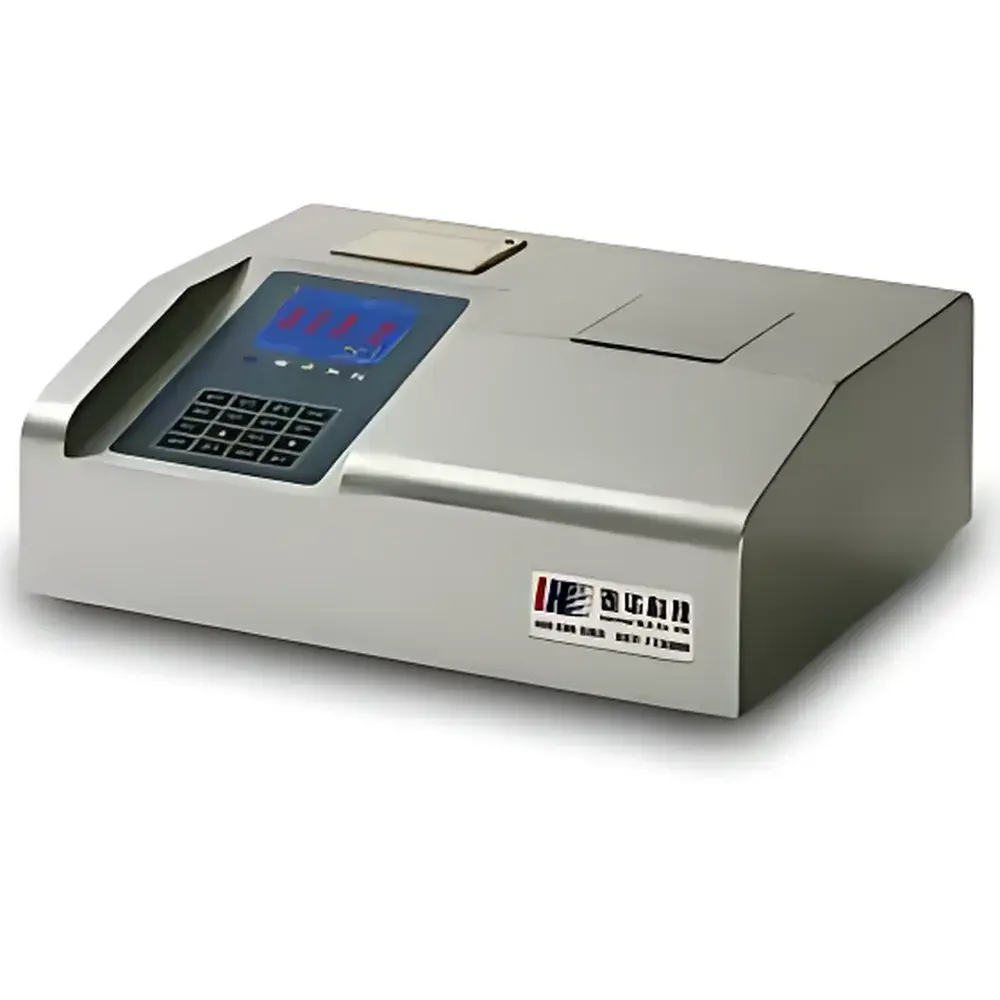
HePu 5B-3B(V8) Multi-Parameter Laboratory Water Quality Analyzer
| Brand | HePu (Jinan Hepu Instrument Co., Ltd.) |
|---|---|
| Origin | Shandong, China |
| Manufacturer Type | Authorized Distributor |
| Product Category | Domestic |
| Model | 5B-3B(V8) |
| Instrument Type | Benchtop Laboratory Water Quality Analyzer |
| Measured Parameters | COD, Ammonia Nitrogen, Total Phosphorus, Turbidity, Sulfide, Cyanide, Sulfate, Boron, Free & Total Chlorine, Fluoride, Iodide, Nitrate Nitrogen, Arsenic, Beryllium, Cobalt, Hexavalent Chromium, Copper, Lead, Antimony, Vanadium, Thorium, Uranium, Volatile Phenols, Aniline, Nitrobenzene, Formaldehyde, Iron, Nitrite Nitrogen, Mercury, Manganese, Nickel, Zinc, Barium, Silver |
| COD Range | 2–10,000 mg/L (multi-range) |
| Ammonia N | 0.02–60 mg/L |
| Total P | 0.002–5 mg/L |
| Turbidity | 0.5–400 NTU |
| Detection Limits | COD: 0.1 mg/L |
| NH₃-N | 0.01 mg/L |
| TP | 0.001 mg/L |
| Turbidity | 0.1 NTU |
| Accuracy | COD <50 mg/L: ±10% |
| COD ≥50 mg/L | ±5% |
| NH₃-N/TP/Turbidity | ±5% |
| Repeatability | ≤±5% |
| Optical Stability | ≤0.001 A/10 min |
| Light Source Lifetime | 100,000 hours |
| Sample Throughput | 15 or 30 samples per digestion cycle (configurable) |
| Digestion Temp Range | Ambient to 190 °C |
| Precision Control | ±0.5 °C at 120 °C and 165 °C setpoints |
| Digestion Timer | 1 min – 96 h |
| Data Storage | 12,000 measurement records with timestamp, parameter ID, and result |
| Calibration Curves | 330 stored (30 preloaded standard curves + 300 user-expandable) |
| Display | 320×240 color LCD |
| Connectivity | USB port + optional infrared wireless module |
| Power Supply | 220 V AC, 50 Hz |
Overview
The HePu 5B-3B(V8) Multi-Parameter Laboratory Water Quality Analyzer is a modular benchtop spectrophotometric system engineered for standardized, regulatory-compliant analysis of inorganic and organic contaminants in drinking water, wastewater, surface water, and industrial effluents. It operates on the principle of absorbance-based quantification using fixed-wavelength photometry (typically 420 nm, 470 nm, 620 nm, and 700 nm), aligned with established methods including ISO 6060 (COD), ISO 7150-1 (ammonia nitrogen), ISO 6878 (total phosphorus), and ISO 7027 (turbidity). The instrument integrates an embedded digestion control module supporting dual-temperature-zone operation, enabling simultaneous or sequential thermal pretreatment of samples according to method-specific requirements (e.g., 165 °C/10 min for COD dichromate oxidation; 120 °C/30 min for persulfate digestion of total phosphorus). Its architecture complies with fundamental GLP documentation requirements through time-stamped data logging, audit-ready curve management, and traceable calibration history.
Key Features
- Integrated dual-zone digestion block with independent temperature and timer control—supports parallel processing of heterogeneous sample matrices requiring different digestion protocols.
- Auto-scan intelligent parameter selection: press-and-hold key initiates automatic recognition of test type based on inserted cuvette or tube geometry, minimizing operator error.
- 330 programmable calibration curves—including 30 factory-validated reference curves traceable to NIST-certified standards—and 300 user-defined curves adaptable to site-specific interferences or matrix effects.
- 12,000-entry non-volatile memory with full metadata (date, time, operator ID, parameter name, raw absorbance, calculated concentration, digestion conditions).
- Optical subsystem featuring long-life LED light sources (100,000 h MTBF), thermally stabilized optics, and drift compensation algorithms ensuring ≤0.001 A/10 min baseline stability.
- Safety-engineered digestion chamber with transparent, heat-resistant quartz-acrylic shield rated to 200 °C, integrated over-temperature cut-off, and auto-delayed power-down after timer expiration.
- Flexible connectivity: native USB 2.0 interface for direct PC synchronization; optional infrared transceiver supports secure, line-of-sight wireless transfer compliant with ISO/IEC 11801 Class D cabling performance benchmarks.
Sample Compatibility & Compliance
The 5B-3B(V8) accommodates standard 10 mm, 20 mm, and 30 mm pathlength glass or quartz cuvettes, as well as 16 mm OD digestion tubes conforming to ASTM D1253 and ISO 8467 specifications. It meets critical interference tolerance thresholds defined in US EPA Method 410.4 (chloride interference <1000 mg/L for COD; optional high-chloride module extends limit to 10,000 mg/L) and ISO 11923 (turbidity measurement under low-light scattering conditions). All optical and thermal modules are calibrated against certified reference materials accredited to ISO/IEC 17025 by CNAS-recognized laboratories. The system supports 21 CFR Part 11–ready data export when paired with validated third-party LIMS software, fulfilling audit trail, electronic signature, and data integrity prerequisites for environmental testing laboratories operating under ISO/IEC 17025:2017 or China’s CMA certification framework.
Software & Data Management
Data acquisition and reporting are managed via HePu’s proprietary AquaLink v3.2 desktop application (Windows 10/11 compatible), which provides GMP-aligned features including role-based user access control, electronic logbook generation, and PDF report templating with embedded digital signatures. Raw spectral data, calibration logs, and digestion event timestamps are exported in CSV and XML formats compatible with ELN platforms such as LabArchives and Benchling. Curve validation reports include residual error analysis, correlation coefficient (R² ≥ 0.999), and confidence interval estimation per ISO 8466-1. Historical datasets can be queried by date range, parameter, operator, or batch ID—enabling trend analysis aligned with ISO 5725-2 precision evaluation protocols.
Applications
This analyzer serves municipal water utilities conducting routine compliance monitoring per GB 5749–2022 (China’s Sanitary Standard for Drinking Water), environmental monitoring stations performing surface water quality assessment per HJ 91.1–2019, and industrial QA/QC labs verifying pretreatment efficiency in electroplating, pharmaceutical, and petrochemical effluent streams. Its extended parameter list—including heavy metals (As, Cr⁶⁺, Pb, Hg, Ni, Zn), disinfection byproducts (free/total chlorine, nitrate/nitrite), and emerging contaminants (volatile phenols, aniline, formaldehyde)—enables multi-matrix screening without cross-platform method revalidation. The dual-temperature digestion capability further supports research applications involving refractory organics or particulate-bound nutrients requiring stepped thermal oxidation.
FAQ
Does the 5B-3B(V8) support method validation per ISO/IEC 17025?
Yes—the instrument’s calibration traceability, documented uncertainty budgets, and built-in repeatability/reproducibility checks satisfy Clause 7.7 of ISO/IEC 17025:2017 for in-house method verification.
Can custom digestion protocols be programmed beyond the default temperature/time presets?
Yes—up to 10 user-defined digestion profiles may be saved, each with independent ramp rate, hold temperature, dwell time, and cooling delay parameters.
Is the infrared wireless module compatible with existing laboratory network security policies?
The optional IR module operates in point-to-point mode only (no IP stack or Wi-Fi dependency), eliminating firewall or VLAN configuration requirements while maintaining data confidentiality through physical-layer transmission constraints.
How is optical alignment verified during routine maintenance?
A built-in self-diagnostic routine performs LED intensity profiling and dark-current correction at startup; annual verification using HePu’s NIST-traceable neutral density filters (P/N AQ-CAL-ND1000) is recommended.
What consumables require periodic replacement?
Primary consumables include digestion tubes (certified borosilicate glass, 16 mm OD), cuvettes (UV-grade quartz for low-absorbance measurements), and reagent kits supplied in ISO 8655-compliant volumetric dispensers—each lot accompanied by CoA referencing CRM batch numbers.







