
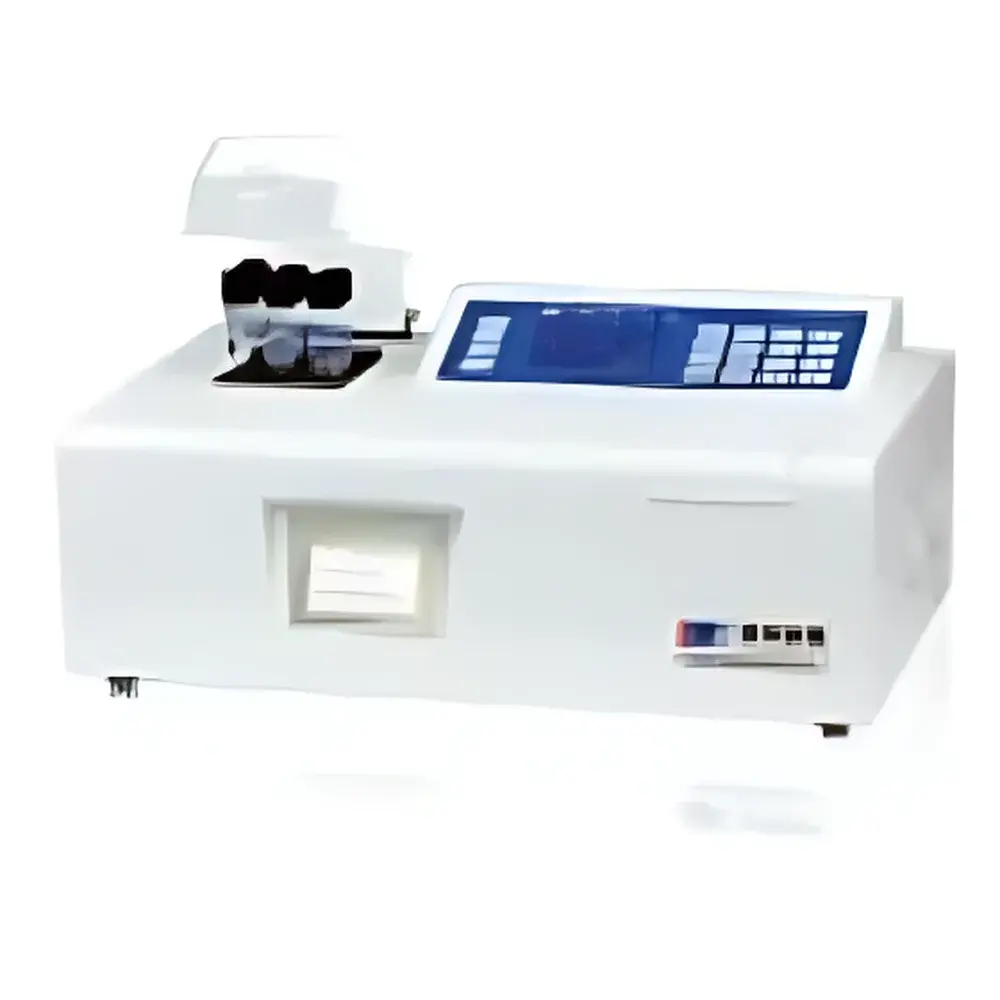
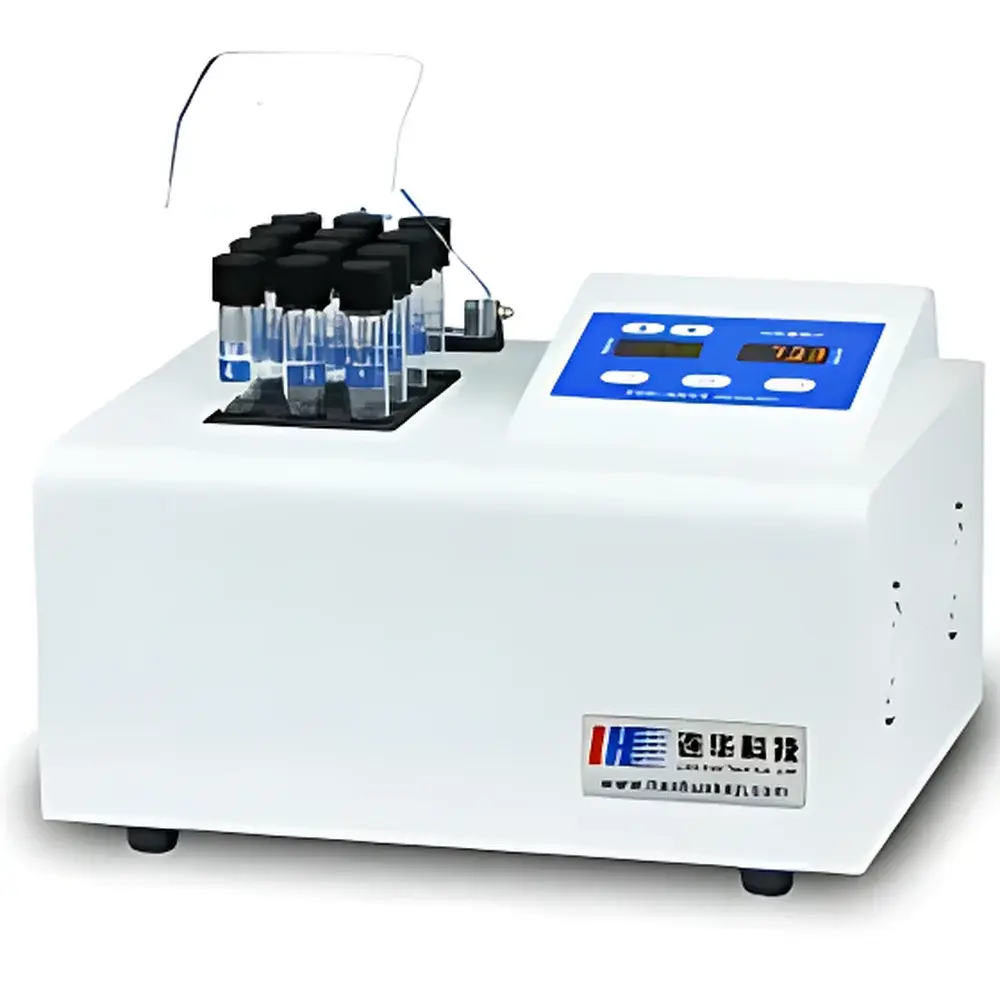
HePu 5B-6C Four-Parameter Laboratory Water Quality Analyzer
| Brand | HePu (Jinan Hepu Instrument Co., Ltd.) |
|---|---|
| Origin | Shandong, China |
| Model | 5B-6C |
| Instrument Type | Benchtop Laboratory Water Quality Analyzer |
| Measured Parameters | COD, Ammonia Nitrogen (NH₃-N), Total Phosphorus (TP), Turbidity |
| COD Range | 5–5000 mg/L (multi-range) |
| NH₃-N Range | 0.02–30 mg/L (multi-range) |
| TP Range | 0.002–10 mg/L (multi-range) |
| Turbidity Range | 0.5–400 NTU |
| COD Accuracy | ±10% (<50 mg/L), ±5% (≥50 mg/L) |
| NH₃-N/TP/Turbidity Accuracy | ±10% (NH₃-N), ±5% (TP & Turbidity) |
| Detection Limits | 0.1 mg/L (COD), 0.01 mg/L (NH₃-N), 0.001 mg/L (TP), 0.1 NTU (Turbidity) |
| Repeatability | ≤±5% for all parameters |
| Optical Stability | ≤0.001 A/10 min |
| Light Source | Cold LED (100,000 h lifetime), Narrow-band Interference Filter |
| Digestion Temp. | 165 °C ±0.5 °C (COD), 120 °C ±0.5 °C (TP) |
| Digestion Time | 10 min (COD), 30 min (TP) |
| Sample Throughput | 12 samples per batch (COD/TP), 20 (NH₃-N), unlimited (Turbidity) |
| Measurement Time | 20 min (COD), 10–15 min (NH₃-N), 35–50 min (TP), 1 min (Turbidity) |
| Chloride Interference Tolerance | ≤1000 mg/L Cl⁻ (standard), up to 10,000 mg/L (optional compensation) |
| Data Storage | 12,000 records (date/time/parameter/result) |
| Calibration Curves | 48 built-in (10 standard, 38 user-adaptable) |
| Curve Auto-Calibration & Save | Yes |
| Display | 320 × 240 color LCD, bilingual interface (Chinese default, English-capable) |
| Input | Full Chinese keypad |
| Connectivity | USB port |
| Power Supply | AC 220 V ±10%, 50/60 Hz |
| Safety Features | Heat-insulated digestion block lid, transparent heat-resistant splash guard (imported polymer), auto-delay shutdown, thermal overprotection |
Overview
The HePu 5B-6C Four-Parameter Laboratory Water Quality Analyzer is a benchtop spectrophotometric system engineered for precise, multi-parameter analysis of key water quality indicators in regulatory and operational environments. It implements standardized colorimetric and turbidimetric measurement principles compliant with ISO 8467 (COD by dichromate oxidation), ISO 7150-1 (ammonia nitrogen via Nesslerization or salicylate method), ISO 6878 (total phosphorus by ascorbic acid–molybdate reduction), and ISO 7027 (turbidity by nephelometry). Designed for routine monitoring in municipal water utilities, environmental protection agencies, wastewater treatment plants, aquaculture facilities, and industrial process control labs, the instrument integrates digestion, optical detection, and data processing into a single compact platform—eliminating inter-device calibration drift and reducing operator dependency on external reagent kits or standalone spectrophotometers.
Key Features
- Simultaneous quantification of four critical parameters: Chemical Oxygen Demand (COD), Ammonia Nitrogen (NH₃-N), Total Phosphorus (TP), and Turbidity—each following internationally recognized analytical protocols.
- Integrated digestion module with dual-temperature capability (165 °C ±0.5 °C for COD; 120 °C ±0.5 °C for TP), supporting up to 12 samples per batch with programmable heating profiles and thermal safety interlocks.
- High-stability optical system featuring cold LED light sources (100,000 h rated lifetime), narrow-band interference filters (FWHM <10 nm), and real-time baseline correction—ensuring long-term photometric repeatability (≤0.001 A/10 min).
- Flexible sample handling: compatible with both 10-mm square cuvettes and 16-mm round digestion tubes, enabling seamless transition between rapid field-ready assays and high-precision lab-grade determinations.
- Intuitive 320 × 240 color LCD interface with dual-font display mode, full Chinese keypad input, and context-sensitive operation prompts—optimized for technicians operating under mixed-language lab conditions.
- Comprehensive data governance: stores 12,000 measurement records with timestamp, parameter ID, raw absorbance/turbidity values, and result concentration—structured for traceability and audit readiness.
- Pre-loaded calibration library of 48 curves—including 10 factory-validated reference curves aligned with national standard methods—and 38 user-definable curves adaptable to matrix-specific interferences (e.g., saline wastewater, humic-rich surface water).
Sample Compatibility & Compliance
The 5B-6C accommodates diverse aqueous matrices including raw surface water, treated drinking water, secondary effluent, cooling tower recirculation water, and aquaculture pond water. Its chloride tolerance (≤1000 mg/L Cl⁻ without correction; extendable to 10,000 mg/L with optional algorithmic compensation) ensures robustness in coastal or industrial discharge monitoring. All measurement protocols align with Chinese Environmental Protection Standards (HJ/T 399–2007 for COD; HJ 535–2009 for NH₃-N; HJ 671–2013 for TP; HJ 1077–2019 for turbidity), and support GLP-compliant documentation workflows. While not FDA 21 CFR Part 11 certified out-of-the-box, its secure USB data export and immutable record timestamps facilitate integration into validated LIMS environments meeting ISO/IEC 17025 requirements.
Software & Data Management
Data acquisition and reporting are managed through embedded firmware supporting direct printing (via optional thermal printer), USB mass-storage export (CSV format), and infrared wireless transmission (IRDA 1.1 compliant, optional module). The system logs every measurement event—including curve selection, digestion settings, and operator ID input—with no editable fields post-recording. Built-in curve auto-calibration allows users to validate and update calibration functions using certified reference standards, with version-stamped history retained alongside original factory curves. Exported datasets include metadata headers required for QA/QC review: instrument ID, firmware revision, calibration date, and uncertainty flags for out-of-range absorbance readings.
Applications
- Municipal water supply surveillance: continuous verification of disinfection byproduct precursors (COD, NH₃-N) and coagulant efficiency indicators (TP, turbidity) across intake, treatment, and distribution points.
- Wastewater compliance reporting: generation of discharge permit–required data packages for NPDES or local regulatory submissions, particularly where multi-parameter correlation (e.g., BOD₅ estimation from COD/NH₃-N ratios) is mandated.
- Industrial process optimization: real-time tracking of cooling water corrosion potential (via NH₃-N spikes), phosphorus-based scale inhibitor dosing accuracy (TP), and filtration performance (turbidity decay profiles).
- Aquaculture health management: early detection of nitrogenous waste accumulation and suspended solids load—critical for maintaining dissolved oxygen saturation and preventing pathogen proliferation in recirculating systems.
- Environmental field lab deployment: rapid screening of watershed contamination events using pre-programmed emergency response curves, with offline storage eliminating dependency on network connectivity.
FAQ
Does the 5B-6C meet international standards such as ISO or ASTM?
Yes—the optical and procedural design follows ISO 8467, ISO 7150-1, ISO 6878, and ISO 7027. While not formally accredited to ASTM D1252 (COD) or D1429 (turbidity), its methodology is technically equivalent and widely accepted for non-certified compliance monitoring.
Can the instrument be used for regulatory reporting under China’s MEP requirements?
Yes—it complies fully with HJ/T 399–2007, HJ 535–2009, HJ 671–2013, and HJ 1077–2019, and is listed in the Ministry of Ecology and Environment’s Recommended Equipment Catalog for Environmental Monitoring.
Is English language support available on the display and software?
The interface defaults to Chinese, but English menu labels and report templates can be enabled via firmware configuration—no hardware modification required.
What maintenance is required to sustain measurement accuracy?
Annual verification against NIST-traceable standards (e.g., potassium hydrogen phthalate for COD, ammonium chloride for NH₃-N) is recommended. Optical path cleaning with ethanol-moistened lint-free swabs every 200 runs maintains photometric integrity.
How does the system handle high-turbidity samples that may interfere with colorimetric assays?
For NH₃-N and TP measurements, integrated dilution guidance algorithms prompt users to perform serial dilution when absorbance exceeds linear range thresholds—automatically adjusting final concentration calculations based on entered dilution factors.







