
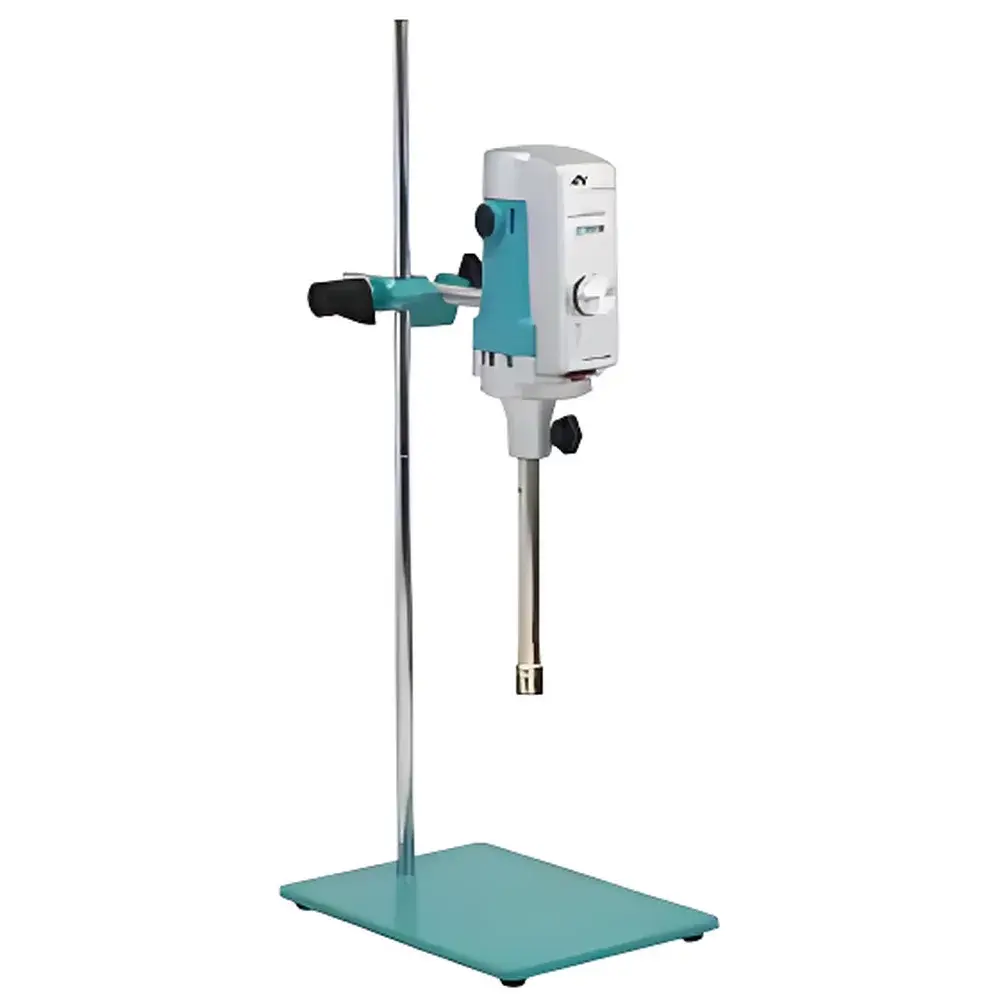
HEPU AE500S-H 50G High-Shear Laboratory Homogenizer
| [Brand | HEPU |
|---|---|
| Origin | Shandong, China |
| Model | AE500S-H 50G |
| Drive Type | Probe-type rotor-stator homogenizer |
| Dimensions (W×D×H) | 215 × 310 × 720 mm |
| Processing Volume | 500–20,000 mL |
| Input Power | 850 W |
| Output Power | 500 W |
| Speed Range | 1,000–14,000 rpm |
| Max. Rotor Tip Speed | 16 m/s |
| Torque | 34.1 N·cm |
| Working Head Material | SS316L stainless steel |
| Working Head Diameter | 50 mm |
| Standard Stator Orifice Sizes | 5, 20, 50 mm² |
| Max. Viscosity | 8,000 mPa·s |
| Ambient Temperature Limit | ≤40 °C |
| Relative Humidity Limit | ≤80 % |
| Net Weight | 9.2 kg] |
Overview
The HEPU AE500S-H 50G is a high-shear, probe-type laboratory homogenizer engineered for precision dispersion, emulsification, and particle size reduction in batch-mode operations. It operates on the rotor-stator principle: a high-speed rotating rotor generates intense hydrodynamic shear forces within a precisely engineered narrow gap between rotor and stator. This geometry induces combined mechanical effects—including radial acceleration, turbulent flow recirculation, cavitation, and laminar shear—enabling efficient phase mixing of immiscible systems (e.g., oil-in-water or water-in-oil emulsions) and uniform particle deagglomeration in suspensions. Designed for reproducible small-to-medium scale development workflows, the AE500S-H 50G supports formulation optimization in R&D laboratories across pharmaceutical, cosmetic, food, chemical, and materials science disciplines—where controlled energy input and scalable process parameters are critical for downstream translation.
Key Features
- Robust brushless motor with continuous-duty S1 rating, delivering stable 500 W mechanical output at up to 14,000 rpm under load
- Digital speed control with real-time rpm display (resolution: ±10 rpm), dynamic speed monitoring, and memory function for repeatable protocol recall
- Integrated overload protection and thermal cutoff to safeguard motor integrity during extended operation or high-viscosity processing
- SS316L stainless steel working head (50 mm diameter) certified for corrosion resistance and cleanability per ISO 8502-3; compatible with CIP/SIP validation protocols
- Modular stator system with three interchangeable orifice plates (5 mm², 20 mm², 50 mm²) enabling empirical optimization of shear intensity vs. throughput
- Ergonomic vertical column design (720 mm height) with adjustable clamp mount; accommodates vessels from 500 mL beakers to 20 L jacketed reactors
- Compliant with IEC 61000-6-3 (EMC emission) and IEC 61000-6-2 (immunity); meets CE marking requirements for laboratory equipment safety (EN 61010-1)
Sample Compatibility & Compliance
The AE500S-H 50G processes aqueous, organic, and semi-solid matrices with viscosities up to 8,000 mPa·s—covering formulations such as topical ointments (USP ), nanoemulsion preconcentrates, pigment dispersions (ASTM D1210), and protein-stabilized colloids. Its SS316L wetted parts meet FDA-compliant material specifications for non-implantable device contact surfaces. While not intrinsically rated for ATEX or IECEx hazardous environments, it is suitable for use in ISO Class 7/8 cleanrooms when operated with validated cleaning procedures. The instrument supports GLP-compliant documentation via external data logging interfaces (RS-232 optional), and its timer-based operation (1–1000 min) enables traceable execution of SOP-defined homogenization cycles aligned with 21 CFR Part 11 audit trail expectations.
Software & Data Management
The AE500S-H 50G features embedded firmware without proprietary software dependency—ensuring long-term operational continuity and minimizing cybersecurity exposure. All critical operating parameters (speed setpoint, actual rpm, elapsed time, overload events) are displayed locally and can be logged externally via analog voltage output (0–10 V) or RS-232 serial interface (optional module). When integrated into automated lab networks, it accepts TTL-level start/stop commands and reports status flags for PLC synchronization. No cloud connectivity or vendor-hosted platforms are required, preserving data sovereignty and simplifying 21 CFR Part 11 compliance through user-managed electronic records.
Applications
- Pharmaceutical: Preparation of micro/nanoemulsions for oral or dermal delivery; homogenization of semisolid bases (e.g., carbomer gels, petrolatum ointments) per USP
- Cosmetic: Development of stable emulsions for moisturizers, sunscreens, and cleansing balms; pigment dispersion in color cosmetics
- Food Science: Viscosity-controlled homogenization of sauces, dressings, and functional beverage suspensions; reduction of particle size in nutraceutical emulsions
- Materials Research: Exfoliation of 2D nanomaterials (e.g., graphene oxide, MXenes) in aqueous media; dispersion of carbon nanotubes in polymer precursors
- Chemical Engineering: Catalyst slurry homogenization prior to fixed-bed testing; surfactant micelle characterization via post-homogenization DLS sampling
FAQ
What is the maximum recommended processing volume for consistent homogenization performance?
For optimal shear transfer and temperature control, the recommended working volume is 1,000–10,000 mL in standard cylindrical vessels. Volumes below 500 mL may result in insufficient submersion depth (15,000 mL require extended cycle times to ensure complete recirculation.
Can the AE500S-H 50G be used with abrasive or highly viscous samples?
Yes—provided the sample viscosity remains ≤8,000 mPa·s and contains no particles >200 µm in diameter. For abrasive slurries (e.g., ceramic pastes), use the 50 mm² stator and limit run time to ≤3 minutes per cycle to minimize wear.
Is calibration traceable to national standards available?
Speed calibration is performed using an NIST-traceable optical tachometer at time of manufacture. Certificate of Conformance (CoC) includes verification data at 3,000, 8,000, and 14,000 rpm; annual recalibration is recommended per ISO/IEC 17025 guidelines.
How does the rotor-stator geometry influence emulsion stability?
Smaller stator orifices (e.g., 5 mm²) generate higher localized shear rates (>10⁵ s⁻¹), promoting narrower droplet size distributions (Dv90 <200 nm in optimized oil-in-water systems); larger orifices prioritize throughput over ultimate fineness.
Does the unit support GMP documentation requirements?
While the base unit lacks built-in electronic signature or audit trail functionality, its analog/digital outputs enable integration with validated LIMS or ELN systems that provide full 21 CFR Part 11 compliance—including user authentication, change history, and immutable record retention.
Related Products



