
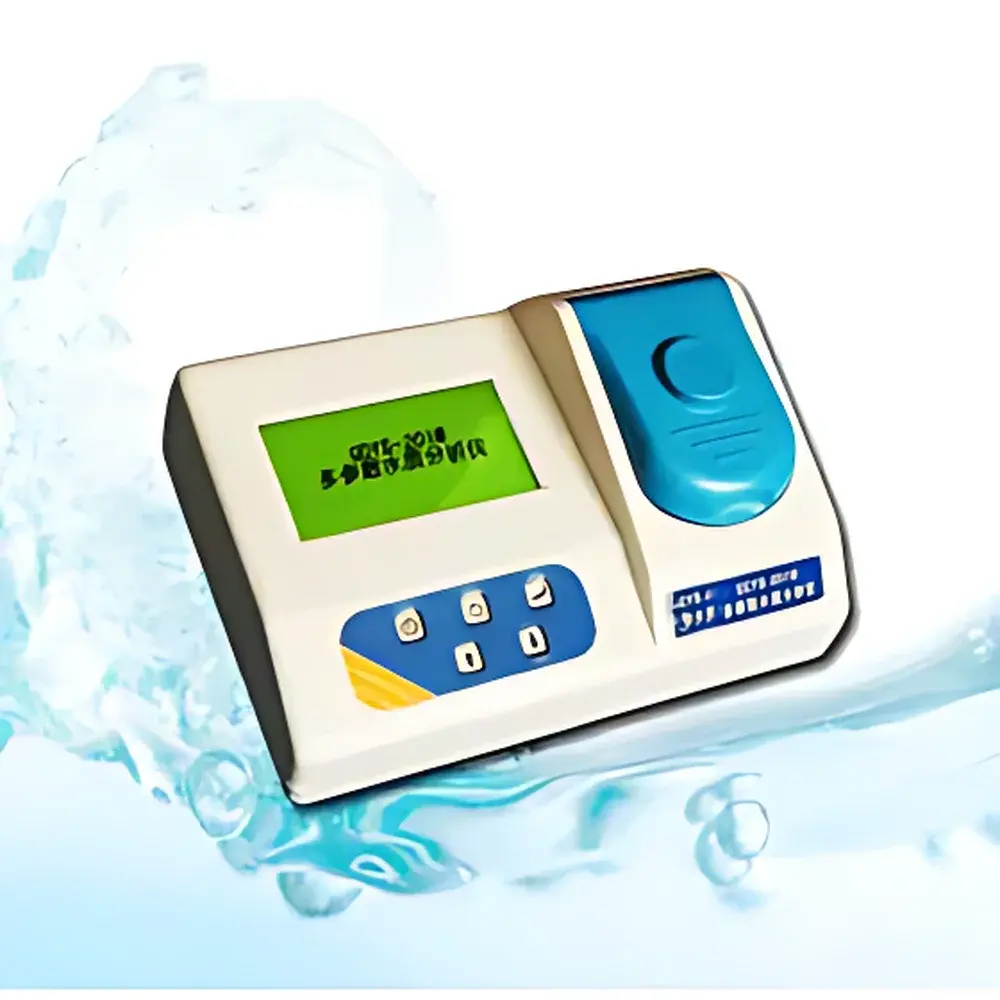
GDYS-201M Multi-Parameter Water Quality Analyzer (35 Parameters)
| Brand | Jihepu |
|---|---|
| Origin | Shandong, China |
| Manufacturer Type | Authorized Distributor |
| Country of Manufacture | China |
| Model | GDYS-201M |
| Instrument Type | Benchtop Laboratory Water Quality Analyzer |
| Detection Capabilities | 35 Water Quality Parameters |
| Optical Wavelengths | 380, 430, 470, 520, 538, 595, 612, 630 nm |
| Photometric Stability | ±0.005 A / 20 min |
| Display | 4.8-inch Full-Text Chinese LCD |
| Data Storage | >2000 Records |
| Power Supply | Rechargeable Li-ion Battery (7.2 V, 1.0 Ah) |
| Interface | RS-232 / USB |
| Dimensions | 275 × 215 × 125 mm |
| Weight | Approx. 2.8 kg |
Overview
The GDYS-201M Multi-Parameter Water Quality Analyzer is a benchtop photometric laboratory instrument engineered for precise, standardized quantification of 35 physicochemical and contaminant parameters in drinking water, wastewater, surface water, and industrial process streams. It operates on the principle of spectrophotometric analysis using discrete-wavelength LED light sources (380–630 nm) and fixed-pathlength cylindrical glass cuvettes, enabling consistent absorbance measurement across all assays. Each parameter is determined via method-specific colorimetric or titrimetric reactions—fully aligned with national standard methods (e.g., GB/T 5750 series for drinking water, HJ standards for environmental monitoring). The system integrates optical detection, microprocessor-based signal conditioning, real-time calibration compensation, and automated result calculation—eliminating manual interpolation and reducing operator-dependent variability. Designed for routine compliance testing and academic research, the GDYS-201M supports trace-level detection (e.g., nitrite-N: 0.01–0.40 mg/L), broad dynamic ranges (e.g., pH: 0.0–14.0; salinity: 0.2–28%), and field-deployable operation via its integrated rechargeable battery.
Key Features
- Single-channel optical architecture with eight pre-aligned LED wavelengths (380, 430, 470, 520, 538, 595, 612, 630 nm), ensuring wavelength reproducibility without mechanical filter wheels or grating drift.
- Integrated cylindrical glass cuvette system—sample reaction and measurement occur in the same sealed vessel, minimizing cross-contamination and photometric pathlength variation.
- Onboard microprocessor with embedded firmware supporting automatic zeroing, blank subtraction, curve-fitting (linear/logarithmic), and concentration conversion per parameter-specific calibration equation.
- High-stability photometric performance: baseline drift ≤ ±0.005 A over 20 minutes, critical for low-absorbance measurements (e.g., residual chlorine, fluoride).
- Full-text Chinese LCD interface (4.8-inch) with intuitive menu navigation, real-time status prompts, and context-sensitive help—optimized for non-specialist lab technicians and field personnel.
- Internal data management: stores >2000 test records with timestamp, parameter ID, sample ID, operator code, and raw absorbance values—compliant with basic GLP documentation requirements.
- RS-232 and USB interfaces enable bidirectional communication with Windows-based PCs for data export, remote configuration, and report generation.
Sample Compatibility & Compliance
The GDYS-201M accepts liquid aqueous samples within standard turbidity (<500 NTU) and suspended solids (<100 mg/L) limits. Sample pretreatment—including filtration (0.45 µm), acidification (for metals), or digestion (for total phosphorus/CODMn)—follows published Chinese national standards (e.g., GB/T 5750.6–2023 for metals, HJ 505–2009 for CODCr). All 35 assay protocols are validated against reference methods specified in GB/T 5750 (Standard Methods for Examination of Drinking Water), HJ/T 91–2002 (Surface Water Monitoring Technical Specifications), and relevant environmental protection industry standards. While not certified to ISO/IEC 17025 or EPA approval lists, the instrument’s adherence to standardized chemistries and documented measurement uncertainty (±5% for key analytes such as NH3-N, NO2−-N, DO) supports use in internal quality control, educational laboratories, and preliminary regulatory screening where formal accreditation is not mandated.
Software & Data Management
The included PC software (Windows-compatible, no admin rights required) provides full instrument control, method selection, and data visualization. Users can assign custom sample IDs, enter metadata (analyst name, location, sampling date), apply batch corrections, and generate summary statistics (mean, SD, CV%). Export functionality supports native .CSV and Microsoft Excel (.xlsx) formats—enabling integration into LIMS or statistical packages (e.g., R, JMP). Reports include instrument serial number, calibration history, and measured absorbance values—supporting audit readiness under basic GLP frameworks. The software does not implement FDA 21 CFR Part 11 electronic signature or audit trail features; however, exported files retain immutable timestamps and user-defined fields suitable for internal QA review.
Applications
- Drinking water safety verification: residual chlorine, turbidity, fluoride, nitrate-N, and heavy metals (Pb, Cd, Cr(VI), Cu, Zn, Ni, Mn, Fe, Al, Ag, Ca).
- Wastewater treatment plant (WWTP) effluent monitoring: CODCr, CODMn, NH3-N, PO43−, TP, CN−, phenol, SO42−, S2−.
- Environmental field surveys: DO, pH, salinity, color, ozone, ClO2, and Cr(III)/Cr(VI) speciation in rivers, lakes, and groundwater.
- Industrial process water control: hardness (titrimetric), formaldehyde (in cooling towers), and volatile phenols (in petrochemical discharge).
- Academic teaching labs: quantitative analysis training across redox, complexometric, and chromogenic reaction principles.
FAQ
Does the GDYS-201M support ASTM or ISO-standardized methods?
No—it implements Chinese national standard methods (GB/T and HJ series) exclusively. Method equivalence to ASTM D1253 (chlorine), ISO 7888 (pH), or ISO 5667-3 (sampling) must be verified independently by the end user.
Can the instrument perform simultaneous multi-wavelength scans?
No—it uses discrete single-wavelength LED excitation per assay. Wavelength selection is manual or method-triggered; no spectral scanning or derivative analysis is available.
What is the typical reagent shelf life and storage requirement?
Reagent kits (50 tests per parameter) are stable for 12 months unopened at 4–30°C. After opening, solid reagents should be desiccated; liquid reagents require refrigeration (2–8°C) and are usable for ≤30 days.
Is external calibration verification possible?
Yes—users may load custom calibration curves using absorbance-concentration pairs via the PC software. Factory-default curves are locked but can be overridden for method validation studies.
Does the device meet IP rating for field use?
It has no formal IP rating. The enclosure is designed for controlled indoor lab or vehicle-mounted mobile lab environments—not direct outdoor exposure or high-humidity field deployment without protective housing.







