
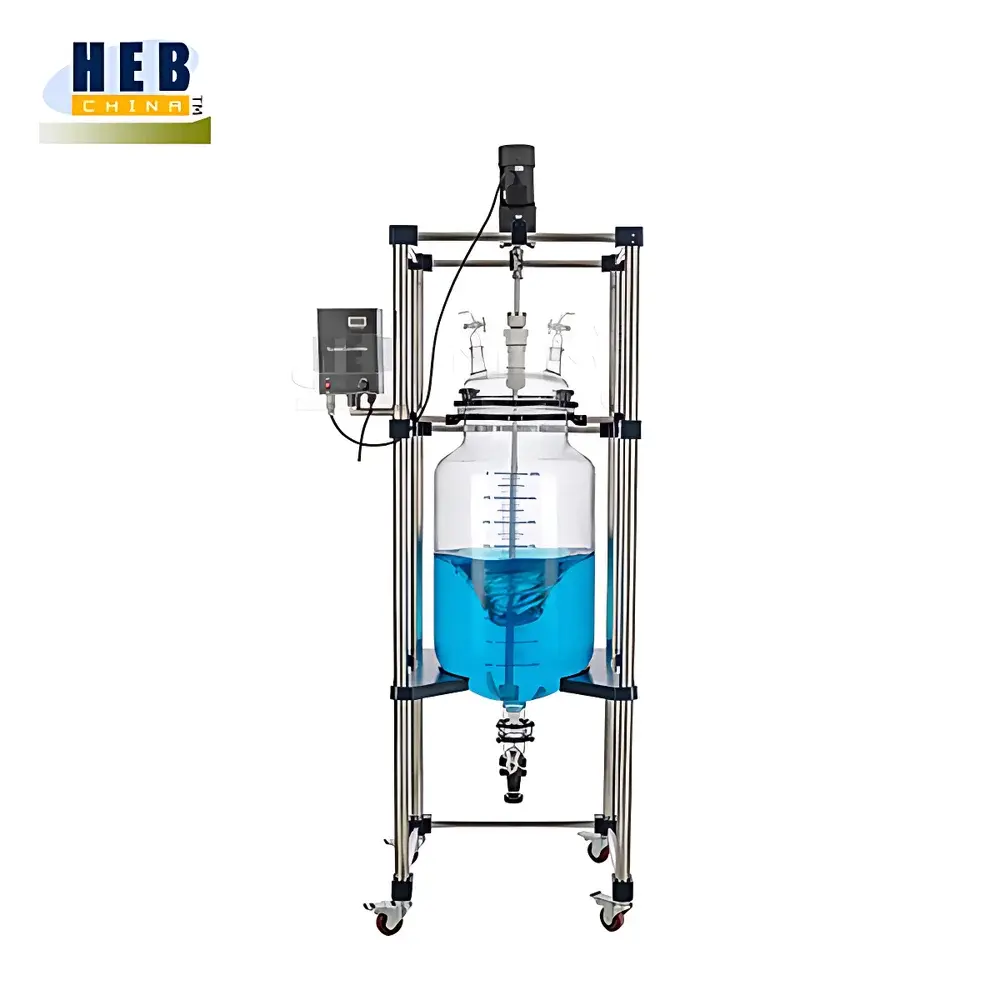
HEPU FY-200L Cylindrical Glass Separatory Reactor
| Brand | HEPU |
|---|---|
| Origin | Shandong, China |
| Manufacturer Type | Direct Manufacturer |
| Origin Category | Domestic (China) |
| Model | FY-200L Cylindrical |
| Price Range | USD 2,800 – 7,000 |
| Usable Volume | Large-Scale |
| Construction Material | Borosilicate Glass 3.3 (High-Purity) + PTFE |
| Operating Pressure | Low-Pressure (Up to 0.1 MPa Gauge) |
| Total Capacity | 200 L |
| Vacuum Capability | ≤ −0.098 MPa (Absolute) |
| Motor Power | 200 W |
| Speed Range | 0–450 rpm (Variable-Frequency Controlled, Digital Display) |
| Stirring Shaft | 304 Stainless Steel with PTFE Sheathing |
| Stirrer Blade | Crescent-Type, 304 SS Core + PTFE Coating |
| Sealing System | Mechanical Seal with Ceramic Bearing |
| Frame | Aluminum Alloy + Stainless Steel Structural Support |
| Base | Casters with Locking Brakes |
| Electrical Safety | Integrated Thermal Fuse Protection |
| Dimensions (W×D×H) | 750 × 800 × 2100 mm |
| Net Weight | 67 kg |
| Packing Size | 1920 × 720 × 760 mm (Wooden Crate) |
| Gross Weight | 115 kg |
Overview
The HEPU FY-200L Cylindrical Glass Separatory Reactor is a purpose-engineered laboratory-scale reaction and phase separation system designed for controlled chemical synthesis, extraction, and post-reaction liquid–liquid partitioning under low-pressure or mild vacuum conditions. Built around a seamless, high-purity borosilicate glass 3.3 (linear thermal expansion coefficient: 3.3 × 10⁻⁶ K⁻¹) cylindrical vessel, the reactor enables real-time visual monitoring of mixing homogeneity, phase formation, sedimentation kinetics, and interfacial behavior—critical parameters in solvent extraction, crystallization optimization, and multi-step batch synthesis. Its operating principle relies on programmable low-speed mechanical agitation (0–450 rpm) to ensure uniform mass transfer during reaction, followed by gravity-driven stratification and sequential layer-wise discharge via a side-mounted, PTFE-lined glass valve assembly. The system operates within a safe low-pressure envelope (≤ 0.1 MPa gauge) and achieves vacuum levels down to 2 kPa absolute (−0.098 MPa), supporting degassing, solvent removal, and moisture-sensitive chemistry without thermal degradation.
Key Features
- Borosilicate glass 3.3 main vessel (Φ465 mm × 696 mm internal height) with full optical clarity and chemical inertness toward acids, alkalis, and organic solvents.
- PTFE-sealed, side-discharge glass valve (Φ80 mm flanged outlet, Φ33 mm orifice, 34# standard taper interface) enabling residue-free, layer-selective fluid withdrawal without cross-contamination.
- Low-torque, high-torque-density 200 W variable-frequency motor with digital RPM display and precision knob-based micro-adjustment for reproducible shear control.
- Crescent-shaped impeller (240 mm span, 17 mm diameter shaft, 1200 mm total length) fabricated from 304 stainless steel core with full PTFE overmolding—resistant to abrasion and electrochemical corrosion.
- Mechanical seal assembly incorporating ceramic bearing and graphite-faced stationary seal ring—designed for long-term operation with minimal particulate generation.
- Modular 34# standard taper port configuration: three-neck lid (60 mm stirrer port, two 34# functional ports) supports condensers, thermometers, addition funnels, and inert gas inlets.
- Mobile frame constructed from anodized aluminum alloy and 304 stainless steel, fitted with four industrial-grade locking casters (load capacity ≥ 30 kg per wheel).
- Integrated thermal fuse protection circuit compliant with IEC 61000-4-5 surge immunity and EN 60335-1 electrical safety standards.
Sample Compatibility & Compliance
The FY-200L reactor accommodates heterogeneous reaction mixtures including aqueous–organic biphasic systems, suspension polymerizations, emulsion-based formulations, and precipitating crystallization media. All wetted surfaces—vessel body, valves, stirrer components, and seals—are composed exclusively of USP Class VI-certified PTFE and ASTM E438 Type I, Class A borosilicate glass 3.3, ensuring compliance with ISO 3585 and DIN 7080 specifications. The design supports GLP-aligned documentation workflows; optional calibration certificates for motor speed (traceable to NIST standards) and vacuum gauge (EN 61000-4-30 validated) are available upon request. While not rated for ASME BPVC Section VIII or PED 2014/68/EU certification, the unit meets CE marking requirements for low-voltage equipment (2014/35/EU) and electromagnetic compatibility (2014/30/EU).
Software & Data Management
This is a manually operated, non-automated benchtop reactor with no embedded firmware or digital control interface. Speed setting, vacuum regulation (via external vacuum pump), and temperature monitoring (via optional external probe) remain operator-directed. However, the standardized 34# taper ports and modular geometry allow seamless integration with third-party data acquisition systems—including PT100 temperature loggers (IEC 60751 Class A), digital vacuum gauges (e.g., MKS Baratron series), and programmable stirrer controllers (e.g., IKA RV 10 digital). Audit trails, electronic batch records, and 21 CFR Part 11-compliant electronic signatures require external LIMS or ELN deployment; no onboard memory or network connectivity is provided.
Applications
- Batch-scale liquid–liquid extraction of natural products (e.g., alkaloid isolation from plant extracts using chloroform/water systems).
- Controlled hydrolysis and esterification reactions requiring phase observation and timed intermediate sampling.
- Scale-up studies bridging 5 L jacketed lab reactors to pilot-scale 200 L operations while preserving interfacial mass transfer characteristics.
- Development of pharmaceutical suspensions and nanoemulsions where visual confirmation of droplet coalescence or creaming onset is essential.
- Teaching laboratories for demonstrating Le Chatelier’s principle, partition coefficients (log P), and Stokes’ law sedimentation behavior.
- Environmental testing of surfactant-mediated oil–water separation efficiency under variable salinity and pH.
FAQ
Is the FY-200L suitable for exothermic reactions requiring external cooling?
Yes—its cylindrical glass body permits optional clamping onto external circulating chillers via silicone tubing connected to top/bottom ports; however, no integrated jacket is included.
Can the reactor be operated under positive pressure?
No—it is explicitly rated for low-pressure and vacuum service only (max 0.1 MPa gauge); pressurized operation voids warranty and compromises structural integrity.
What maintenance is required for the mechanical seal?
Annual inspection of ceramic bearing wear and PTFE seal compression set is recommended; replacement kits (including O-rings and spring-loaded seal cartridges) are available as OEM spare parts.
Does the unit include vacuum or temperature measurement instrumentation?
No—vacuum is achieved via external pump connection (KF25 or NW25 flange adapter optional); temperature monitoring requires user-supplied probe and readout device.
Is custom port configuration available?
Yes—HEPU offers engineering consultation for modified neck arrangements, additional 34# or 24# taper ports, and PTFE-coated stainless steel support brackets (lead time: 6–8 weeks).
Related Products



