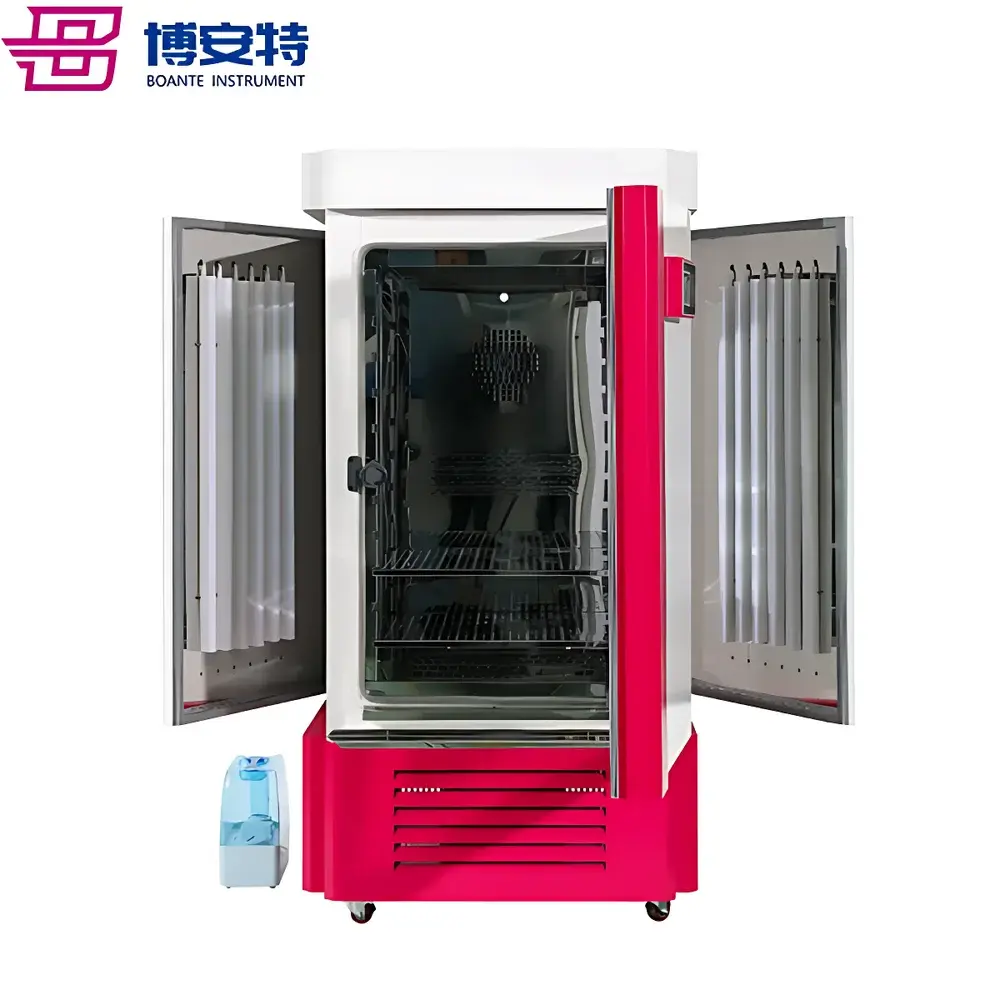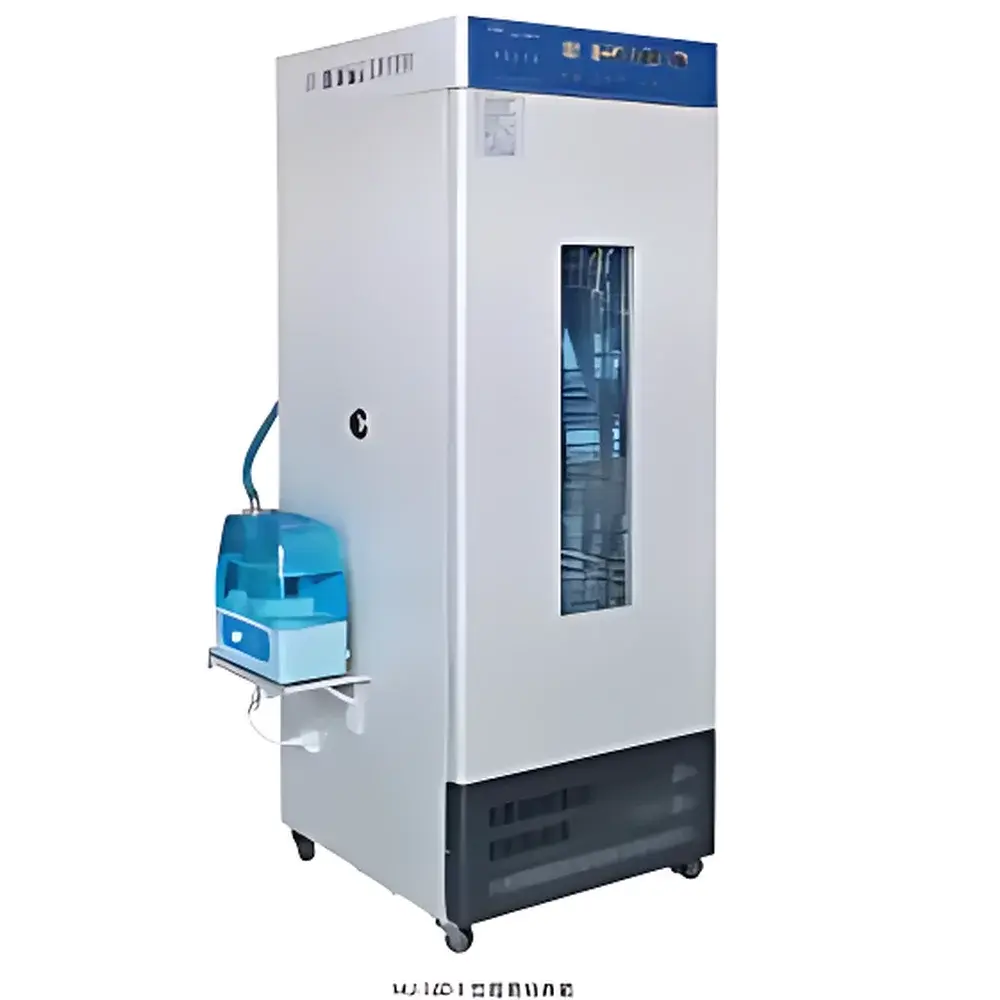
HePu LRHS-150-II Temperature and Humidity Controlled Incubator
| Brand | HePu (Jihepu) |
|---|---|
| Origin | Shandong, China |
| Model | LRHS-150-II |
| Capacity | 150 L |
| Temperature Range (with humidification) | 0–65 °C |
| Temperature Uniformity | ≤ ±0.5 °C |
| Humidity Range | 50–90 %RH (operational only when chamber temperature > 10 °C) |
| Humidity Fluctuation | ±(5–8) %RH |
| Refrigerant | R134a (ozone-friendly) |
| Power Supply | 220 V ±10%, 50 Hz |
| Net Weight | 90 kg |
| External Dimensions (W×D×H) | 590 × 620 × 1400 mm |
| Internal Chamber Dimensions (W×D×H) | 450 × 420 × 850 mm |
| Control System | Digital PID + Fuzzy logic, RS485 interface, LED display (English), programmable up to 30 segments (each segment adjustable to 9999 min/h), setpoint resolution: 0.1 °C / 1 %RH, control accuracy: ±0.1 °C / ±1 %RH |
| Safety Features | Dual-limit temperature protection, independent heater/compressor/humidifier control, water-level sensing, compressor overpressure/overheat protection, auto-fault shutdown with audible alarm, power-loss memory (10-year retention), cold/hot/start-break restart modes |
Overview
The HePu LRHS-150-II Temperature and Humidity Controlled Incubator is an engineered environmental simulation platform designed for precise, reproducible maintenance of biological, pharmaceutical, and material samples under tightly regulated thermal and hygroscopic conditions. Based on forced-air convection architecture with independent thermoelectric heating, ultrasonic humidification, and vapor-compression refrigeration, the system delivers stable operation across a broad operational envelope—from ambient chilling (0 °C) to elevated incubation (65 °C), coupled with active humidity control between 50 %RH and 90 %RH. Its design adheres to core principles of ISO 14644-1 cleanroom-compatible airflow management and ASTM E2912-21 guidelines for environmental chamber performance validation. The unit is intended for non-sterile but contamination-controlled applications including stability testing per ICH Q1A(R3), accelerated aging per ASTM D3045, microbial growth studies, textile conditioning per ISO 139, and food packaging permeability evaluation—where long-term parameter fidelity and traceable process documentation are essential.
Key Features
- Stainless steel interior chamber (SUS-304 mirror finish) with adjustable stainless steel shelving (15 kg load capacity per shelf; 50 mm vertical increment adjustment)
- Dual-door structure: outer magnetic-seal door with tempered glass observation window; inner tempered glass door for minimized thermal leakage and real-time visual monitoring
- Forced horizontal airflow via high-efficiency axial fan, optimized for uniform temperature distribution (≤ ±0.5 °C at steady state, per empty-chamber test at 20 °C ambient)
- Independent PID + Fuzzy logic control loops for temperature and humidity—eliminating cross-coupling effects during dynamic setpoint transitions
- Ultrasonic external humidifier with electromagnetic water-level sensor and manual refill reservoir; compatible with optional thermal-balance internal humidification upgrade
- R134a-based hermetic refrigeration system with finned copper evaporator/condenser, Danfoss dryer filter, and capillary expansion device—compliant with EU F-Gas Regulation (EU) No 517/2014
- RS485 serial interface (up to 1.2 km cable length) supporting Modbus RTU protocol for integration into centralized lab monitoring systems or SCADA platforms
- Comprehensive safety architecture: dual-stage overtemperature cutoff, compressor high-pressure/overheat lockout, dry-run prevention for humidifier, and automatic fault-triggered power isolation
Sample Compatibility & Compliance
The LRHS-150-II accommodates standard microbiological vessels (Petri dishes, flasks, multiwell plates), pharmaceutical stability batches (blister packs, vials), textile swatches, polymer films, and electronic component assemblies. Its chamber geometry (450 × 420 × 850 mm) supports ISO/IEC 17025-compliant placement of NIST-traceable reference sensors for in-situ validation. While not certified as a Class II biosafety cabinet, its sealed construction and UV germicidal lamp (254 nm, optional) enable routine decontamination between cycles—supporting GLP-aligned workflows. The system meets electrical safety requirements per IEC 61010-1 and EMC immunity standards per IEC 61326-1. Humidity control performance is validated per ISO 24353:2022 Annex B for environmental test chambers.
Software & Data Management
The embedded controller provides English-language menu navigation, 30-segment programmable profiles (each with independent T/RH ramp/soak settings), and timestamped logging of all critical parameters at user-defined intervals (1–60 min). All data—including setpoints, actual values, alarms, and system status—are stored internally with 10-year non-volatile retention, even during extended power outages. RS485 output enables direct acquisition by third-party software (e.g., LabVIEW, MATLAB, or custom Python scripts) for CSV export, trend visualization, and audit-ready reporting. Optional USB-to-RS485 adapters allow connection to Windows/Linux hosts; no proprietary drivers required. Data integrity conforms to FDA 21 CFR Part 11 principles through immutable timestamps, operator ID logging (via optional keypad login), and electronic signature-capable export formats.
Applications
- ICH Q1A(R3)-aligned long-term and accelerated stability studies of APIs and finished dosage forms
- ASTM D4332-compliant conditioning of polymeric packaging materials prior to permeability testing
- ISO 291-standard preconditioning of plastic specimens before mechanical property evaluation
- Controlled-humidity incubation of fungal cultures (e.g., Aspergillus niger) for biodegradation assays
- Temperature–humidity stress screening of printed circuit boards (IPC-9701)
- Textile moisture regain testing per AATCC Test Method 20A
- Seed germination trials under defined hygrothermal regimes (ISTA Rules)
FAQ
Can the LRHS-150-II operate continuously at 0 °C with active humidification?
No. Humidification is disabled below 10 °C to prevent condensation-induced corrosion and sensor drift; the unit functions as a dry-cooling incubator in this range.
Is the RS485 interface compatible with common industrial SCADA protocols?
Yes—it implements standard Modbus RTU over RS485, enabling seamless integration with Siemens SIMATIC, Rockwell Allen-Bradley, or Ignition SCADA platforms using off-the-shelf gateways.
What calibration standards are recommended for periodic verification?
NIST-traceable PT100 probes (DIN Class A) for temperature and chilled-mirror hygrometers (e.g., Michell Optidew) for humidity—per ISO/IEC 17025-accredited calibration intervals.
Does the unit support remote monitoring via Ethernet or Wi-Fi?
Not natively; however, RS485-to-Ethernet converters (e.g., Moxa NPort series) can be deployed externally to enable TCP/IP access without firmware modification.
Are consumables such as humidifier tanks or filters included in the base configuration?
The ultrasonic humidifier reservoir is integral and reusable; no disposable filters are required—maintenance consists solely of periodic descaling and distilled water replenishment.
Related Products