
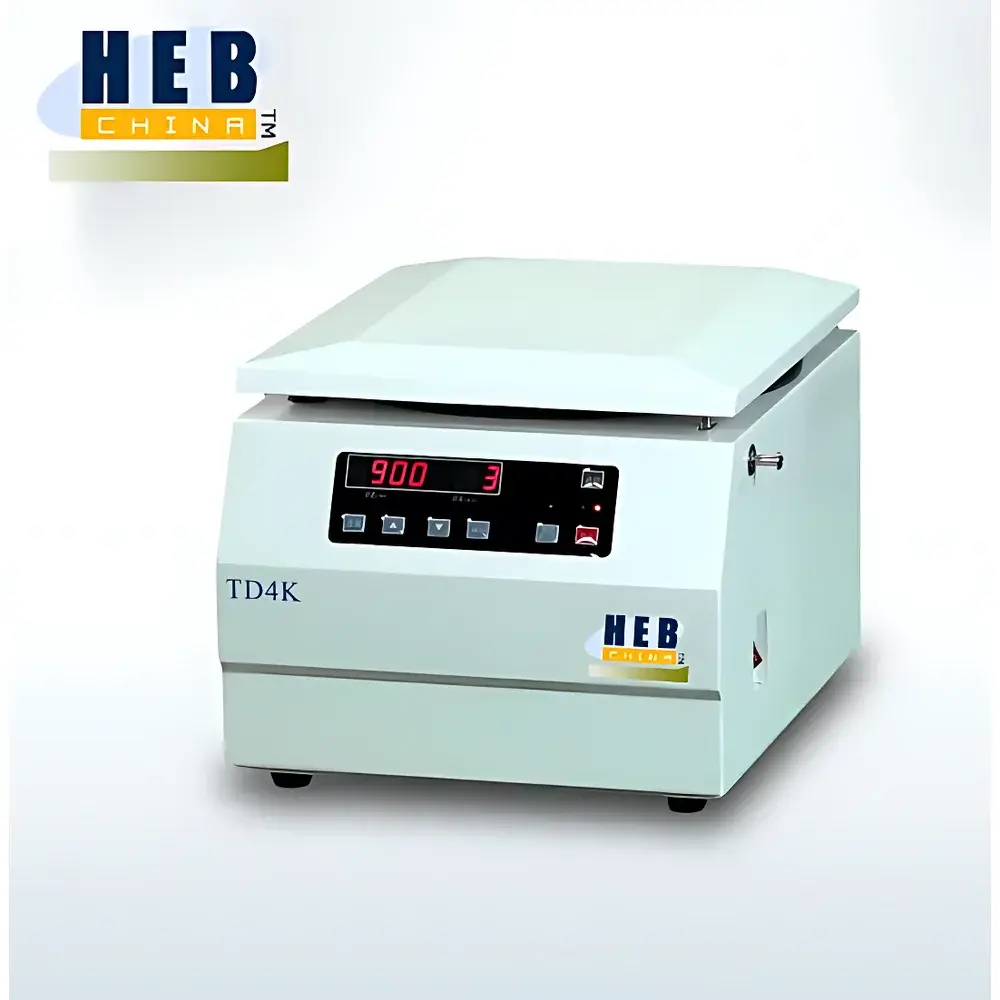
HePu TD4K Blood Typing Card Centrifuge
| [Brand | HePu (Jihepu) |
|---|---|
| Origin | Shandong, China |
| Model | TD4K |
| Type | Benchtop Low-Speed Centrifuge |
| Max Speed | 4500 rpm |
| Max RCF | 3650 × g |
| Max Capacity | 12 × 15 mL or 12/24 blood typing cards |
| Timer Range | 1–59 min |
| Speed Accuracy | ±20 rpm |
| Power Supply | AC 220 V ±10%, 50/60 Hz, 10 A |
| Power Consumption | 100 W |
| Noise Level | ≤65 dB(A) |
| Dimensions (W×D×H) | 385 × 320 × 270 mm |
| Net Weight | 15 kg |
| Rotor Options | Blood Typing Card Rotor (12- or 24-position), Angle Rotor (12 × 15 mL) |
| Construction | 4 mm thick all-steel frame with stainless steel centrifuge chamber |
| Drive System | Brushless DC motor with imported SKF bearings |
| Control Interface | Touchscreen LCD with real-time RCF calculation and display |
| Safety | Electronic lid lock |
| Warranty | 3 years comprehensive, lifetime technical support] |
Overview
The HePu TD4K Blood Typing Card Centrifuge is a purpose-engineered benchtop low-speed centrifuge designed exclusively for standardized hemagglutination assays in clinical transfusion laboratories. It operates on the principle of sedimentation-based separation under controlled gravitational force (RCF), enabling precise and reproducible pelleting of red blood cells (RBCs) within microcolumn gel cards or slide-based agglutination platforms. Unlike general-purpose centrifuges, the TD4K integrates card-specific rotor geometry, optimized acceleration/deceleration profiles, and calibrated dwell times to ensure consistent band formation and unambiguous interpretation of antigen-antibody reactions—critical for ABO/Rh typing, antibody screening, and compatibility testing per CLSI EP12-A2 and ISO 15189:2022 requirements.
Key Features
- Compact footprint (385 × 320 × 270 mm) engineered for high-density clinical lab environments where bench space is constrained.
- Robust 4 mm all-steel chassis and electropolished stainless-steel centrifuge chamber (Φ280 mm) provide structural integrity, corrosion resistance, and compliance with IEC 61010-2-020 safety standards for laboratory equipment.
- Brushless DC motor with imported SKF precision bearings ensures maintenance-free operation, vibration-damped rotational stability, and acoustic performance ≤65 dB(A) at full load—enabling continuous use in proximity to diagnostic workstations.
- Real-time parameter adjustment during active runs: users may modify time or speed without interrupting the centrifugation cycle, minimizing workflow disruption during batch processing.
- Intuitive touchscreen LCD interface with automatic RCF recalculation synchronized to set rpm; eliminates manual conversion errors and supports traceable method documentation.
- Electronically interlocked lid mechanism prevents accidental opening during operation and enforces mandatory deceleration before lid release—meeting EN 61000-6-3 EMC and mechanical safety directives.
Sample Compatibility & Compliance
The TD4K accommodates two dedicated rotor configurations: a 12-position blood typing card rotor (optimized for ID-Micro Typing System–compatible cards) and a 24-position variant (for high-throughput serology labs), as well as a standard 12 × 15 mL angle rotor for parallel sample preparation. All rotors are balanced to ISO 21501-4 tolerances and validated for use with common gel card formats (e.g., DiaMed ID-Card, Ortho BioVue). The instrument complies with ISO 13485:2016 quality management system requirements for in vitro diagnostic (IVD) ancillary equipment and supports GLP-compliant audit trails when integrated into LIS-connected workflows. It meets essential performance criteria outlined in CLSI MM18-A3 for centrifuge validation in blood bank settings.
Software & Data Management
While the TD4K operates as a standalone instrument, its digital control architecture supports external data logging via RS232 serial output (optional USB-to-serial adapter). Timestamped run logs—including date/time, set rpm, actual RCF, duration, and rotor ID—can be exported for inclusion in electronic laboratory notebooks (ELN) or LIMS databases. The firmware adheres to FDA 21 CFR Part 11 principles through secure user access levels (operator/administrator), immutable event logs, and parameter change tracking—facilitating regulatory inspections under CAP, COLA, or AABB accreditation frameworks.
Applications
- Routine ABO and Rh(D) blood group determination using microcolumn gel technology.
- Antibody identification and titration via indirect antiglobulin test (IAT) protocols.
- Pre-transfusion compatibility testing (crossmatching) with gel card systems.
- Supporting automated immunohematology platforms by providing standardized pre-analytical sample conditioning.
- Research applications requiring gentle, reproducible pelleting of erythrocytes or leukocyte-depleted samples for downstream flow cytometry or molecular analysis.
FAQ
Is the TD4K certified for clinical diagnostic use in the EU or USA?
The TD4K is CE-marked per Directive 2014/30/EU (EMC) and 2014/35/EU (LVD); however, it is classified as an IVD ancillary device—not an IVD itself—and therefore does not require IVDR or FDA 510(k) clearance. Its design aligns with harmonized standards referenced in EU Annex II for supporting equipment.
Can the TD4K accommodate non-standard card formats?
Only rotors supplied by HePu and validated for dimensional and dynamic balance compatibility should be used. Third-party card carriers are not supported due to risk of imbalance-induced rotor failure or inconsistent sedimentation kinetics.
What maintenance is required beyond routine cleaning?
No scheduled lubrication or bearing replacement is needed—the brushless motor and SKF bearings are sealed for life. Users must inspect the lid seal and rotor threads quarterly and validate speed accuracy annually using a NIST-traceable tachometer per CLSI EP17-A2.
Does the instrument support programmable multi-step protocols?
No. The TD4K executes single-step centrifugation only, consistent with standardized blood bank protocols that specify fixed time/speed combinations per assay type (e.g., 10 min at 4500 rpm for gel cards).
How is calibration verified during installation?
Factory calibration includes speed verification at three points (1500, 3000, and 4500 rpm) using laser Doppler velocimetry, with RCF values cross-checked against ISO 21501-4 reference tables. A Certificate of Conformance is provided with each unit.



