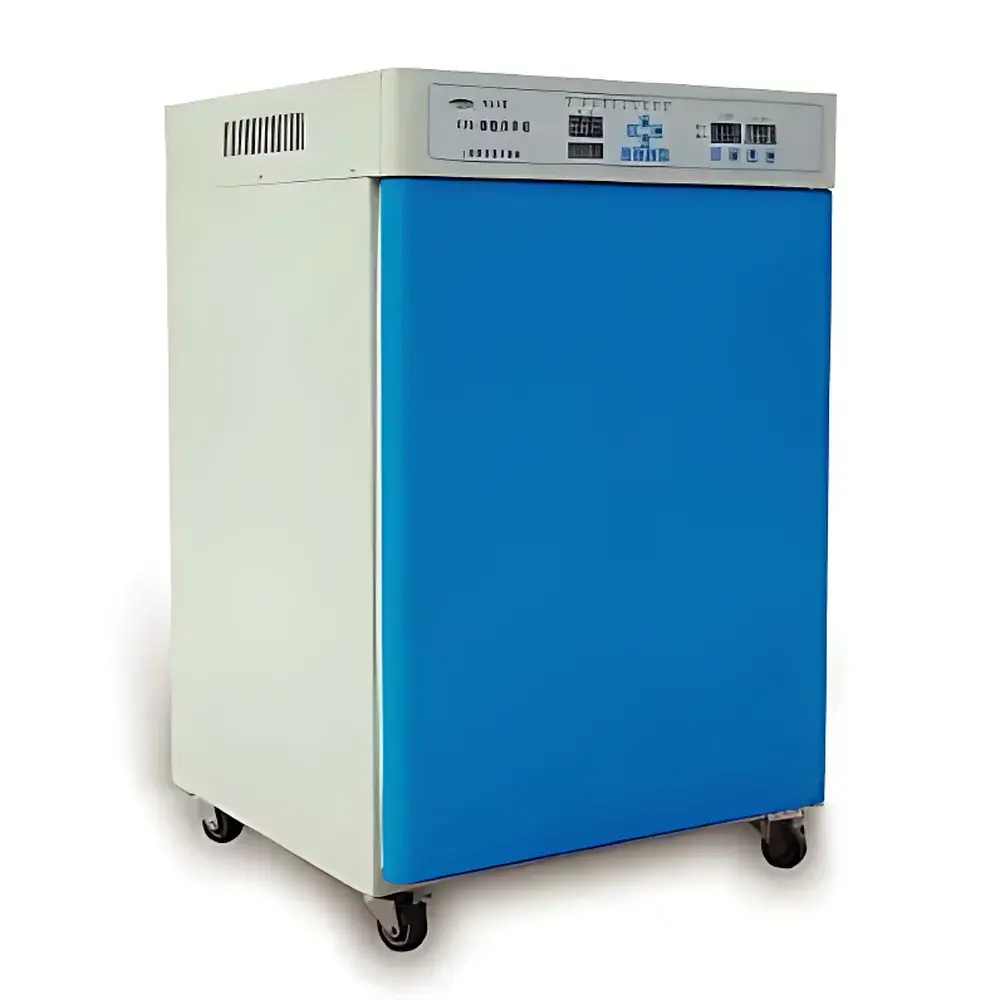
HePu WJ-3 Advanced CO₂ Incubator
| Brand | HePu (Jihepu) |
|---|---|
| Origin | Shandong, China |
| Model | WJ-3 |
| Capacity | 80 L / 160 L |
| Temperature Range | Ambient +3°C to 60°C |
| Temperature Uniformity | ≤ ±0.5°C |
| Temperature Stability | ≤ ±0.2°C |
| CO₂ Concentration Range | 0–20% |
| CO₂ Control Accuracy | ±0.1% |
| Humidity Range | 20–95% RH (natural evaporation via water pan) |
| Heating Options | Air-jacketed or Water-jacketed |
| CO₂ Sensor | Imported NDIR infrared sensor |
| Control System | Microprocessor-based PID + Fuzzy logic with triple PT100 probes (chamber, door, water bath) |
| Safety Features | Over-temperature, CO₂ loss, low-water, and sensor-failure alarms |
| Compliance | Designed for GLP-compliant labs |
| Power Supply | 1φ 220 V, 50 Hz |
| External Dimensions (WJ-3) | 57 × 59 × 85 cm |
| Net Weight | 60 kg |
Overview
The HePu WJ-3 Advanced CO₂ Incubator is an engineered environmental control platform designed for reliable, long-term cultivation of mammalian cells, primary tissues, and sensitive microbial strains under physiologically relevant conditions. It operates on dual thermal management architectures—air-jacketed or water-jacketed—enabling precise regulation of temperature, CO₂ concentration, and relative humidity within the sterile chamber. The incubator employs a forced-air convection system with horizontal arc-flow air distribution and high-impedance axial fans to ensure uniform thermal and gaseous profiles across the working volume. CO₂ concentration is continuously monitored using a calibrated, imported non-dispersive infrared (NDIR) sensor, enabling closed-loop feedback control via solenoid valve modulation in gas-replacement mode—delivering superior stability over conventional flow-mixing methods. Temperature is governed by a microprocessor-driven PID+Fuzzy algorithm with real-time linear compensation, supported by DIN Class A PT100 platinum resistance thermometers at three critical points: chamber, door, and (in water-jacketed configuration) water bath. This multi-point sensing architecture minimizes thermal lag and mitigates boundary effects during door opening events.
Key Features
- Two structural configurations: air-jacketed (dual PT100 sensing) and water-jacketed (triple PT100 sensing) for optimized thermal inertia and recovery performance
- NDIR-based CO₂ monitoring with ±0.1% accuracy and ≤±0.1% fluctuation—validated against traceable gas standards per ISO 6142
- Triple-sensor PID control system with automatic power modulation, self-diagnostic I/O checks, and fail-safe thermal cutoffs
- UV germicidal lamp integrated into chamber ceiling for routine decontamination cycles compliant with ISO 14644-1 Class 5 cleanroom practices
- Steel-framed tempered glass inner door with anti-condensation heating to maintain optical clarity and prevent moisture accumulation
- Stainless steel (SUS-304) interior chamber with mirror-finish surface and seamless welded corners for easy cleaning and corrosion resistance
- Intelligent door-open protocol: automatic suspension of fan operation, CO₂ supply, and heating circuits to minimize contamination risk and environmental perturbation
- Digital LED interface with English-language menu navigation, 0.1°C/0.1% resolution display, and programmable timer (1–9999 min or continuous mode)
Sample Compatibility & Compliance
The WJ-3 accommodates standard T-25, T-75, and multi-well plates on adjustable stainless steel wire shelving (2 shelves standard for 80 L; 3 for 160 L), with 50 mm vertical increment spacing. Its chamber geometry and airflow design meet ASTM E1384 requirements for volumetric uniformity in biological incubators. Humidity maintenance relies on passive water-pan evaporation—suitable for short-to-medium duration cultures where >85% RH is required. For applications demanding tighter humidity control (e.g., stem cell differentiation assays), external humidification modules may be interfaced via optional ports. The unit complies with electrical safety standards IEC 61010-1 and electromagnetic compatibility per EN 61326-1. Its operational parameters align with FDA guidance for cell culture environment qualification under 21 CFR Part 11 when paired with validated data logging software—supporting traceability, electronic signatures, and audit trail generation for GMP/GLP workflows.
Software & Data Management
While the WJ-3 features a standalone embedded controller, it includes RS-232 communication capability for integration with third-party laboratory information management systems (LIMS) or SCADA platforms. Optional PC-based software enables remote parameter setting, real-time graphing of temperature/CO₂/humidity trends, and export of CSV-formatted logs compliant with ALCOA+ principles (Attributable, Legible, Contemporaneous, Original, Accurate). All alarm events—including over-temperature, CO₂ deviation >±0.3%, low-water detection, and sensor fault—are timestamped and stored in non-volatile memory for post-event root-cause analysis. The system supports configurable alarm thresholds and notification outputs (relay dry-contact) for facility-wide alerting integration.
Applications
This incubator serves as a foundational tool in academic research laboratories, biopharmaceutical QC/QA units, and contract development and manufacturing organizations (CDMOs). Typical use cases include: human mesenchymal stem cell expansion under 5% CO₂; hybridoma culture for monoclonal antibody production; embryonic fibroblast passaging in serum-free media; mycobacterial growth studies requiring elevated CO₂; and plant tissue culture protocols sensitive to diurnal humidity shifts. Its stable thermal profile (≤±0.2°C fluctuation) and rapid recovery (<15 min to re-stabilize after 30-sec door opening at 37°C/5% CO₂) make it suitable for high-frequency access environments such as core imaging facilities and automated liquid-handling suites.
FAQ
What CO₂ gas purity and pressure specifications are required?
A minimum purity of 99.9% (Grade 3.0) CO₂ is required, delivered at a regulated pressure of 0.5 MPa. Use of oil-free regulators and stainless steel gas lines is recommended to prevent sensor fouling.
Is the WJ-3 compatible with validation protocols for ISO 13485 or FDA 21 CFR Part 11?
Yes—when operated with approved data logging software and documented IQ/OQ/PQ procedures, the WJ-3 meets essential environmental monitoring criteria for quality systems in medical device and biologics manufacturing.
How does the water-jacketed version differ in performance from the air-jacketed model?
Water-jacketed units provide higher thermal mass and slower temperature drift during power interruptions; they achieve ±0.1°C stability over extended periods but require periodic water replenishment and antifungal treatment. Air-jacketed models offer faster warm-up times and lower energy consumption.
Can humidity be actively controlled beyond natural evaporation?
No—the WJ-3 uses passive humidification only. For active humidity control, users should consider external steam-generating humidifiers with chamber-integrated ducting, subject to compatibility verification.
What maintenance intervals are recommended for optimal sensor longevity?
NDIR CO₂ sensors should be zero-calibrated annually using certified nitrogen gas; PT100 probes require verification every six months using a traceable dry-block calibrator. UV lamp output should be measured quarterly with a radiometer to ensure ≥100 µW/cm² intensity at 254 nm.