
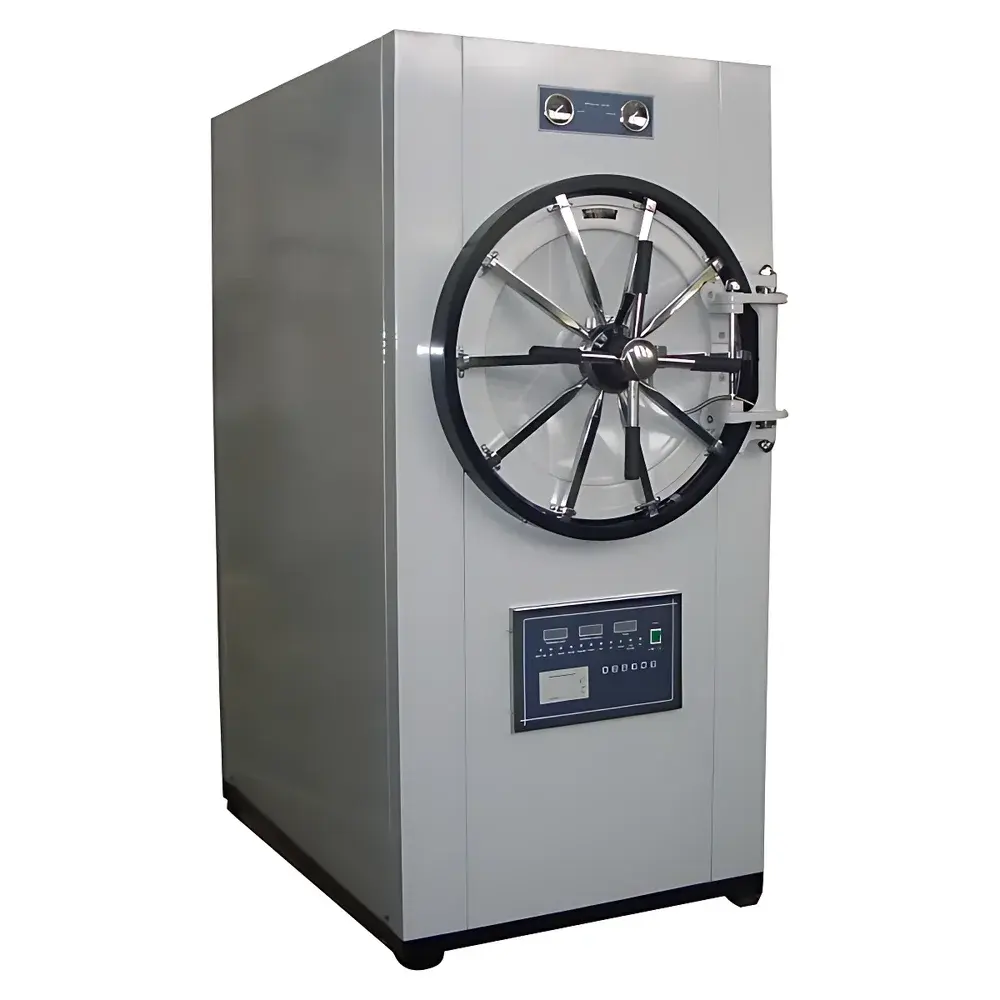
HePu WS-200YDB Horizontal Autoclave
| [Brand | HePu |
|---|---|
| Origin | Shandong, China |
| Model | WS-200YDB |
| Sterilization Chamber Volume | 200 L |
| Chamber Dimensions | Φ515 × 1000 mm |
| Max Operating Temperature | 134 °C |
| Max Operating Pressure | 0.22 MPa |
| Temperature Range | 105–134 °C |
| Temperature Uniformity | ≤ ±2 °C |
| Cycle Timer Range | 1–99 min |
| Drying Timer Range | 1–99 min |
| Power Supply | 9 kW / AC 380 V, 50 Hz |
| External Dimensions (W×D×H) | 140 × 75 × 170 cm |
| Shipping Dimensions (W×D×H) | 156 × 91 × 188 cm |
| Net Weight | 350 kg |
| Gross Weight | 436 kg |
| Safety Interlock Threshold | Door mechanically locked when chamber pressure > 0.027 MPa |
| Protection Systems | Overpressure relief valve, overtemperature cutoff, low-water-level shutoff, overcurrent circuit breaker] |
Overview
The HePu WS-200YDB Horizontal Autoclave is a fully automated, gravity-displacement and steam-penetration-based sterilization system engineered for high-reliability terminal sterilization of heat-stable materials in laboratory, clinical, pharmaceutical, and industrial environments. It operates on the fundamental principle of saturated steam under controlled pressure: at elevated pressures (up to 0.22 MPa), the boiling point of water increases, enabling steam temperatures up to 134 °C. During sterilization, condensation of saturated steam onto cooler load surfaces releases latent heat—ensuring rapid, uniform thermal transfer throughout porous and solid loads. This thermodynamic mechanism effectively denatures proteins and nucleic acids in microorganisms, achieving sterility assurance levels (SAL) of 10−6 for bacterial spores—including Bacillus stearothermophilus—when validated cycles are applied. Designed as a horizontal, front-loading unit, the WS-200YDB supports batch processing of large-volume or bulky items such as surgical instrument sets, textile packs, glassware, culture media, and food samples, complying with internationally recognized sterilization physics and microbiological validation frameworks.
Key Features
- Fully programmable microprocessor control with LED digital display providing real-time visualization of chamber temperature, pressure, elapsed time, and cycle phase (pre-vacuum, heating, sterilization, exhaust, drying)
- Adjustable sterilization temperature range (105–134 °C) and independent timer settings for sterilization (1–99 min) and post-cycle drying (1–99 min), enabling optimization for diverse load types and material sensitivities
- Integrated safety interlock system: mechanical door lock engages automatically when internal pressure exceeds 0.027 MPa; door remains physically restrained until pressure drops below threshold—preventing operator exposure to pressurized steam
- Redundant protection architecture: dual thermal cutoffs (overtemperature), spring-loaded safety valve (overpressure), conductive low-water-level sensor with auto-shutdown, and electromagnetic overcurrent breaker
- Automated sequence management including automatic water fill, cold-air purge, steam generation, sterilization hold, vacuum-assisted exhaust, and forced-air drying—minimizing manual intervention and human error
- Optional thermal printer interface (RS-232 or USB) for continuous, time-stamped recording of all critical process parameters—supporting audit-ready documentation per GLP, GMP, and ISO 13485 requirements
Sample Compatibility & Compliance
The WS-200YDB accommodates a broad spectrum of sterilizable materials within its 200 L cylindrical chamber (Φ515 × 1000 mm). Compatible loads include wrapped and unwrapped surgical instruments, cotton gauze and linen packs, stainless-steel trays, borosilicate glass containers, agar and broth media bottles, rubber stoppers, and pre-packaged food test samples. Chamber geometry and steam distribution design ensure consistent thermal penetration across heterogeneous loads, with verified temperature uniformity ≤ ±2 °C across all zones during steady-state operation. The system conforms to core sterilization standards including ISO 17665-1 (Moist Heat Sterilization), EN 285 (Large Steam Sterilizers), and GB 8599–2008 (Chinese National Standard for Horizontal Autoclaves). Its safety interlocks and fail-safe controls align with IEC 61010-1 (Safety Requirements for Electrical Equipment for Measurement, Control, and Laboratory Use).
Software & Data Management
While the base configuration employs embedded firmware without external PC connectivity, the system supports optional data logging via integrated thermal printer output. Each printed record includes date/time stamp, setpoints (temperature, duration), actual chamber temperature/pressure profiles (sampled every 10 seconds), phase transitions, alarm events (e.g., low water, overtemp), and operator ID if configured. For laboratories requiring electronic records compliant with FDA 21 CFR Part 11, third-party data acquisition modules can be interfaced through analog voltage outputs (0–10 V) corresponding to temperature and pressure signals—enabling integration into validated LIMS or SCADA platforms with appropriate audit trail configuration. All firmware operations retain non-volatile memory retention for last-run parameters and fault history—even during power loss.
Applications
- Hospital central sterile supply departments (CSSD) for reprocessing surgical kits, endoscopes accessories, and implant packaging
- Pharmaceutical QC labs performing sterilization validation of excipients, buffers, and stability-test samples
- Biotechnology research facilities sterilizing culture media, pipette tips, and labware prior to aseptic processing
- Food safety laboratories conducting thermal resistance testing (D-value, z-value) of pathogens in matrix-specific substrates
- Chemical manufacturing sites decontaminating spent catalyst carriers or reactor components prior to maintenance
- Academic teaching labs demonstrating principles of moist-heat sterilization kinetics and F0 calculation methodologies
FAQ
What is the maximum validated load weight the WS-200YDB can accommodate?
The chamber is rated for volumetric capacity (200 L), not mass. Load density must allow unobstructed steam flow; typical packed density for wrapped instrument sets is ≤ 0.25 g/cm³. Overloading compromises air removal and thermal penetration—validation studies must define maximum permissible load configurations.
Does the unit support vacuum-assisted air removal?
Yes—the standard cycle includes a gravity-displacement pre-sterilization phase with timed steam flushes to evacuate ambient air, ensuring saturation. Optional vacuum-pulse systems are available as add-on modules for enhanced air removal in porous or lumened devices.
Is third-party IQ/OQ/PQ validation support provided?
HePu supplies factory acceptance test (FAT) reports and basic installation qualification templates. Full commissioning—including thermocouple mapping, biological indicator challenge tests, and F0 verification—must be performed by qualified in-house or contracted validation specialists per ISO 13485 or local regulatory expectations.
Can the autoclave be integrated into a building’s BMS?
Analog signal outputs (4–20 mA or 0–10 V) for temperature and pressure are available upon request. Digital integration (Modbus RTU/TCP) requires custom firmware and is subject to additional qualification.



