
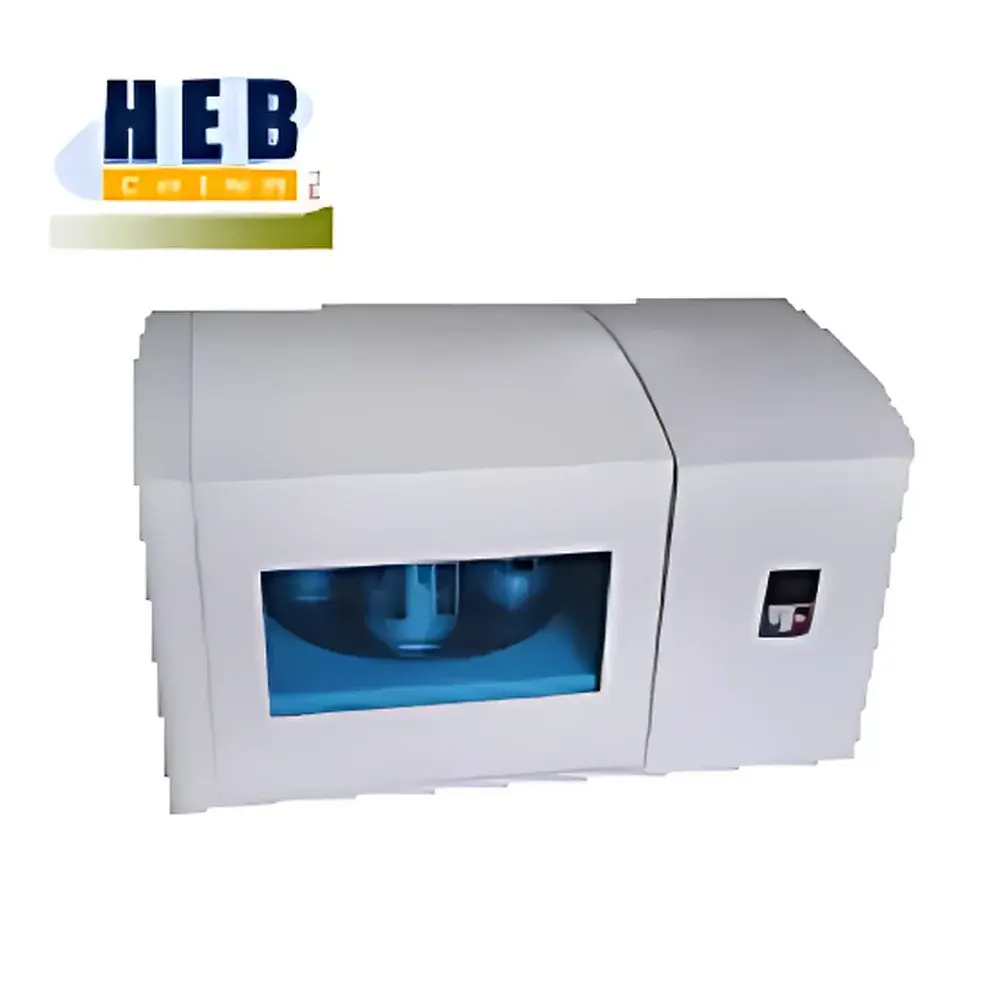
JH-B4 Variable-Frequency Planetary Ball Mill
| Brand | Jihepu (Jinan Hepu) |
|---|---|
| Origin | Shandong, China |
| Model | JH-B4 |
| Grinding Principle | Impact & Friction Force |
| Feed Size | ≤10 mm (soil), ≤3 mm (metal ores) |
| Discharge Size | ≤0.1 µm |
| Batch Capacity | 50–250 mL per jar |
| Speed Range | 0–1499 rpm (0–50 Hz) |
| Jar Quantity | 1/2/4 |
| Jar Materials | Agate, Stainless Steel, Tungsten Carbide, PTFE, Nylon, Zirconia, Polycarbonate |
| Display | Digital or LCD Touchscreen (B4A variant) |
| Max Continuous Operation | 72 h (full load) |
| Noise Level | ≤50 dB(A) |
| Dimensions | 80 × 50 × 50 cm |
| Weight | 150 kg |
Overview
The JH-B4 Variable-Frequency Planetary Ball Mill is a precision-engineered laboratory grinding system designed for high-energy mechanical comminution of solid samples via planetary motion. Operating on the principle of combined impact and friction forces generated by eccentric rotation of grinding jars around a sun wheel while simultaneously rotating on their own axes, this mill delivers consistent, reproducible particle size reduction down to ≤0.1 µm. Its variable-frequency drive enables precise, stepless speed control (0–1499 rpm), ensuring optimal energy input across diverse material classes — from brittle soils and ceramics to tough metallic ores and polymeric compounds. The instrument is widely deployed in environmental laboratories for sample preparation prior to elemental analysis (e.g., heavy metal quantification by ICP-MS or AAS), as well as in geological, metallurgical, pharmaceutical, and materials science research settings where contamination control and batch-to-batch repeatability are critical.
Key Features
- Variable-frequency AC drive with digital speed regulation (0–1499 rpm), enabling fine-tuned kinetic energy delivery for sensitive or heterogeneous samples.
- Dual-mode operation: configurable dry grinding and wet grinding protocols, supporting solvent-based dispersion and cryogenic milling when paired with compatible jars.
- Programmable operation: B4A variant features an LCD touchscreen interface supporting up to 50-segment gradient programs (speed, time, direction), with storage for 10 complete multi-step protocols.
- Robust mechanical architecture rated for continuous operation up to 72 hours under full load, with integrated power-fail recovery to retain active program parameters.
- Modular jar configuration: accommodates 1, 2, or 4 grinding jars (50 mL, 100 mL, or 250 mL volume options) with interchangeable materials including agate, stainless steel, tungsten carbide, zirconia, PTFE, nylon, and polycarbonate — minimizing cross-contamination and chemical reactivity.
- Low-noise design (<50 dB[A]) achieved through vibration-damped base construction and balanced planetary gear train, suitable for shared lab environments.
Sample Compatibility & Compliance
The JH-B4 is validated for processing hard, medium-hard, brittle, and fibrous samples including soil matrices, mineral ores, catalysts, ceramics, alloys, plant tissues, and pharmaceutical excipients. Its ≤0.1 µm final particle size meets requirements for subsequent analytical workflows such as XRD phase identification, SEM-EDS morphological assessment, and digestion-based trace metal analysis per EPA Method 3050B or ISO 11466. Jar material selection aligns with ISO 17025:2017 clause 6.4.2 (equipment suitability) and supports GLP-compliant sample preparation when used with documented SOPs. While not inherently 21 CFR Part 11 compliant, audit-trail-capable software (sold separately) enables electronic record retention for regulated QC/QA applications.
Software & Data Management
The optional PC-based control software (not included) provides centralized management for multiple JH-B4 units. It supports remote firmware updates, real-time parameter monitoring, export of timestamped operation logs (start/stop time, speed profile, jar ID), and integration into LIMS via CSV or XML output. All gradient programs are stored with user-defined naming and versioning, facilitating method transfer between instruments and operators. Software-generated reports include compliance metadata (operator ID, date/time stamp, instrument serial number), supporting traceability in accredited testing laboratories.
Applications
- Environmental testing: Homogenization and micronization of soil, sediment, and sludge samples prior to acid digestion and heavy metal analysis (Pb, Cd, As, Cr).
- Geochemical research: Preparation of rock and ore powders for XRF calibration standards and geochemical fingerprinting.
- Materials development: Synthesis of nanocomposites, mechanochemical activation of catalysts, and amorphization of crystalline APIs.
- Quality control: Particle size standardization of raw materials in ceramics, pigments, and battery cathode precursors.
- Agricultural & veterinary labs: Grinding of feed, tissue, and manure samples for nutrient and contaminant screening.
FAQ
What jar materials are recommended for acidic sample digestion prep?
Agate and PTFE jars are preferred for acid-resistant applications; zirconia offers superior wear resistance for extended runs with abrasive minerals.
Can the JH-B4 operate unattended overnight?
Yes — with programmable timing and power-fail memory, it supports fully autonomous 72-hour operation under defined load conditions.
Is speed calibration traceable to national standards?
RPM output is factory-calibrated against NIST-traceable tachometric reference; users may perform periodic verification using external optical tachometers.
How is cross-contamination minimized between batches?
By selecting chemically inert jars (e.g., agate or zirconia) and implementing validated cleaning protocols (e.g., ultrasonic wash with ethanol/water, followed by oven drying at 105°C).
Does the system support GMP documentation requirements?
When paired with the optional software suite and configured with user access controls and electronic signatures, it supports ALCOA+ data integrity principles for regulated environments.



