
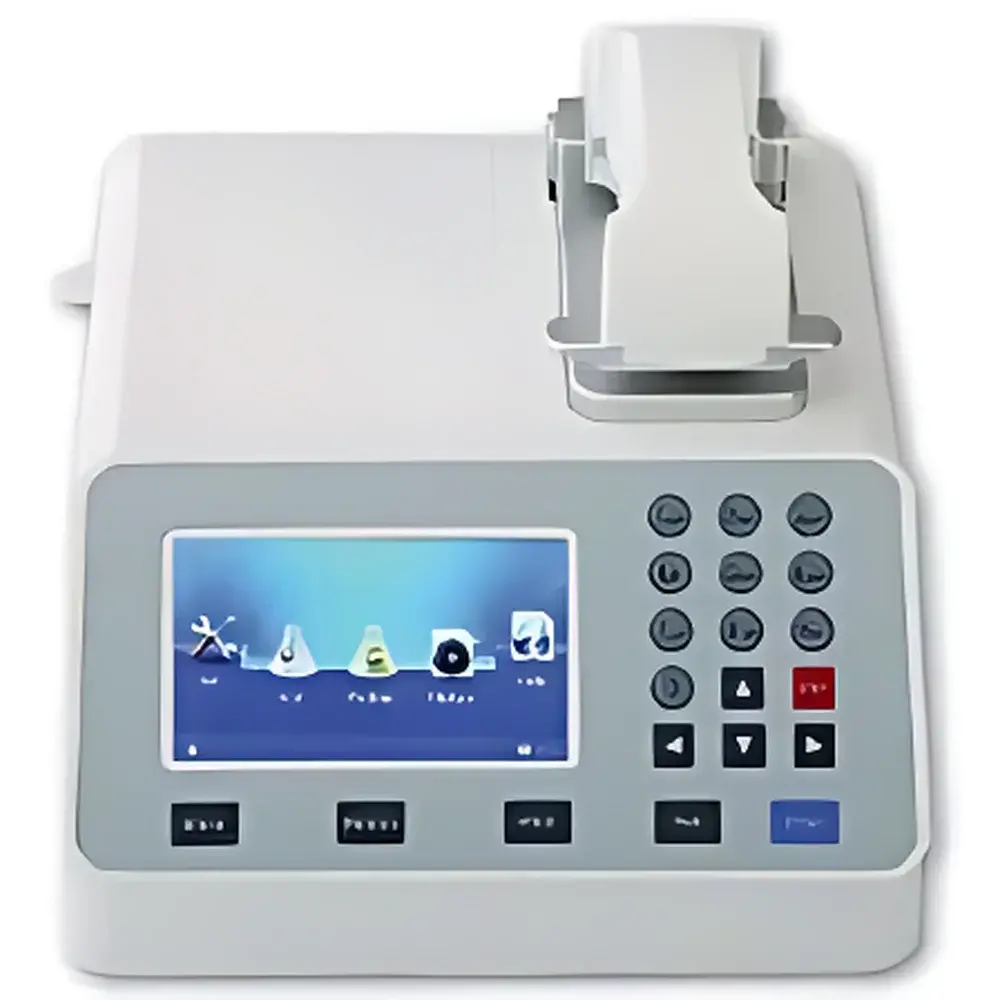
Hercuvan ND-2800 Microvolume UV-Vis Spectrophotometer for Nucleic Acid and Protein Quantification
| Brand | Hercuvan |
|---|---|
| Origin | Malaysia |
| Model | ND-2800 |
| Automation Level | Dedicated Fully Automatic |
| Sample Throughput per Run | 1 |
| Sample Volume Range | 0.3–2 µL |
| Processing Time per Sample | ≤15 seconds |
| Wavelengths | 230 nm, 260 nm, 280 nm |
| Pathlength Options | 1.0 mm / 0.2 mm |
| Absorbance Accuracy | ±1% |
| Absorbance Precision | ±0.003 Abs |
| Absorbance Range | 0.02–80 AU (equivalent to 10 mm) |
| DNA Detection Limit | 10–4000 ng/µL |
| BSA Detection Limit | 0.5–110 mg/mL |
| Light Source | Pulsed Xenon Lamp |
| Spectral Readout Time | <5 s |
| Dimensions | 24 × 22 × 14 cm |
| Weight | 2.35 kg |
Overview
The Hercuvan ND-2800 is a dedicated microvolume UV-Vis spectrophotometer engineered for rapid, accurate quantification and purity assessment of nucleic acids (DNA/RNA) and proteins in life science laboratories. It operates on the principle of fixed-wavelength absorbance spectroscopy at three biologically critical wavelengths—230 nm (for contaminants such as chaotropic salts and phenol), 260 nm (for nucleic acid absorbance), and 280 nm (for aromatic amino acid absorption in proteins). Unlike conventional cuvette-based instruments, the ND-2800 employs a proprietary surface tension-based sample retention system: a minimal volume (0.3–2 µL) is deposited directly onto an optical quartz pedestal, eliminating the need for disposable cuvettes, capillaries, or dilution steps. Its pulsed xenon lamp ensures stable, drift-free illumination without warm-up delay, enabling immediate measurement upon sample loading. The instrument reports A260, A280, A230, A260/280, A260/230, and concentration (ng/µL for DNA/RNA; mg/mL for BSA) in under 15 seconds per sample—fully compliant with standard nucleic acid and protein quality control workflows in molecular biology, genomics, and biopharmaceutical QC environments.
Key Features
- Microvolume capability: Accurate analysis from just 0.3 µL of undiluted sample—ideal for precious or low-yield isolates.
- Cuvette-free operation: Eliminates consumable costs, cross-contamination risk, and cleaning protocols associated with traditional quartz or plastic cuvettes.
- No preheating required: Pulsed xenon light source delivers consistent spectral output from first use—no stabilization delay.
- High dynamic range: Measures absorbance values from 0.02 to 80 AU (10 mm equivalent), covering DNA concentrations from 10 to 4000 ng/µL and BSA from 0.5 to 110 mg/mL without manual dilution.
- Dual pathlength integration: Automatically applies correction factors for 1.0 mm and 0.2 mm effective pathlengths, enabling broad concentration coverage within a single platform.
- Robust mechanical design: Compact footprint (24 × 22 × 14 cm) and lightweight chassis (2.35 kg) support benchtop deployment in core facilities, teaching labs, and mobile diagnostic units.
- Intuitive interface: Dedicated “Measure” button initiates full spectral acquisition and calculation; “Print” exports finalized results directly to connected thermal printers.
Sample Compatibility & Compliance
The ND-2800 is validated for direct quantification of purified plasmid DNA, genomic DNA, total RNA, oligonucleotides, and recombinant proteins including BSA, lysozyme, and IgG. It supports routine QC testing aligned with ISO/IEC 17025 requirements for calibration traceability and measurement uncertainty reporting. While not certified for GLP/GMP production environments, its performance characteristics—including ±1% absorbance accuracy and ±0.003 Abs repeatability—meet internal validation criteria for research-grade nucleic acid integrity screening per MIQE and RIN-relevant guidelines. Sample platforms are chemically inert quartz surfaces compatible with common elution buffers (e.g., TE, nuclease-free water, low-salt Tris-HCl), and require only lint-free, non-abrasive wipes for post-measurement cleaning.
Software & Data Management
The ND-2800 operates via embedded firmware with no external PC dependency. All calculations—including extinction coefficient-based concentration derivation, ratio-based purity diagnostics (A260/280, A260/230), and pathlength normalization—are executed onboard using preloaded biochemical constants (e.g., 50 µg/mL·cm for dsDNA, 1.55 for BSA). Measurement history is retained in volatile memory until printed or manually cleared. Though it lacks USB data export or network connectivity, its deterministic output format ensures full auditability: each printout includes timestamp, wavelength set, measured absorbances, derived ratios, calculated concentrations, and operator-defined sample ID. This architecture satisfies basic 21 CFR Part 11 documentation needs when paired with laboratory logbook practices.
Applications
- Pre-sequencing QC: Rapid verification of RNA integrity and contaminant levels prior to library prep.
- CRISPR guide RNA quantification: Accurate measurement of synthetic sgRNAs without dilution artifacts.
- Protein expression monitoring: Real-time assessment of lysate supernatants during purification optimization.
- Educational labs: Teaching absorbance principles, Beer-Lambert law application, and nucleic acid/protein biochemistry fundamentals.
- Diagnostic sample triage: Preliminary screening of extracted nucleic acids from clinical swabs or FFPE tissues before downstream amplification.
- QC release testing: Final concentration verification of master mix components or reference standards in assay development.
FAQ
Does the ND-2800 require calibration with NIST-traceable standards?
No routine recalibration is needed; the instrument is factory-calibrated using certified neutral density filters and wavelength references. Users may verify performance annually using a standardized dsDNA solution (e.g., 50 ng/µL in TE buffer).
Can the ND-2800 measure samples containing detergents or reducing agents?
Yes—but high concentrations (>0.1% SDS or >1 mM DTT) may elevate A230 and compromise A260/230 interpretation. Dilution or buffer exchange is recommended for rigorous purity assessment.
Is the sample pedestal resistant to ethanol or isopropanol carryover?
Quartz pedestals tolerate brief exposure to ≤70% ethanol for cleaning; prolonged contact with >90% alcohol or chloroform may cause hazing and requires replacement per manufacturer’s service schedule.
What is the expected lifetime of the pulsed xenon lamp?
Rated for ≥1 × 10⁹ pulses, corresponding to approximately 5 years of typical academic lab usage (≤50 measurements/day). Lamp replacement is a field-serviceable procedure requiring no optical realignment.
How does the ND-2800 handle viscous or particulate-containing samples?
Viscosity >10 cP may disrupt meniscus formation; centrifugation (12,000 × g, 5 min) is advised prior to loading. Particulates >5 µm can interfere with optical coupling and should be removed by filtration (0.22 µm PVDF).




