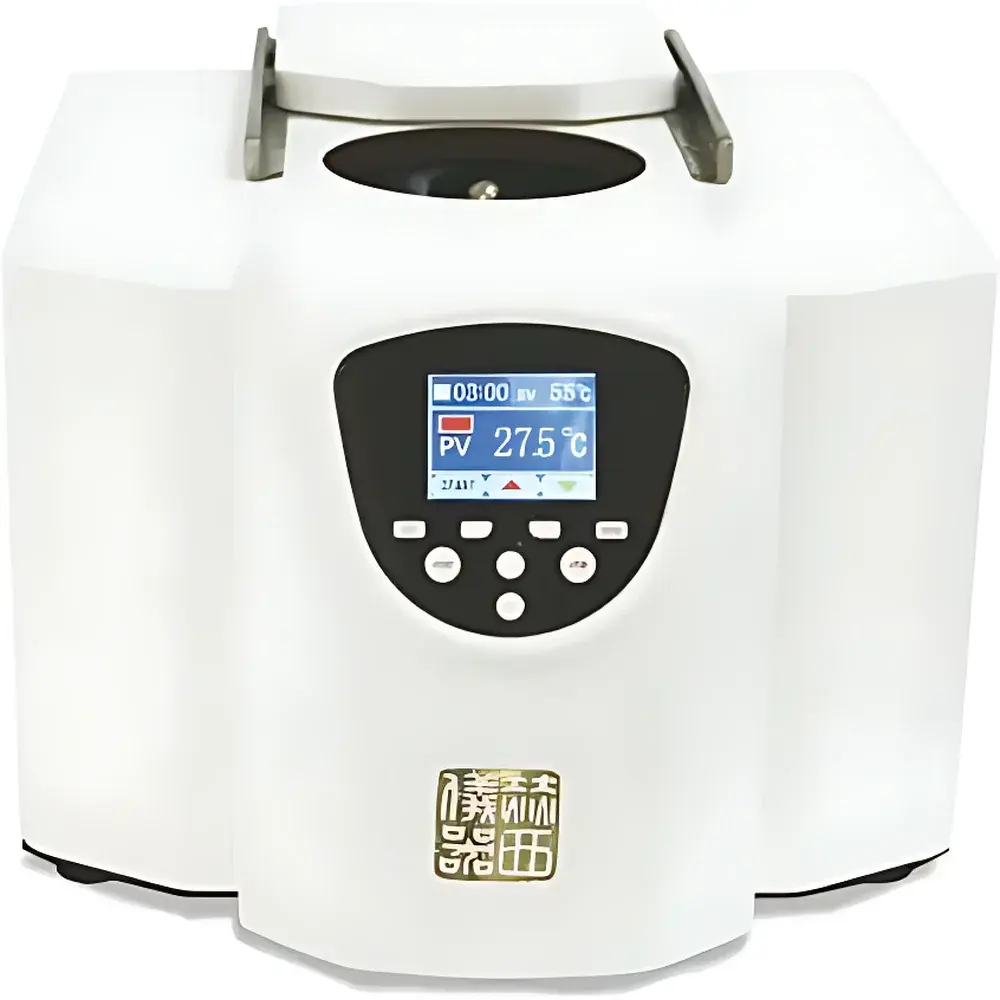
Herexi TLW5R Benchtop Gerber Centrifuge
| Brand | Herexi |
|---|---|
| Origin | Hunan, China |
| Model | TLW5R |
| Max Capacity | 8 Gerber fat meters |
| Max Speed | 1500 rpm |
| RCF Max | 504 ×g |
| Speed Accuracy | ±50 rpm |
| Temp Range | RT +10°C to 65°C |
| Timer | 0–99 h 59 min |
| Drive System | AC frequency-controlled motor with microprocessor control |
| Display | 4.3″ TFT color touchscreen |
| Rotor Type | Fixed-angle |
| Power | 1.5 kW |
| Noise Level | ≤60 dB(A) |
| Dimensions (L×W×H) | 520×415×330 mm |
| Weight | 35 kg |
| Compliance | Designed for GB/T 5413.3–2010 (Mojonnier method), AOAC 920.117 (Gerber method), ISO 1211:2010 (milk fat determination) |
Overview
The Herexi TLW5R Benchtop Gerber Centrifuge is a purpose-built analytical instrument engineered for standardized fat quantification in raw milk, pasteurized milk, cream, and dairy-based products. It operates on the principle of differential sedimentation under controlled centrifugal force—specifically optimized for the Gerber and Babcock methods—where sulfuric acid-digested samples are subjected to precise rotational acceleration to separate lipid phases from aqueous and proteinaceous components. The device integrates thermostatic control (up to 65°C) to ensure consistent sample viscosity and phase separation kinetics, directly supporting reproducibility requirements outlined in GB/T 5413.3–2010 (equivalent to ISO 1211:2010) and AOAC Official Method 920.117. Its fixed-angle rotor accommodates eight standardized Gerber fat meters simultaneously, enabling batch processing while maintaining strict adherence to volumetric geometry and meniscus reading protocols required for gravimetric or volumetric fat percentage calculation.
Key Features
- 4.3-inch full-color TFT touchscreen interface with dual-control logic (touch + physical key redundancy) for intuitive operation under laboratory glove conditions.
- Microprocessor-based control system delivering stable speed regulation (±50 rpm accuracy) and programmable thermal ramping across 10°C above ambient to 65°C—critical for minimizing emulsion stability artifacts during fat layer formation.
- Direct-drive AC frequency-controlled motor eliminates belt wear and ensures long-term torque consistency at 1500 rpm, generating a maximum RCF of 504 ×g—calibrated to meet Gerber method specifications for optimal fat column height development.
- Robust aluminum alloy housing with acoustic damping design limits operational noise to ≤60 dB(A), suitable for shared QC laboratories without dedicated isolation rooms.
- Compliance-ready architecture: timer resolution supports extended runs up to 99 hours 59 minutes; temperature and speed parameters are logged internally with timestamped event history—facilitating GLP-aligned record retention.
Sample Compatibility & Compliance
The TLW5R is validated for use with standardized Gerber fat meters (11 mL capacity, calibrated scale), Mojonnier flasks per GB/T 5413.3–2010, and Babcock bottles conforming to ASTM D1296. Its thermal and mechanical profile satisfies mandatory pre-conditioning steps defined in ISO 1211:2010 Section 7.2 (sample equilibration at 40–50°C prior to centrifugation) and AOAC 920.117 Section 4.1 (centrifugation at ≥1400 rpm for ≥5 min). No modification or adapter is required for standard dairy sample containers; rotor geometry maintains vertical alignment of fat meters within ±0.5° tolerance to prevent meniscus distortion during reading. Device documentation includes traceable calibration certificates for speed and temperature sensors, aligned with ISO/IEC 17025 metrological requirements for testing laboratories.
Software & Data Management
While the TLW5R operates as a standalone benchtop unit without external PC dependency, its embedded firmware supports audit-trail functionality compliant with basic GLP data integrity principles. All user-initiated parameter changes—including setpoints, run duration, and thermal profiles—are recorded with date/time stamps and operator ID (if configured via network authentication). Internal memory retains ≥1000 cycle logs, exportable via USB 2.0 port in CSV format for integration into LIMS or electronic lab notebooks. Firmware updates are delivered via signed binary packages verified against SHA-256 checksums—ensuring firmware integrity per IEC 62443-3-3 security guidelines for laboratory instrumentation.
Applications
- Routine quality control in dairy processing plants for raw milk intake screening and finished product release testing.
- Regulatory compliance testing per national standards (e.g., China’s GB 19301–2010 for raw milk fat content) and international export certifications (e.g., EU Regulation (EC) No 853/2004 Annex III).
- Method validation studies comparing Gerber, Mojonnier, and Rose-Gottlieb extraction techniques under identical centrifugal conditions.
- Teaching laboratories demonstrating classical lipid separation physics and standardized food analysis protocols per ISO/IEC 17025 Clause 5.4.2.
- Research on fat globule size distribution effects on separation efficiency—when coupled with post-centrifugation optical density profiling or capillary electrophoresis.
FAQ
What standards does the TLW5R support for official fat testing?
It is designed for full conformance with GB/T 5413.3–2010 (Mojonnier), ISO 1211:2010 (Gerber), AOAC 920.117, and ASTM D1296—covering both volumetric and gravimetric fat determination workflows.
Can the TLW5R be used with non-Gerber sample tubes?
No—it is mechanically and thermally optimized exclusively for 11 mL Gerber fat meters and Mojonnier flasks specified in GB/T 5413.3–2010; alternative tube formats require validation per ISO 17025 Clause 5.4.5.
Is temperature calibration traceable to national standards?
Yes—factory calibration uses NIST-traceable dry-block calibrators; certificate of calibration includes uncertainty values per ISO/IEC 17025 Annex A.
Does the device meet FDA 21 CFR Part 11 requirements?
It supports ALCOA+ data integrity principles (Attributable, Legible, Contemporaneous, Original, Accurate) but lacks electronic signature capability; Part 11 compliance requires supplementary procedural controls and LIMS-level audit trail enforcement.
What maintenance intervals are recommended for routine operation?
Rotor inspection every 500 cycles; drive belt replacement not applicable (direct-drive system); annual verification of temperature uniformity across chamber per ISO 13485 Annex C.