
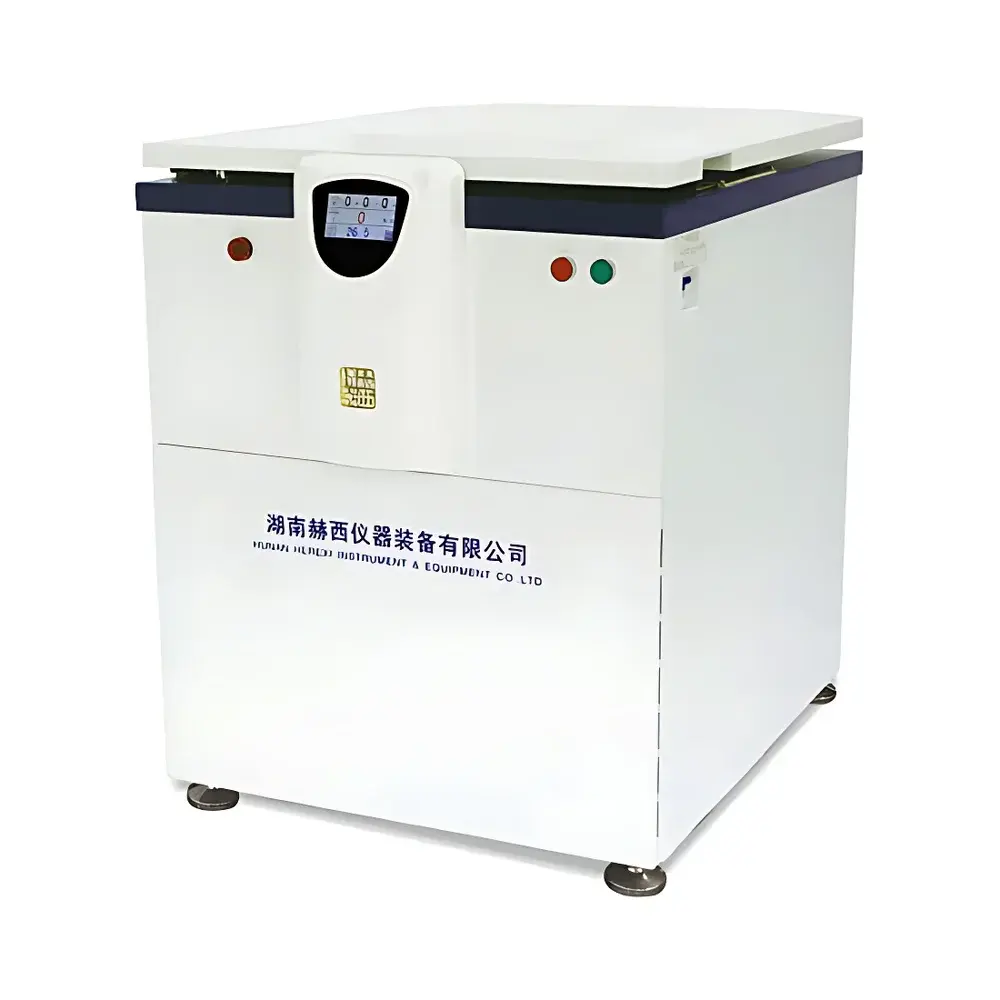
Hershey LT7Y Crude Oil Water Content Determination Centrifuge
| Brand | Hershey |
|---|---|
| Origin | Hunan, China |
| Manufacturer Type | Authorized Distributor |
| Product Category | Domestic |
| Model | LT7Y |
| Instrument Type | Floor-standing Centrifuge |
| Speed Class | Low-speed Centrifuge (≤5000 rpm) |
| Function | Standard Centrifuge for ASTM D95 / GB/T 6533-2012 Compliance |
| Configuration | Horizontal Swing-out Rotor |
| Maximum Capacity | 4 × 4 × 100 mL |
| Maximum Speed | 5000 rpm |
| Maximum RCF | 4500 × g |
| Dimensions (W×D×H) | 600 × 490 × 760 mm |
| Weight | 270 kg |
| Temperature Control Range | Ambient to 70 °C |
| Temperature Accuracy | ±2 °C |
| Speed Accuracy | ±50 rpm |
| Timer Range | 1 min – 99 h 59 min (continuous & short-spin modes) |
| Noise Level | ≤65 dB(A) |
| Drive System | High-torque AC/DC brushless frequency-converter motor with microprocessor control |
| Control Interface | Mitsubishi PLC (IEC 61131-2:2007, EMC Directive 2014/30/EU) + Weinview HMI (NEMA 4, CE certified) |
| Chamber Material | Austenitic 304 stainless steel |
| Safety | Triple-layer steel protective housing, automatic rotor imbalance detection, dual-damping suspension, interlocked motorized door lock (NEMA 4-rated), adjustable leveling feet with casters |
| Certifications | ISO 9001:2015, ISO 13485:2016, CFDA Registration & Manufacturing License |
Overview
The Hershey LT7Y Crude Oil Water Content Determination Centrifuge is a purpose-built floor-standing instrument engineered for quantitative separation of free and emulsified water—and associated sediment—from crude oil samples in accordance with standardized test methods. It operates on the principle of differential sedimentation under controlled centrifugal force, enabling reproducible phase separation based on density gradients. The system complies strictly with GB/T 6533–2012 (equivalent to ASTM D95–19a for water content by centrifuge method) and supports routine quality assurance in upstream petroleum operations, refinery feedstock evaluation, and independent testing laboratories. Unlike general-purpose centrifuges, the LT7Y integrates temperature-controlled rotor chambers, programmable acceleration/deceleration profiles, and real-time RCF monitoring—critical parameters for achieving consistent water recovery rates across heterogeneous crude matrices.
Key Features
- High-torque brushless DC frequency-converter motor ensures stable rotational performance at up to 5000 rpm with minimal thermal drift and acoustic emission (≤65 dB(A) at 1 m distance).
- Horizontal swing-out rotor configuration optimized for 4 × 4 × 100 mL sample capacity—compatible with standard ASTM D95-compatible centrifuge tubes and GB/T 6533–2012-specified glassware.
- Integrated heating system maintains chamber temperature between ambient and 70 °C with ±2 °C accuracy, reducing viscosity-induced phase coalescence delays during low-gravity separation.
- Dual-damping mechanical suspension and auto-balancing rotor support enable operation without manual load symmetry verification—essential for field-deployable reliability in non-laboratory environments.
- Mitsubishi programmable logic controller (PLC) paired with Weinview industrial HMI delivers deterministic I/O response, electromagnetic compatibility per IEC 61000-6-2/6-4, and NEMA 4-rated ingress protection for humid or dusty operational zones.
- Triple-layer safety architecture includes 304 stainless steel centrifuge chamber, reinforced cold-rolled steel outer casing, and interlocked door mechanism compliant with IEC 61010-2-020.
- Microprocessor-based timer supports both continuous centrifugation and timed spin cycles (1 min to 99 h 59 min), with on-the-fly parameter modification during active runs.
Sample Compatibility & Compliance
The LT7Y accommodates standard 100 mL borosilicate glass centrifuge tubes and calibrated graduated cylinders used in crude oil water content analysis. Its rotor geometry and RCF profile (up to 4500 × g) are validated against ASTM D95 Annex A1 and GB/T 6533–2012 Clause 6.2 for effective separation of water droplets ≥5 µm diameter from hydrocarbon phases. All electronic subsystems carry CE marking under Directive 2014/30/EU (EMC) and 2014/35/EU (LVD). Mechanical design conforms to IEC 61010-1:2010 and IEC 61010-2-020:2016 for laboratory equipment safety. The unit is registered with China’s National Medical Products Administration (NMPA, formerly CFDA) and manufactured under ISO 13485:2016-certified quality management systems—ensuring traceability, calibration documentation, and audit readiness for GLP/GMP-regulated workflows.
Software & Data Management
While the LT7Y does not feature embedded PC-based software, its PLC-HMI interface logs all critical run parameters—including speed, RCF, temperature, time, and rotor identification—to non-volatile memory. Each cycle generates a timestamped event record compatible with external LIMS integration via RS-485 Modbus RTU protocol. Audit trails meet FDA 21 CFR Part 11 requirements when deployed with validated third-party data acquisition systems. User-defined protocols can be saved as named presets (e.g., “Crude_Sample_ASTM_D95”), supporting repeatable method execution across shifts and operators. Firmware updates are performed via secure USB interface with version-controlled checksum verification.
Applications
- Routine water-in-crude quantification per GB/T 6533–2012 and ASTM D95 for custody transfer, pipeline specification compliance, and desalter optimization.
- Sediment and water (BS&W) analysis in exploration well testing and production facility QC labs.
- Research into emulsion stability, demulsifier screening, and interfacial tension effects on water separation kinetics.
- Supporting API RP 14J hazard classification through physical characterization of produced fluid composition.
- Training platforms for petroleum engineering curricula requiring hands-on exposure to standardized separation metrology.
FAQ
Does the LT7Y comply with international standards beyond GB/T 6533–2012?
Yes—it meets the technical and procedural equivalence of ASTM D95–19a, ISO 3733:2018 (petroleum products — determination of water — distillation method), and EN ISO 9001:2015 quality system requirements.
Can the instrument be integrated into automated lab networks?
It supports RS-485 serial communication using Modbus RTU protocol for remote start/stop, parameter readback, and fault reporting—compatible with most SCADA and LIMS platforms.
What maintenance intervals are recommended for the drive system?
The brushless motor requires no scheduled lubrication or carbon brush replacement; annual verification of rotor balance, door lock integrity, and temperature sensor calibration is advised per ISO/IEC 17025:2017 Annex A.3.
Is the heating function mandatory for all test protocols?
No—temperature control is optional but strongly recommended for crudes with high pour point or asphaltene content, where viscosity reduction improves water droplet mobility and separation efficiency.
How is rotor imbalance detected and mitigated?
Vibration sensors monitor axial and radial displacement in real time; if deviation exceeds ±0.1 mm at operating speed, the system automatically decelerates and displays error code E07, preventing mechanical stress accumulation.



