
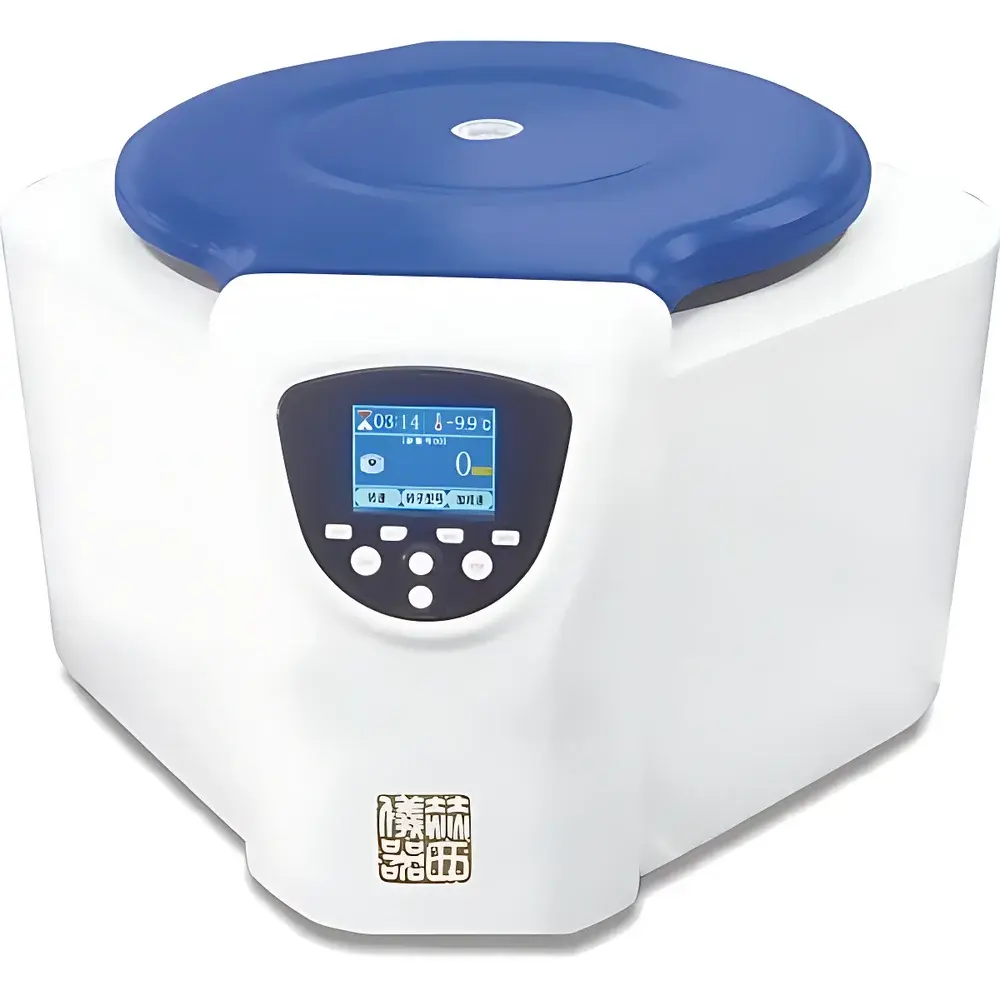
Hershey TD5T Crude Oil Water Content Determination Centrifuge
| Brand | Hershey |
|---|---|
| Origin | Hunan, China |
| Model | TD5T |
| Instrument Type | Benchtop Low-Speed Centrifuge |
| Rotor Configuration | Horizontal Swing-Out Rotor |
| Maximum Capacity | 4 × 250 mL |
| Maximum Speed | 5000 rpm |
| Maximum RCF | 4200 × g |
| Speed Accuracy | ±50 rpm |
| Temperature Control Range | Ambient +10°C to 70°C |
| Temperature Accuracy | ±2°C |
| Timer Range | 0–99 min |
| Noise Level | ≤60 dB(A) |
| Power Supply | AC 220 V, 50 Hz |
| Net Weight | 50 kg |
| Dimensions (L×W×H) | 600 × 540 × 360 mm |
| Drive System | Microprocessor-Controlled Brushless DC Frequency-Conversion Motor |
| Safety Features | Overspeed Protection, Imbalance Detection, Automatic Rotor Recognition, Electromechanical Door Lock, Dual-Damping Suspension System |
| Display Options | PLC LCD or LED Digital Display |
| Compliance | GB/T 6533–1986 (Determination of Water and Sediment in Crude Oil by Centrifuge Method) |
Overview
The Hershey TD5T Crude Oil Water Content Determination Centrifuge is a purpose-engineered benchtop low-speed centrifuge designed specifically for quantitative separation of water and sediment from crude oil samples in accordance with GB/T 6533–1986. This standard specifies the centrifugal method for determining water content and total sediment in crude petroleum—critical parameters for custody transfer, refining feedstock qualification, and upstream quality assurance. The TD5T operates on the principle of differential sedimentation under controlled gravitational force (RCF), where immiscible water droplets and solid particulates are accelerated radially outward in a rotating horizontal rotor, enabling phase stratification within standardized centrifuge tubes. Its thermal regulation capability (ambient +10°C to 70°C) ensures consistent sample viscosity during processing—a key factor influencing separation efficiency and reproducibility across varying crude compositions. Unlike general-purpose centrifuges, the TD5T integrates temperature-controlled acceleration and deceleration profiles optimized for non-Newtonian hydrocarbon matrices, minimizing emulsion reformation and maximizing interfacial clarity post-run.
Key Features
- Microprocessor-controlled brushless DC frequency-conversion motor delivering stable rotational speed with minimal torque fluctuation and acoustic emission (<60 dB(A) at full load); zero carbon brush wear ensures long-term operational reliability without scheduled motor maintenance.
- Horizontal swing-out rotor configuration supporting four 250 mL calibrated centrifuge tubes—compatible with ASTM D96 and ISO 3735 sample containers—enabling batch processing of field-collected crude samples per regulatory workflow requirements.
- Dual-damping suspension system with automatic dynamic balancing; rotor assembly self-compensates for minor mass asymmetries, eliminating manual counterbalancing and reducing vibration transmission to the lab bench.
- Electromechanical door interlock with fail-safe locking mechanism prevents lid opening during operation and enforces mandatory deceleration before release—compliant with IEC 61010-2-20 safety directives for laboratory centrifuges.
- Programmable temperature control (±2°C accuracy) integrated into the centrifugation cycle, allowing precise thermal conditioning of viscous crudes to reduce interfacial tension and enhance water coalescence kinetics.
- Two display interface options: high-contrast LED digital panel for rapid parameter verification or full-function PLC LCD with real-time graphical feedback of speed, temperature, elapsed time, and remaining runtime—parameters modifiable mid-run without interrupting the protocol.
Sample Compatibility & Compliance
The TD5T accommodates standard 250 mL glass or polypropylene centrifuge tubes conforming to ISO 8573-1 and ASTM D4057 sampling specifications. It supports crude oils ranging from light paraffinic to heavy asphaltic grades, including emulsified systems stabilized by natural surfactants (e.g., asphaltenes, naphthenic acids). All operational protocols align with GB/T 6533–1986, which references equivalent methodologies in API RP 1175 and ISO 3735:2000. While not certified to GLP or 21 CFR Part 11 out-of-the-box, its audit-ready event log (timestamped start/stop, setpoint deviations, error codes) provides traceable documentation suitable for internal QA/QC and third-party inspection frameworks. Optional calibration certificates (traceable to NIM, China) are available upon request for metrological validation.
Software & Data Management
The TD5T operates via embedded firmware with no external PC dependency. All user-defined methods—including speed ramp profiles, hold times at target RCF, and thermal soak durations—are stored in non-volatile memory (up to 99 protocols). Each run generates an immutable session record containing date/time stamp, rotor ID, actual vs. setpoint values (speed, temperature, duration), and any triggered safety events (e.g., imbalance alert, overtemperature cutoff). These logs can be exported manually via USB interface in CSV format for integration into LIMS environments or regulatory reporting templates. Firmware updates are performed locally using signed binary files, preserving data integrity and version control compliance.
Applications
- Routine water-in-crude assays for pipeline custody transfer verification per API MPMS Chapter 10.8.
- Sediment quantification in storage tank bottom samples prior to refinery feed introduction.
- Emulsion stability testing under controlled thermal shear conditions (e.g., evaluating demulsifier efficacy).
- Preparative separation of water-cut fractions for downstream GC-FID or Karl Fischer titration analysis.
- Field-deployable QC in mobile laboratories supporting offshore platform operations or remote well sites.
FAQ
Does the TD5T meet international standards beyond GB/T 6533?
Yes—the mechanical design, rotor geometry, and centrifugal force calibration are functionally equivalent to instruments compliant with ISO 3735:2000 and ASTM D96. Full conformance documentation requires site-specific validation per ISO/IEC 17025.
Can the TD5T be used for non-petroleum samples such as biodiesel or lubricating oils?
It may be employed for analogous water/sediment determinations in other hydrocarbon-based fluids, provided viscosity and density fall within the validated operational envelope (≤500 cSt at 40°C). Method adaptation and in-house verification are required per ISO 17025 Clause 7.2.2.
Is rotor balancing required before each run?
No—the dual-damping suspension and automatic dynamic balancing eliminate manual balancing. However, tubes must be loaded symmetrically in paired positions (e.g., positions 1+3 and 2+4) to maintain nominal rotor inertia.
What maintenance intervals are recommended for routine operation?
Annual verification of temperature sensor calibration and rotor integrity inspection (crack detection via dye penetrant or ultrasonic testing) are advised. The brushless motor requires no periodic servicing beyond visual inspection of ventilation pathways.



