
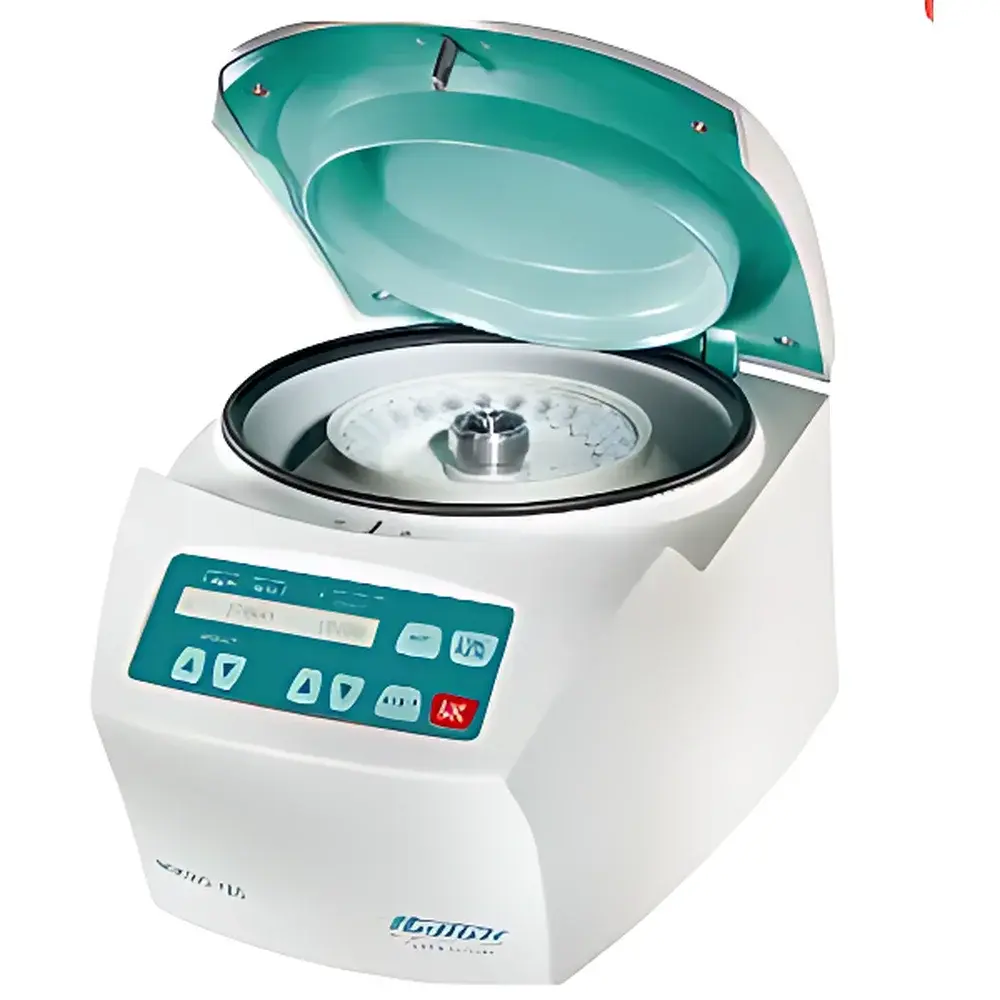
Hettich Mikro 185 Benchtop Microcentrifuge
| Brand | Hettich |
|---|---|
| Origin | Germany |
| Model | Mikro 185 |
| Instrument Type | Benchtop Centrifuge |
| Function | General-Purpose Microcentrifuge |
| Configuration | Fixed-Angle Rotor |
| Maximum Capacity | 24 × 1.5/2.0 mL |
| Maximum Speed | 14,000 rpm |
| Maximum RCF | 18,845 × g |
| Dimensions (H×W×D) | 261 × 353 × 238 mm |
| Weight | 11 kg |
| Power Supply | 200–240 V, 50–60 Hz |
| Power Consumption | 330 VA |
| Electromagnetic Compatibility | EN/IEC 61326-1, Class B |
| Timer Range | 1–99 min, ∞ (continuous), and short-spin mode |
Overview
The Hettich Mikro 185 is a compact, high-performance benchtop microcentrifuge engineered for precision and reliability in routine laboratory workflows requiring rapid sedimentation of small-volume samples. Operating on the principle of centrifugal force generation via high-speed rotor rotation, the Mikro 185 accelerates sample separation by applying controlled radial acceleration—expressed as relative centrifugal force (RCF)—to accelerate phase separation in suspensions, precipitates, or emulsions. With a maximum speed of 14,000 rpm and an RCF of 18,845 × g, it delivers consistent performance across standard microvolume applications including nucleic acid pelleting, protein precipitation, cell debris removal, and PCR tube processing. Its robust brushless motor, integrated thermal management system, and low-noise mechanical design ensure stable operation under extended use conditions typical of high-throughput molecular biology, clinical diagnostics, and pharmaceutical quality control labs.
Key Features
- Fixed-angle rotor configuration supporting up to 24 × 1.5/2.0 mL tubes—optimized for common microcentrifuge tube formats (e.g., Eppendorf-style, PCR strips)
- Intelligent safety architecture: automatic lid interlock during operation, emergency quick-release lid mechanism, imbalance detection with immediate shutdown, and motor overheat protection
- Precise digital timer with three operational modes: programmable duration (1–99 minutes), continuous run (∞), and momentary spin (short-spin) for rapid pellet consolidation
- Compliant electromagnetic emissions per EN/IEC 61326-1, Class B—suitable for shared laboratory environments with sensitive instrumentation
- Compact footprint (261 × 353 × 238 mm) and lightweight construction (11 kg) enable flexible placement on crowded benches or mobile lab carts
- Energy-efficient design consuming only 330 VA at full load—aligned with ISO 50001-informed lab sustainability practices
Sample Compatibility & Compliance
The Mikro 185 accommodates standard polypropylene and polycarbonate microtubes ranging from 0.2 mL to 2.0 mL, including conical-bottom and skirted PCR tubes. It supports common rotor configurations (12-, 18-, and 24-position fixed-angle rotors), all manufactured from corrosion-resistant aluminum alloy and certified for autoclaving. The device complies with IEC 61010-1 for electrical safety in laboratory equipment and meets essential requirements of the EU Machinery Directive 2006/42/EC. While not inherently 21 CFR Part 11 compliant (as it lacks audit-trail-capable software), its mechanical repeatability and documented calibration traceability support GLP/GMP-aligned workflows when integrated into validated SOPs.
Software & Data Management
The Mikro 185 operates via an intuitive front-panel interface with LED display and tactile push-button controls—designed for glove-compatible, contamination-resistant interaction. It does not feature onboard data logging or network connectivity; however, its operational parameters (speed, time, RCF) are retained across power cycles and can be manually recorded for batch documentation. For laboratories requiring electronic record retention, integration with external LIMS or ELN systems is achievable through standardized manual entry protocols aligned with ALCOA+ principles (Attributable, Legible, Contemporaneous, Original, Accurate, Complete, Consistent, Enduring, Available).
Applications
- Routine nucleic acid purification workflows—including spin-column elution, ethanol precipitation, and plasmid miniprep supernatant clarification
- Protein biochemistry: ammonium sulfate precipitation, membrane fraction recovery, and antibody conjugate clarification
- Clinical microbiology: rapid sedimentation of blood plasma, urine sediments, and sputum homogenates prior to culture or molecular testing
- Pharmaceutical QC: particulate matter removal from sterile filtrates, excipient suspension homogenization checks, and stability study sample preparation
- Academic research: high-cycle repetitive centrifugation in CRISPR library prep, single-cell lysate processing, and extracellular vesicle enrichment (when paired with appropriate rotor adapters)
FAQ
Is the Mikro 185 compatible with 0.2 mL PCR strip tubes?
Yes—the 24-position rotor accepts standard 0.2 mL PCR strips without adapters, provided tubes are uniformly loaded to maintain balance.
Does the centrifuge include a rotor and tubes?
No—rotors and consumables are sold separately; users select fixed-angle rotors based on volume and tube geometry requirements.
Can the Mikro 185 be used in cold rooms?
It is rated for ambient operation between 10–40 °C; prolonged use below 15 °C may affect motor startup torque and timer accuracy—consult Hettich technical documentation for low-temperature validation data.
What maintenance is required?
Routine cleaning of the rotor chamber and lid gasket is recommended after each use; annual visual inspection of rotor threads and bearing integrity is advised per manufacturer guidelines.
Is calibration traceable to national standards?
Speed and timer calibration can be verified using NIST-traceable tachometers and stopwatches; Hettich provides optional factory calibration certificates upon request.



