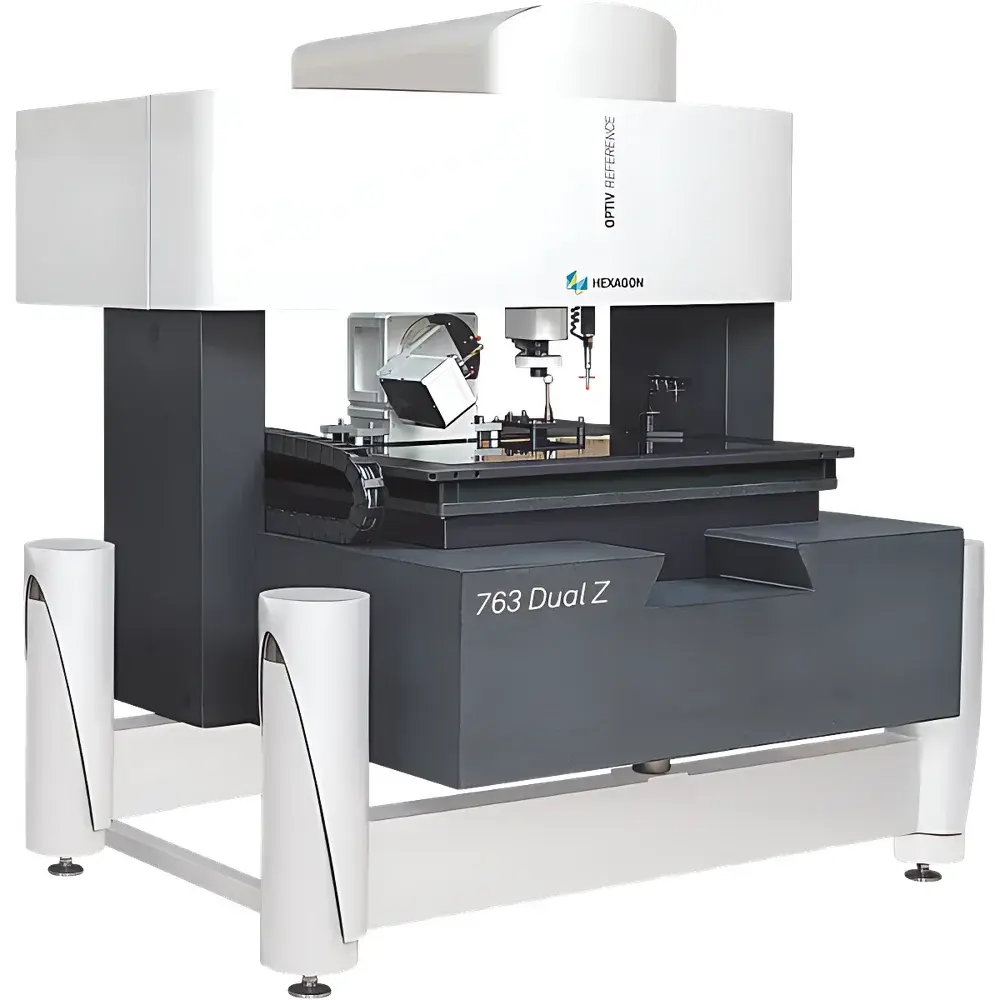
Hexagon Metrology OPTIV REFERENCE Series Multi-Sensor Coordinate Measuring Machine with Dual-Z Axis Architecture
| Brand | Hexagon |
|---|---|
| Origin | Shandong, China |
| Manufacturer Type | Authorized Distributor |
| Country of Origin | China |
| Model | OPTIV REFERENCE |
| Quotation | Upon Request |
| Measurement Volume | 530 × 400 × 300 mm to 730 × 600 × 300 mm |
Overview
The Hexagon Metrology OPTIV REFERENCE series represents the highest-accuracy tier within Hexagon’s line of multi-sensor coordinate measuring machines (CMMs) designed for non-contact and tactile geometric metrology. Engineered for sub-micron volumetric accuracy, the system integrates air-bearing motion systems across all three linear axes (X, Y, Z), minimizing mechanical hysteresis and thermal drift while enabling smooth, frictionless translation essential for repeatable nanoscale positioning. Its defining architectural innovation—the OPTIV Dual-Z axis—mounts optical and tactile (trigger) sensors on two physically independent vertical axes. This eliminates sensor interference during multi-sensor sequencing, a common limitation in single-Z-axis configurations, thereby increasing measurement throughput and reducing program complexity without compromising traceability or calibration integrity. The machine’s foundation is a monolithic granite structure, thermally stabilized and vibration-damped, providing long-term geometric stability under laboratory and production-floor conditions.
Key Features
- Monolithic granite frame with precision V-groove dovetail guideways on the Y-axis for enhanced rigidity and straightness performance
- Optimized air-bearing distribution with active pneumatic balancing to maintain consistent float height and load-independent motion characteristics
- Central-drive precision ground ball screw transmission on X and Y axes, minimizing Abbe error through symmetrical force application and reduced moment arm effects
- High-resolution open-loop optical encoder system (imported) delivering position feedback with sub-100 nm interpolation capability and low cyclic error
- Industrial-grade monochrome CCD camera with progressive scan technology, optimized for high-contrast edge detection and low-noise imaging under controlled LED illumination
- 2-Step Zoom optical path architecture featuring dual CCD sensors—one optimized for wide-field overview imaging, the other for high-magnification detail capture—enabling seamless scale transition without mechanical refocusing
- PC-DMIS Vision metrology software suite, compliant with ISO 10360-7 and VDI/VDE 2617 Part 8, supporting automated feature recognition, GD&T evaluation per ASME Y14.5 and ISO 1101, and full report generation with audit trail
- Optional chromatic confocal white-light sensor for surface topography acquisition, step-height measurement, and thin-film thickness analysis on reflective or translucent materials
- Optional CNC rotary table (A/B axes) enabling fully automated multi-face inspection within a single measurement routine, supporting ISO 10360-2 alignment verification and kinematic calibration
Sample Compatibility & Compliance
The OPTIV REFERENCE accommodates parts ranging from miniature microelectromechanical systems (MEMS) components to large automotive brackets, with maximum workpiece weights up to 50 kg. Its open gantry design allows unobstructed access for fixturing complex geometries, including deep cavities, inclined surfaces, and asymmetric profiles. The system complies with international metrological standards including ISO 10360 (acceptance and reverification testing of CMMs), ISO 14253-1 (geometrical product specifications), and EN ISO/IEC 17025 requirements for accredited calibration laboratories. When configured with PC-DMIS Vision and enabled audit trail functionality, it supports FDA 21 CFR Part 11 compliance for regulated industries such as medical device manufacturing and pharmaceutical packaging QA/QC.
Software & Data Management
PC-DMIS Vision provides a unified environment for programming, execution, and reporting across optical, tactile, and optical-probe hybrid measurement strategies. It features real-time video overlay with dynamic crosshair alignment, automatic edge detection with adaptive thresholding, and statistical process control (SPC) integration via direct ODBC connectivity to enterprise MES or QMS platforms. All measurement data—including raw images, coordinate point clouds, GD&T results, and operator annotations—are stored in a structured SQL database with time-stamped revision history, user authentication logs, and configurable retention policies. Calibration certificates, sensor characterization files, and environmental monitoring records (temperature, humidity) are linked directly to measurement reports to satisfy GLP/GMP documentation requirements.
Applications
Typical use cases include precision validation of injection-molded plastic housings (e.g., smartphone frames, connector bodies), turbine blade root geometry inspection in aerospace, gear tooth profile and lead deviation analysis, printed circuit board (PCB) fiducial placement verification, and orthopedic implant dimensional certification. In R&D labs, the system supports reverse engineering workflows through dense point-cloud stitching and NURBS surface fitting. Its dual-Z architecture is particularly advantageous for measuring tall, narrow components—such as fuel injector nozzles or MEMS accelerometers—where traditional single-Z setups require repeated repositioning or compromise between optical field-of-view and probe accessibility.
FAQ
What is the difference between OPTIV REFERENCE and OPTIV PERFORMANCE models?
The REFERENCE series uses air bearings on all axes and incorporates the Dual-Z architecture as standard, whereas PERFORMANCE models utilize mechanical bearing systems and a single-Z configuration—resulting in lower volumetric accuracy and reduced multi-sensor flexibility.
Can the system perform measurements in temperature-controlled environments?
Yes; the granite base and low-coefficient thermal expansion components allow stable operation in ISO Class 2 (20 ± 1 °C) metrology labs. Optional environmental compensation modules integrate with external temperature/humidity sensors per ISO 10360-2 Annex B.
Is GD&T reporting exportable to Excel or PDF formats?
All reports generated in PC-DMIS Vision support native export to PDF (with embedded fonts and digital signatures), CSV, XML, and Excel-compatible .xlsx formats—including full GD&T callout tables, tolerance stack-up summaries, and annotated image overlays.
Does the system support automated calibration routines for vision lenses?
Yes; PC-DMIS Vision includes ISO 10360-7–compliant lens calibration wizards that guide users through grid-based target imaging, distortion mapping, and magnification verification at multiple zoom levels.
What is the typical lead time for factory acceptance testing (FAT)?
Standard FAT duration is five working days following mechanical installation and environmental stabilization, covering volumetric accuracy verification, repeatability assessment per ISO 10360-2, and software functional validation against customer-defined test parts.