
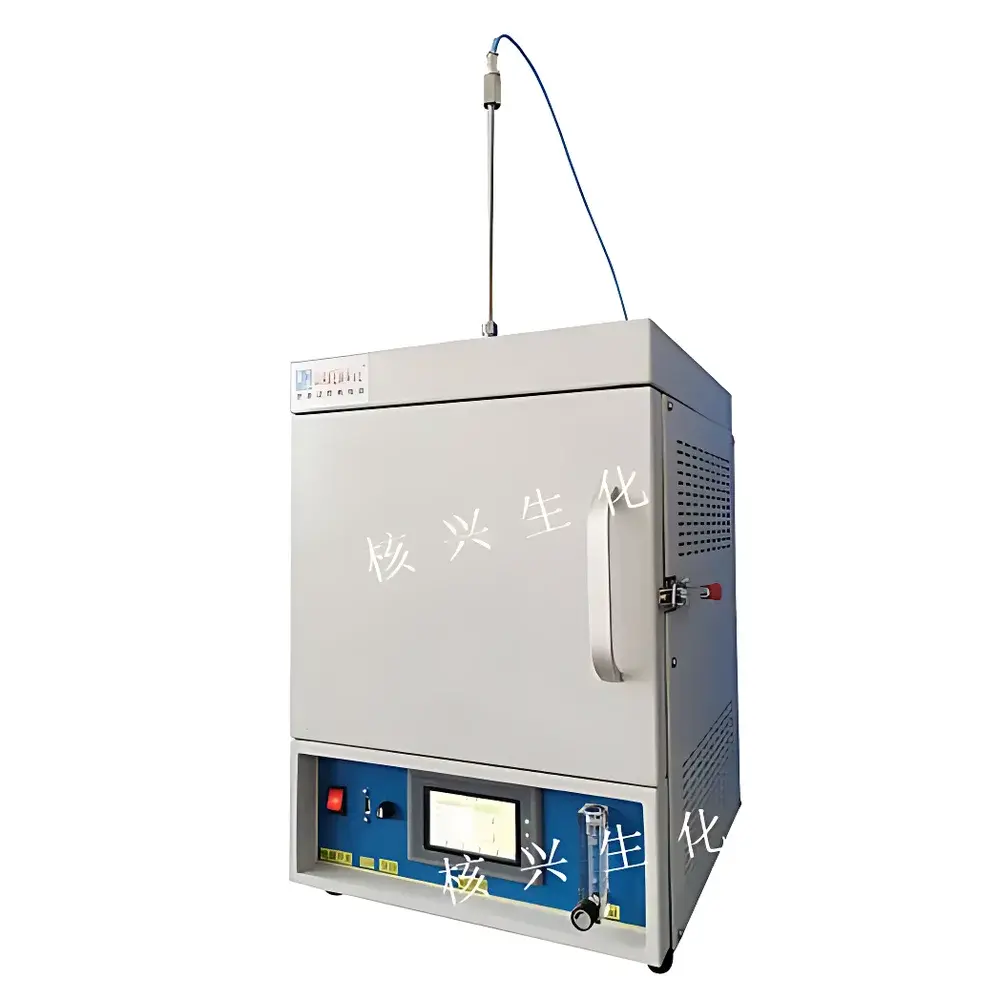
HEXING BIOCHEMICAL MKX-M/R Series Microwave Muffle Furnace
| Brand | HEXING BIOCHEMICAL |
|---|---|
| Origin | Shandong, China |
| Manufacturer Type | Authorized Distributor |
| Product Origin | Domestic (China) |
| Model | MKX-M/R Series |
| Price Range | USD 7,000 – 14,000 |
| Microwave Power | 0–800 W (MKX-M1B), 0–1600 W (MKX-R2HB) |
| Frequency | 2450 MHz |
| Operating Temperature Range | 0–1000 °C (short-term up to 1200 °C) |
| Temperature Sensor | K-type thermocouple |
| Cavity Volume | 1.2 L (MKX-M1B), 5 L (MKX-R2HB) |
| Cavity Material | Industrial-grade stainless steel welded enclosure with internal ceramic fiber insulation (MKX-M1B) or quartz-lined high-purity chamber (MKX-R2HB) |
| Atmosphere Control | Adjustable inlet for air, O₂, N₂, or Ar |
| Control System | PLC-based intelligent controller with color touchscreen interface |
| Safety Compliance | Interlocked door switch, surface temperature <50 °C, microwave leakage <5 mW/cm² (GB 10436-2008) |
Overview
The HEXING BIOCHEMICAL MKX-M/R Series Microwave Muffle Furnace is an advanced sample preparation instrument engineered for rapid, controlled, and contamination-minimized thermal processing of diverse materials under precisely regulated atmospheric conditions. Unlike conventional resistive-heating muffle furnaces, this system utilizes 2450 MHz microwave energy to induce volumetric heating within the sample—significantly reducing thermal lag, minimizing thermal gradients, and eliminating surface-dominated heat transfer limitations. The MKX-M1B variant is optimized for mineral roasting applications—including uranium ore decarbonization at 650 °C—while the MKX-R2HB configuration is purpose-built for rapid, low-residue ashing of biological and environmental matrices in nuclear analytical laboratories. Its design adheres to the thermal pretreatment requirements specified in GB/T 14883.1–1994 (General Principles for Radioactive Substance Testing in Food) and GB 16145–1995 (γ-Spectrometric Analysis of Radionuclides in Biological Samples), supporting GLP-compliant sample preparation workflows in radiochemistry, environmental monitoring, and regulatory testing laboratories.
Key Features
- Industrial-grade fully welded stainless steel cavity with dual-layer thermal insulation—ceramic fiber for MKX-M1B (1.2 L) and high-purity quartz lining for MKX-R2HB (5 L)—ensuring structural integrity and chemical inertness during aggressive ashing or roasting cycles.
- Closed-loop PID-controlled variable-frequency microwave generator delivering non-pulsed, continuously adjustable power (0–800 W or 0–1600 W), enabling precise kinetic control over endothermic decomposition, carbonization, and volatilization steps.
- Atmosphere-flexible gas management system: configurable inlet for oxidizing (air/O₂), inert (N₂/Ar), or reducing atmospheres; MKX-R2HB integrates a through-flow air path with negative-pressure exhaust and centralized fume capture to suppress aerosol carryover and condensable vapor re-deposition.
- Real-time process monitoring via integrated K-type thermocouple (0–1200 °C range) and PLC-driven HMI displaying synchronized time–temperature–power profiles; all experimental data are timestamped, exportable via USB, and support multi-segment programmable protocols.
- Comprehensive safety architecture: electromagnetic interlock on access door, surface temperature monitoring (<50 °C), microwave leakage compliance (<5 mW/cm² per GB 10436-2008), and corrosion-resistant exhaust ducting rated for acidic off-gas streams.
Sample Compatibility & Compliance
The MKX-M/R series accommodates a broad spectrum of sample types—including plant tissues, animal organs, soil extracts, polymer composites, ceramic precursors, and uranium-bearing ores—without cross-contamination or crucible-induced elemental bias. Standard crucible options include high-alumina ceramic (for roasting) and low-background quartz (for radiometric ashing). Crucible selection is guided by dielectric loss tangent (tan δ) matching to ensure efficient microwave coupling and uniform thermal response. The system supports ASTM D5630 (ash content in plastics), ISO 1171 (ash in coal and coke), and USP heavy metal residue testing protocols. For nuclear applications, it satisfies IAEA Technical Reports Series No. 438 requirements for low-blank ashing of bio-monitoring samples prior to gamma spectrometry.
Software & Data Management
The embedded PLC controller features a 7-inch color touchscreen interface with intuitive icon-based navigation. Users define up to 20 customizable thermal programs, each comprising multiple ramp–hold–cool segments with independent setpoints for temperature, power, and dwell time. All operational parameters—including real-time cavity temperature, reflected power, and elapsed cycle time—are logged at 1-second intervals and stored internally for ≥10,000 cycles. Data export is supported in CSV format for traceability and audit readiness. The system includes built-in electronic signature capability and audit trail functionality compliant with FDA 21 CFR Part 11 requirements when deployed in regulated GMP/GLP environments.
Applications
- Radiological sample preparation: rapid ashing of food, urine, vegetation, and sediment for radionuclide quantification (e.g., 137Cs, 90Sr, 238Pu) with minimal volatile loss and reduced procedural blank.
- Mineral processing R&D: oxidative roasting of uranium ores to decompose organic binders and liberate UO3 prior to leaching; sulfur removal from pyritic concentrates.
- Materials science: controlled pyrolysis of MOFs, carbonization of biomass-derived precursors, and sintering of oxide ceramics under inert or reducing atmospheres.
- Environmental analysis: total organic carbon (TOC) determination in sludge, ash yield assessment in fly ash, and sulfonation of polymeric standards per EPA Method 3050B.
- Pharmaceutical QA/QC: residual solvent removal from APIs, excipient thermal stability screening, and container closure integrity validation via thermal stress testing.
FAQ
What distinguishes microwave-assisted ashing from conventional furnace ashing in radiological applications?
Microwave heating enables rapid, uniform volumetric energy deposition—reducing ashing time from hours to minutes while minimizing thermal degradation of volatile radionuclides (e.g., 129I, 210Po) and preventing crucible-mediated contamination.
Can the MKX-R2HB be used for halogenated sample matrices without corrosion concerns?
Yes—the quartz-lined chamber, PTFE-sealed gas pathways, and Hastelloy®-coated exhaust components resist HCl, HF, and SO2 corrosion during acid digestion–ash sequences.
Is remote monitoring or integration with LIMS possible?
The system supports RS-485 Modbus RTU communication; optional Ethernet module enables SCADA integration and remote parameter adjustment via secure TLS-encrypted connection.
Does the furnace meet international electromagnetic compatibility (EMC) standards?
It complies with IEC 61000-6-3 (emission) and IEC 61000-6-2 (immunity) for laboratory environments, with CE marking documentation available upon request.
What maintenance intervals are recommended for sustained performance?
Ceramic fiber integrity inspection every 500 operating hours; quartz chamber cleaning with dilute nitric acid after each high-sulfur or high-halogen batch; microwave waveguide gasket replacement annually or after 1000 h cumulative operation.



