
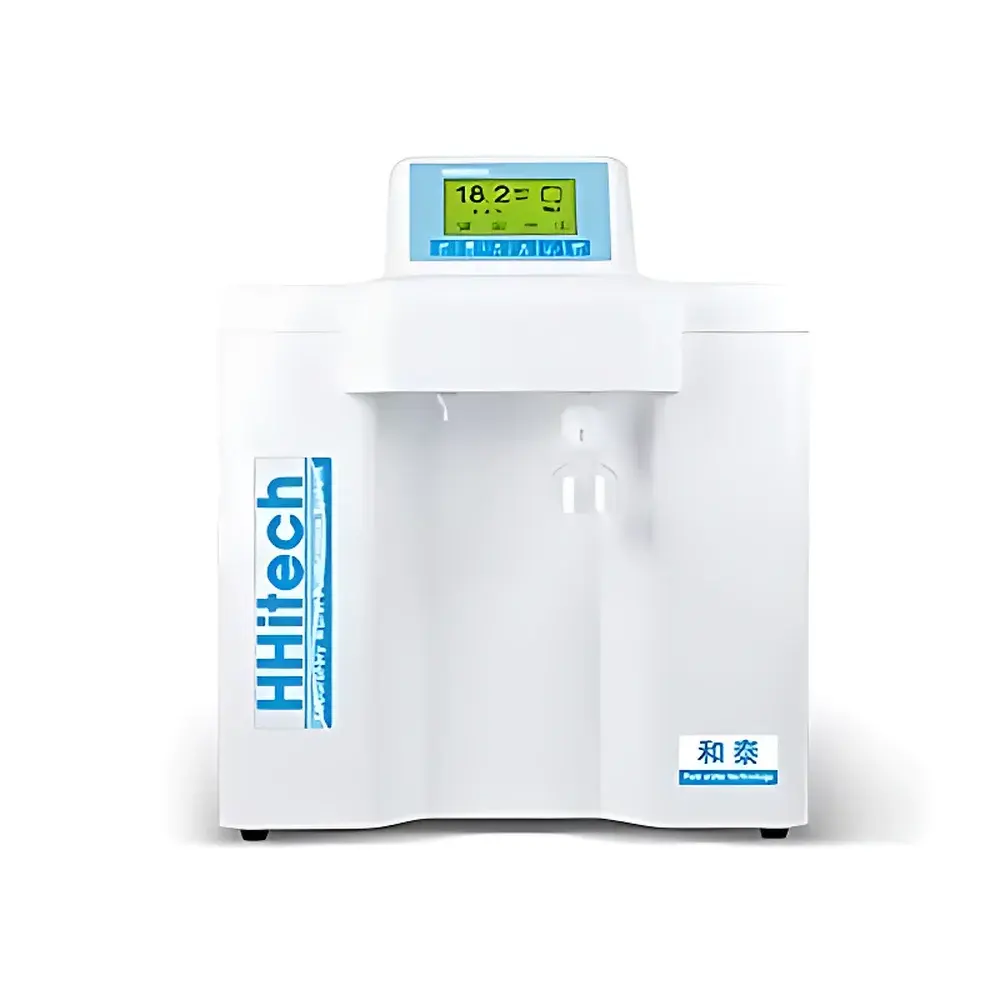
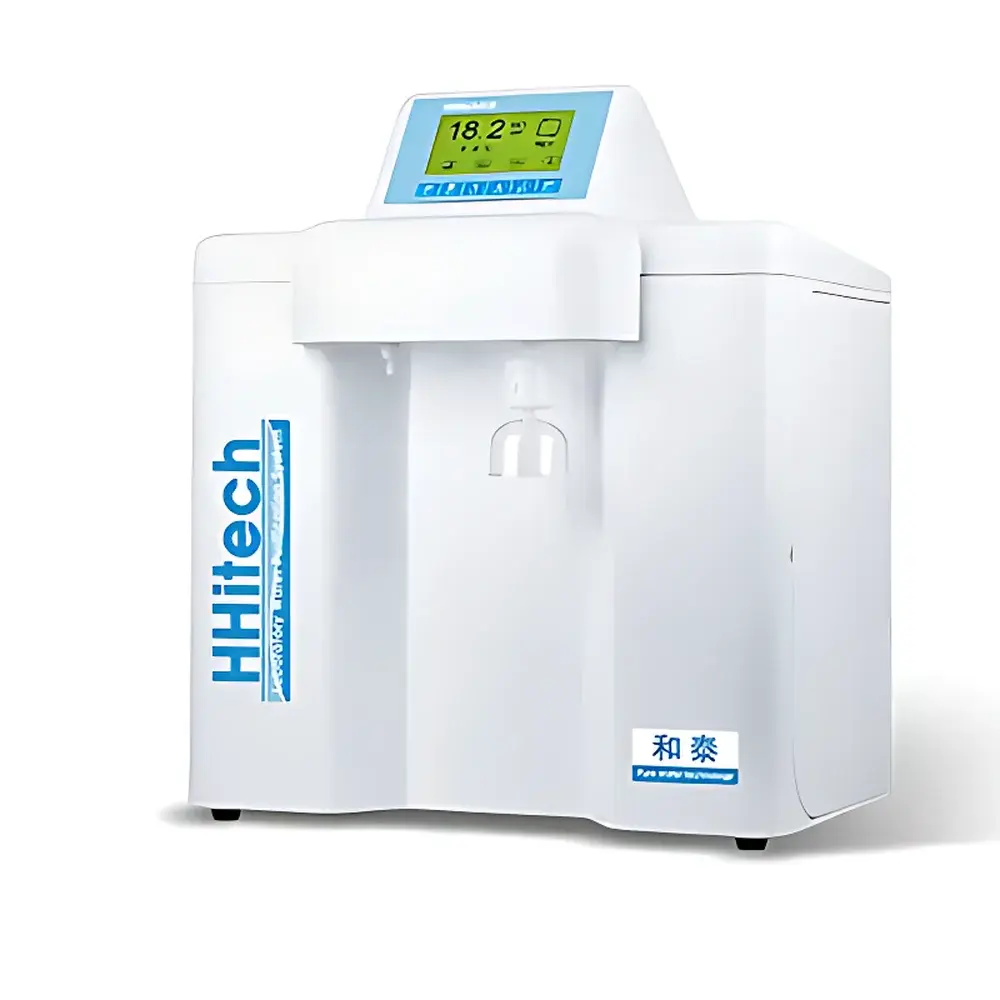
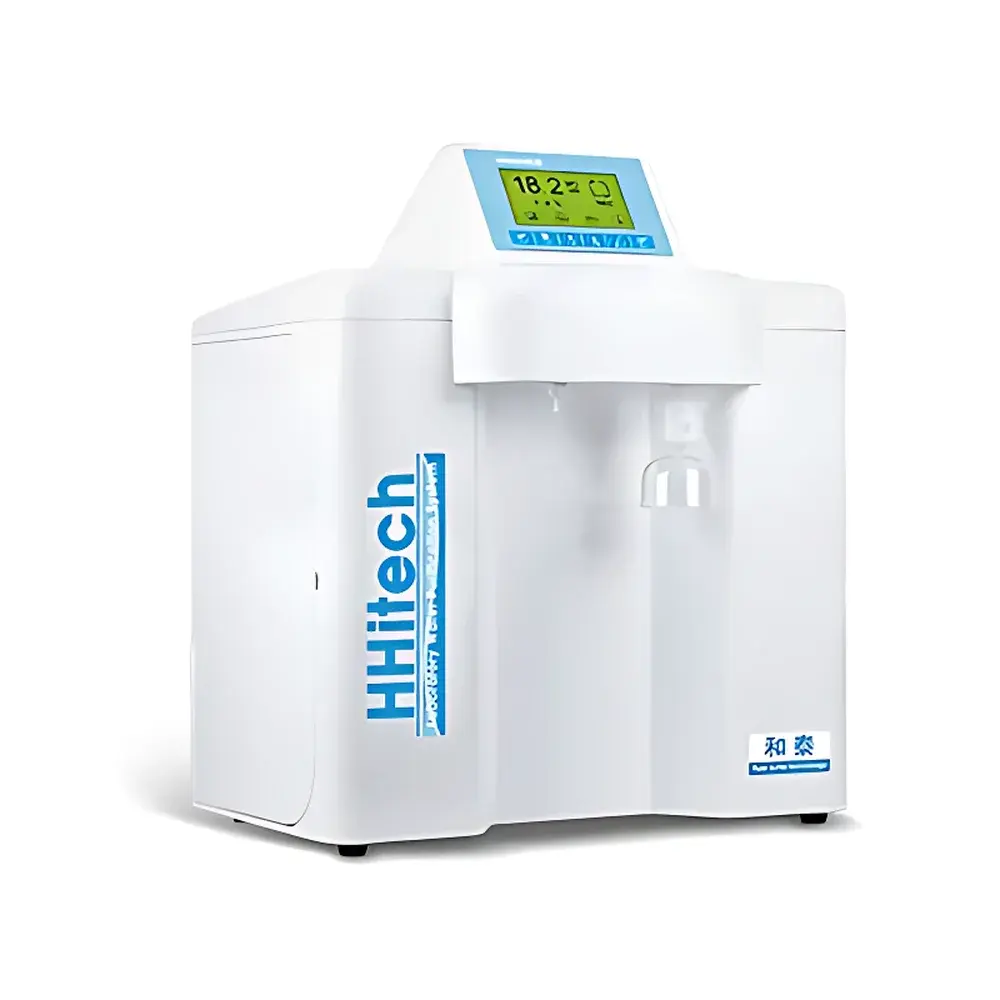
HHitech Master-E Economic Ultra Pure Water System
| Brand | HHitech |
|---|---|
| Origin | Shanghai, China |
| Manufacturer Type | Direct Manufacturer |
| Product Category | Domestic |
| Model | Master-E (Economic Version) |
| Price Range | USD 1,400–4,200 |
| Purified Water Grade | Type I ASTM D1193-20 / ISO 3696 Class 1 |
| Resistivity | 18.2 MΩ·cm @ 25 °C |
| Heavy Metals & Soluble Silica | <0.1 ppb |
| Total Organic Carbon (TOC) | <3 ppb |
| Endotoxin | <0.001 EU/mL |
| Microbial Count | <1 CFU/mL |
| Particles (>0.1 µm) | <1 particle/mL |
Overview
The HHitech Master-E Economic Ultra Pure Water System is a fully integrated, microprocessor-controlled laboratory water purification platform engineered for consistent production of Type I ultrapure water per ASTM D1193-20 and ISO 3696 Class 1 specifications. It employs a multi-stage purification architecture combining pre-filtration (PP + KDF + AC), reverse osmosis (RO), dual-wavelength UV photooxidation (254 nm + 185 nm), mixed-bed deionization (DI), ultrafiltration (UF), and terminal sub-micron filtration (0.45 µm + 0.1 µm PES membrane). This configuration ensures removal of particulates, ions, organic compounds, microorganisms, nucleases, pyrogens, and volatile organics—critical for sensitive analytical and life science applications where trace-level contamination compromises data integrity.
Key Features
- Automated multi-stage purification sequence: PF (5 µm PP) → KDF/copper-zinc alloy prefilter → granular activated carbon → 100 GPD RO membrane (Dow or CSM) → dual-wavelength UV (254/185 nm, imported lamp) → post-carbon polishing → quadruple-column nuclear-grade ion exchange resin → 5,000 Da MWCO PES ultrafilter → 0.45 µm + 0.1 µm PES terminal filter
- Real-time, three-channel conductivity/resistivity monitoring: feedwater, RO permeate, and UP product water—with configurable alarm thresholds and automatic lockout on parameter deviation
- Intelligent consumables management system: programmable service life tracking for prefilter, RO membrane, UV lamp, and DI columns; visual and audible alerts at end-of-life; password-protected factory and user access levels
- GLP-compliant data handling: optional RS232/USB interface enables automated logging of >1 year of water quality records—including date/time stamps, resistivity, TOC, temperature, and alarm events—fully traceable for audit readiness
- Robust mechanical design: NSF-certified fluid path components; quick-connect fittings compliant with ISO 8536-4; integrated pressure tank (15 L standard); ergonomic injection-molded chassis (50 × 36 × 54 cm; ~22 kg)
- Comprehensive safety protocols: dry-run protection, low-inlet-pressure cutoff, full-tank shutoff, real-time conductivity-based alarms, and fail-safe interlock preventing UP water dispensing during out-of-spec conditions
Sample Compatibility & Compliance
The Master-E delivers water meeting stringent international standards required for high-sensitivity instrumentation and regulated workflows. Its output satisfies the purity criteria for HPLC mobile phase preparation, ICP-MS sample dilution, electrophysiology buffer formulation, mammalian cell culture media supplementation, and in vitro fertilization (IVF) applications. The inclusion of a 5,000 Da MWCO ultrafilter and terminal 0.1 µm PES membrane ensures endotoxin levels remain below 0.001 EU/mL—validated per USP and EP 2.6.12. All wetted materials comply with NSF/ANSI Standard 61 for drinking water system components, and the entire fluid path is certified free of extractables that could interfere with ELISA, PCR, or mass spectrometry workflows.
Software & Data Management
The system features an embedded 240 × 128 pixel backlit LCD interface supporting multilevel menu navigation and animated real-time process visualization. It records timestamped water quality metrics—including resistivity, TOC (via UV oxidation calibration curve), temperature, and alarm status—at user-defined intervals. When equipped with the optional RS232/USB module, it exports ASCII-formatted logs compatible with LIMS integration and supports FDA 21 CFR Part 11–compliant electronic signatures when deployed within validated environments. Audit trail functionality captures all operator actions, parameter modifications, and maintenance events—enabling full traceability under GLP and GMP frameworks.
Applications
- Chromatography: mobile phase preparation for HPLC, IC, and UHPLC systems requiring low-ionic-background solvents
- Mass spectrometry: diluent and rinse solution for ICP-MS and LC-MS/MS platforms sensitive to metal and organic contaminants
- Cell and molecular biology: sterile, nuclease-free, low-endotoxin water for transfection reagent preparation, CRISPR editing buffers, and primary neuron culture media
- Electrochemical research: electrolyte formulation for impedance spectroscopy and surface charge studies where residual ions distort double-layer behavior
- Physics and interface science: solvent for Langmuir-Blodgett film deposition and AFM tip cleaning where particulate-induced artifacts must be eliminated
- Quality control laboratories: reference water for conductivity calibration, TOC system suitability testing, and pharmacopeial water testing per USP
FAQ
What inlet water quality is required for optimal RO membrane performance?
Feed water must meet TDS ≤ 200 ppm, temperature 5–45 °C, and pressure 1.0–4.0 kgf/cm² (14–57 psi). Higher TDS or hardness accelerates scaling; pretreatment with KDF and carbon is essential for municipal sources.
How frequently must consumables be replaced under typical lab usage?
Pre-filters: 6–12 months; RO membrane: 2–3 years (dependent on feed water quality); UV lamp: 9,000 hours (~1 year continuous use); DI columns: 6–12 months (varies with TOC load and flow rate).
Is the system compatible with external storage tanks or distribution loops?
Yes—the UP outlet supports connection to pressurized reservoirs (e.g., 15 L tank included) or closed-loop recirculation systems with optional UV loop sanitization modules.
Does the Master-E support regulatory compliance documentation packages?
Factory-issued IQ/OQ documentation templates are available upon request. Full validation support—including installation qualification protocols and performance verification test reports—can be provided for GxP-regulated facilities.
Can TOC be measured directly by the system?
While the Master-E does not include an integrated TOC analyzer, its dual-wavelength UV stage reduces organic content to <3 ppb (measured offline per ASTM D5542), and the system’s resistivity/temperature correlation allows indirect TOC estimation in stable operational states.



