
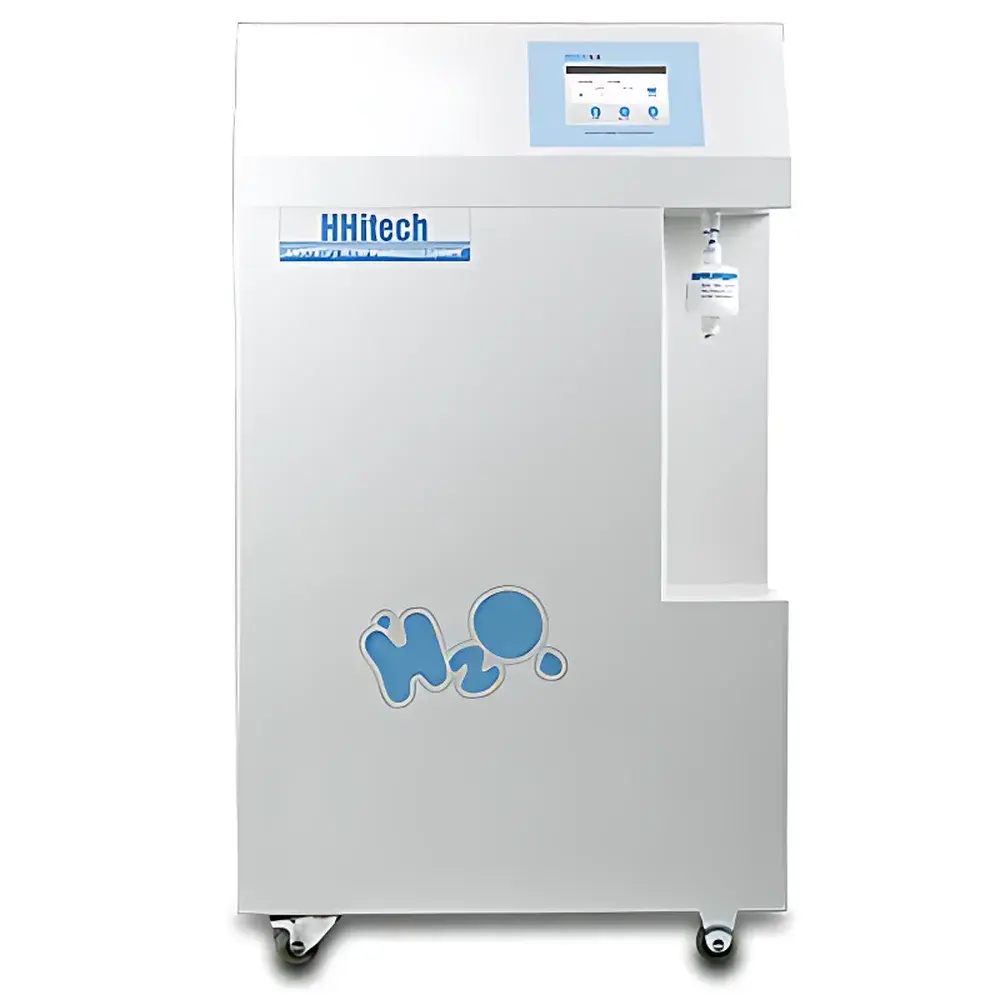
HHitech Pilot-R Dual-Stage Reverse Osmosis Ultra-Pure Water System
| Brand | HHitech |
|---|---|
| Origin | Shanghai, China |
| Manufacturer Type | Original Equipment Manufacturer (OEM) |
| Product Category | Domestic |
| Model | Pilot-R |
| Pure Water Grade | ASTM Type I / ISO 3696 Class 1 / GB/T 6682-2008 Grade I |
| Resistivity | 18.2 MΩ·cm @ 25 °C |
| Heavy Metals & Soluble Silica | <0.1 ppb |
| Total Organic Carbon (TOC) | <3 ppb |
| Microbial Count | <0.1 CFU/mL |
| Endotoxin | <0.001 EU/mL |
| Particles (>0.1 µm) | <1 particle/mL |
| Flow Rate | 45–250 L/h |
Overview
The HHitech Pilot-R Dual-Stage Reverse Osmosis Ultra-Pure Water System is an engineered solution for laboratories requiring continuous, high-volume production of Type I ultrapure water compliant with stringent international standards—including ASTM D1193, ISO 3696, CLSI EP22-A, USP , EP 2.2.43, and GB/T 6682-2008. Designed for central laboratory distribution, pilot-scale manufacturing, and medium-to-high throughput research environments, the Pilot-R integrates dual-stage RO pretreatment with multi-stage polishing (UP, UF, UV, TF) to deliver consistent 18.2 MΩ·cm resistivity water. Its core architecture employs a two-pass reverse osmosis configuration—first pass reduces TDS by ≥95%, second pass achieves ≤5 µS/cm conductivity—followed by electrodeionization (EDI) or mixed-bed ion exchange, 185/254 nm dual-wavelength UV oxidation, 5,000 Da MWCO ultrafiltration, and terminal 0.2 µm PES membrane filtration. This cascaded purification strategy ensures removal of ions, organics, particles, nucleases, endotoxins, and microorganisms at levels required for cell culture, HPLC, LC-MS, molecular biology, and semiconductor rinsing applications.
Key Features
- 5-inch full-color capacitive touchscreen interface with animated navigation menus and multilingual support (English default)
- Real-time three-point water quality monitoring: feed water, RO permeate, and final UP water—displayed simultaneously without manual sampling
- Dual independent quantitative dispensing: programmable volume (10–999,999 mL) and quality-triggered dispensing (resistivity setpoint from 1.0 to 18.25 MΩ·cm)
- Configurable ultra-pure water recirculation loop with adjustable flow rate and programmable on/off scheduling to suppress biofilm formation
- Comprehensive manual disinfection suite: “Recirculation Disinfection”, “Point-of-Use Disinfection”, “Tank Refill”, “Manual Drain”, and “Disinfection Abort”
- Intelligent consumables management: service life configurable per module (PP, KDF, AC, RO, UP, UF, TF, UV); runtime tracking with automatic replacement alerts
- System-level security: dual-tier password protection (factory admin + user), preventing unauthorized parameter changes or calibration adjustments
- Automated RO membrane antiscalant flushing: programmable interval (1–72 h) and duration (30–300 s), plus on-demand manual flush
- NSF-certified fluid path components: all tubing, fittings, and valves comply with NSF/ANSI Standard 61 for potable water contact
- Stainless steel powder-coated chassis with GLP-compliant design: corrosion-resistant enclosure, leveling feet (fixed + castor), and internal expansion space for optional external circulation pump integration
Sample Compatibility & Compliance
The Pilot-R is validated for use with municipal tap water feed sources meeting local drinking water standards (e.g., WHO Guidelines, EPA 810). Feed water quality directly impacts RO membrane longevity and polishing column service intervals; inlet TDS ≤ 500 ppm and chlorine ≤ 0.1 ppm are recommended. All wetted materials—including Dow FilmTec™ RO membranes, Dow Amberjet™ nuclear-grade mixed-bed resin, and imported PES terminal filters—are certified for pharmaceutical and diagnostic use. The system complies with GLP data integrity requirements: audit-trail enabled logging, electronic signature support (per 21 CFR Part 11 readiness), and tamper-evident timestamping. Final water output meets or exceeds specifications for ASTM Type I, ISO Class 1, USP Purified Water and Water for Injection (WFI) pre-treatment stages, and EP 2.2.43 ultrapure water.
Software & Data Management
The embedded control firmware features non-volatile SD card storage capable of retaining ≥12 months of operational history, including hourly resistivity/TOC/TDS logs, alarm timestamps, consumables usage duration, disinfection event records, and system diagnostics. Data export is supported via USB 2.0 interface in CSV format, compatible with LIMS integration and statistical process control (SPC) software. Built-in clock supports NTP synchronization, scheduled standby (0–60 min), and timed shutdown (0–24 h). Alarm categories include feed pressure loss, tank overfill/underfill, conductivity/resistivity excursions, UV lamp failure, and filter saturation warnings—all logged with severity level and recovery status.
Applications
- Centralized water supply for multi-station labs, cleanrooms, and GMP manufacturing suites
- Pilot-scale bioprocessing and formulation development requiring stable, low-endotoxin water
- HPLC mobile phase preparation, GC solvent dilution, and ICP-MS calibration standard preparation
- Cell culture media preparation, stem cell expansion, and IVF embryo handling
- RNA/DNA extraction, PCR setup, CRISPR editing workflows, and next-generation sequencing library prep
- Atomic absorption spectroscopy (AAS), trace metal analysis, and electrochemical testing
- Pharmaceutical stability studies and dissolution testing per USP
FAQ
What feed water quality is required for optimal Pilot-R performance?
Municipal tap water with ≤500 ppm TDS, ≤0.1 ppm free chlorine, and turbidity <1 NTU is recommended. Pre-filtration may be necessary in regions with high iron, manganese, or hardness.
Can the Pilot-R be integrated into an existing building-wide water distribution network?
Yes—the unit includes mounting provisions and internal routing space for optional external booster pumps and closed-loop recirculation manifolds. It supports both pressurized tank (standard 2×15 L internal) and atmospheric reservoir configurations.
How does the dual-wavelength UV system reduce TOC?
The 185 nm UV photons generate hydroxyl radicals that oxidize non-volatile organics into CO₂ and H₂O; 254 nm radiation concurrently inactivates microorganisms and degrades residual ozone.
Is the system compliant with FDA 21 CFR Part 11 for electronic records?
While not validated out-of-the-box for Part 11, the Pilot-R provides foundational capabilities: user authentication, audit trails, electronic signatures (via optional middleware), and immutable data logging—enabling lab-specific validation per internal SOPs.
What maintenance intervals are recommended for consumables under typical lab usage?
RO membranes: 2–3 years (with proper pretreatment and flushing); UP cartridges: 6–12 months; UF/UV modules: 12–24 months; terminal filter: 3–6 months—exact timing depends on feed water quality and daily usage volume.



